Taiwan’s defence minister said China’s recent decision to add seven European firms to its export control list will not prevent Taipei from sourcing weapons, as Taiwan relies mainly on U.S. military supplies. Four of the targeted firms are Czech. China has also sanctioned U.S. defence contractors following recent U.S. arms packages for Taiwan. Japan’s recent easing of export rules could open options, but Tokyo requires a transfer agreement Taiwan currently lacks.
Taiwan: China’s Sanctions On Seven European Arms Firms Won’t Cripple Weapons Sourcing
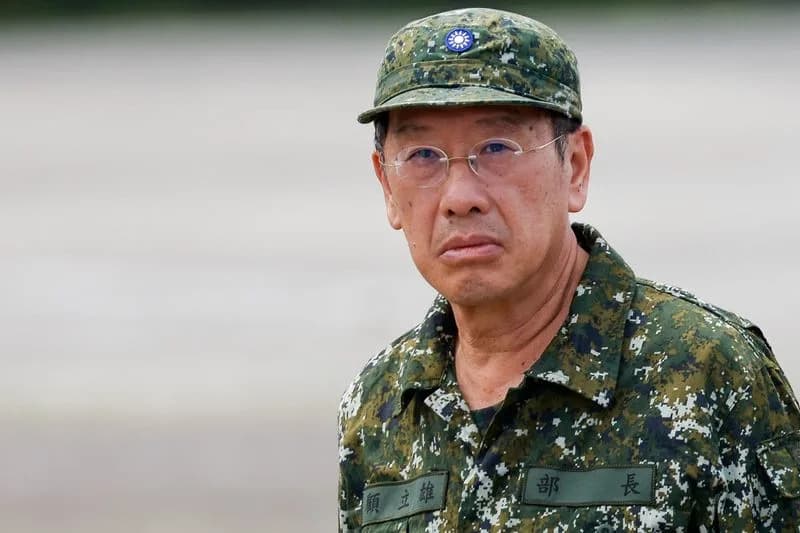
Taiwan's Defence Minister Wellington Koo reacts during the annual Han Kuang military exercise in Kaohsiung, Taiwan July 14, 2025. REUTERS/Ann Wang
TAIPEI, April 27 (Reuters) — Taiwan’s defence minister sought to downplay the impact of recent Chinese sanctions on seven European companies involved in arms-related sales, saying the measures would not prevent Taipei from obtaining necessary military equipment.
China’s Commerce Ministry last Friday added the seven firms to its export control list, banning exports of dual-use items to them in a rare move targeting European companies over Taiwan-related arms sales. Four of the listed firms are Czech.
Taiwan, which Beijing regards as part of its territory, acquires the bulk of its military hardware from the United States. European states have generally avoided selling high-end platforms—such as fighter jets—to Taipei for roughly three decades because of concerns about provoking China.
Speaking to lawmakers in parliament, Defence Minister Wellington Koo said Beijing’s action was not unprecedented and, in his view, would not disrupt Taiwan’s ability to source defence-related goods.
“However, I think such an action, as I understand it, does not affect our ability to continue sourcing goods through relevant diversified channels,” Koo said, without offering further operational detail.
While many Western European countries remain cautious about deepening defence ties with Taiwan due to fears of Chinese retaliation, Taipei has found a more receptive audience in parts of Central and Eastern Europe—an alignment that has strengthened since Russia’s 2022 invasion of Ukraine.
China has also repeatedly imposed sanctions on major U.S. defence contractors after high‑profile arms sales to Taiwan, most recently following Washington’s announcement of an $11 billion weapons package to the island in December.
Japan’s Export Rule Change
When asked whether Taiwan might turn to Japan for arms following Tokyo’s recent easing of overseas defence export rules, Koo noted a key legal constraint: Japan requires recipients of defence exports to sign a defence equipment and technology transfer agreement with Tokyo—a pact Taiwan does not currently have.
Asked whether such an agreement could be possible in the future, Koo replied: “In the future, no possibility can be ruled out. I think I can only say that at present, no transfer agreement exists.”
The move by Tokyo drew welcome responses from some regional partners such as the Philippines, while Beijing voiced strong concern. Relations between Japan and China have been strained since Japanese Prime Minister Sanae Takaichi warned in November that a Chinese attack on Taiwan posing an existential threat to Japan could prompt a military response.
Reporting by Ben Blanchard and Roger Tung; Editing by Kate Mayberry and Raju Gopalakrishnan.
Help us improve.