The Constitutional Court of Guatemala suspended the selection of the country’s next attorney general and ordered a re-evaluation of finalist scores. The court said time served as a judge cannot be counted toward the required years of legal practice, a change that could affect candidate eligibility and rankings. The six-person shortlist — which omitted current Attorney General Consuelo Porras, who has been sanctioned by the U.S., Canada and the EU — now faces reconsideration. The president was given four hours if he already received the list, and the commission has 48 hours to revise evaluations.
Guatemala’s Top Court Freezes Attorney General Selection, Orders Shortlist Re‑evaluation
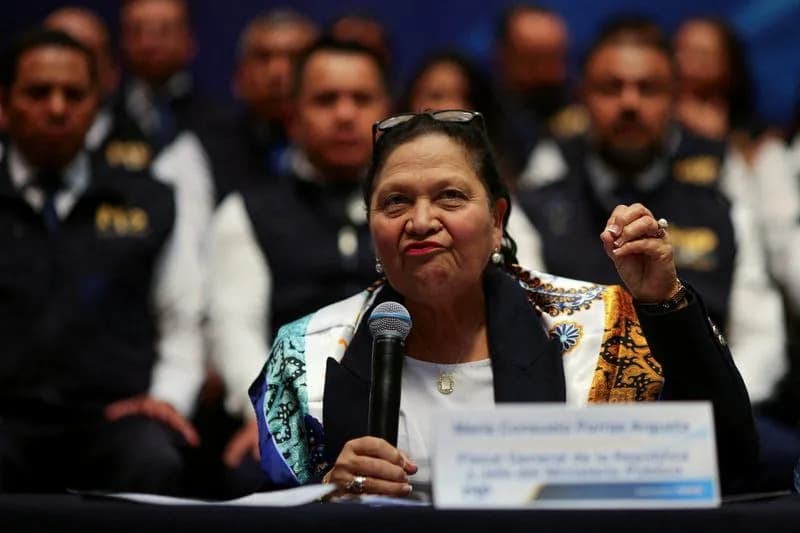
FILE PHOTO: Guatemala’s Attorney General Consuelo Porras delivers a message at the premises of the attorney general's office, in Guatemala City, Guatemala, May 7, 2024. REUTERS/Josue Decavele/File Photo
Guatemala's Constitutional Court on Thursday suspended the process to appoint the country's next attorney general and ordered the nominating commission and the president to re-evaluate the shortlist of finalists.
Court Order and Instructions
The court instructed the nominating commission to “review again the scores given to all applicants who had held the position of judge and assign the corresponding score to each one,” effectively forcing a reassessment of candidate evaluations. It clarified that time served as a judge cannot be counted toward the required years of legal practice for the attorney general post — a determination that could alter the eligibility and ranking of several contenders.
Who Is Affected
The decision casts doubt on a six-person shortlist produced earlier this week by a commission of jurists. That list notably excluded current Attorney General Consuelo Porras, who has been sanctioned by the United States, Canada, the European Union and other governments for alleged corruption, persecution of human rights advocates and steps seen as undermining the 2023 election of President Bernardo Arévalo.
Deadlines and Next Steps
The court gave President Arévalo a four-hour deadline to return the shortlist if he had already received it, and ordered the nominating commission to revise evaluations within 48 hours before the selection process can proceed and the list is sent back to the president. The ruling effectively pauses the replacement process while scores and candidate eligibility are recalculated.
Context and Implications
The move comes amid heightened political tension between the attorney general's office and the executive branch. By ruling that judicial service cannot be counted toward required legal-practice years, the court has introduced a technical criterion that could reshape the field of contenders and prolong uncertainty over who will lead Guatemala’s public prosecutor’s office.
Reporting: Sofia Menchu; Writing: Brendan O'Boyle; Editing: Daina Beth Solomon
Help us improve.