The Senate approved a roughly $70 billion, three-year reconciliation framework to fund ICE and Border Patrol and sent the plan to the House. Reconciliation requires only a simple majority, allowing Republicans to bypass the 60-vote filibuster threshold, but the measure faces review by the Senate parliamentarian and a series of amendment votes. Democrats oppose the move and continue to press for immigration-enforcement reforms after the January shootings of protesters. Next steps include House consideration and final sign-off from the parliamentarian before the bill can be completed.
Senate Moves $70 Billion Reconciliation Plan To Fund ICE and Border Patrol, Sends Measure To House
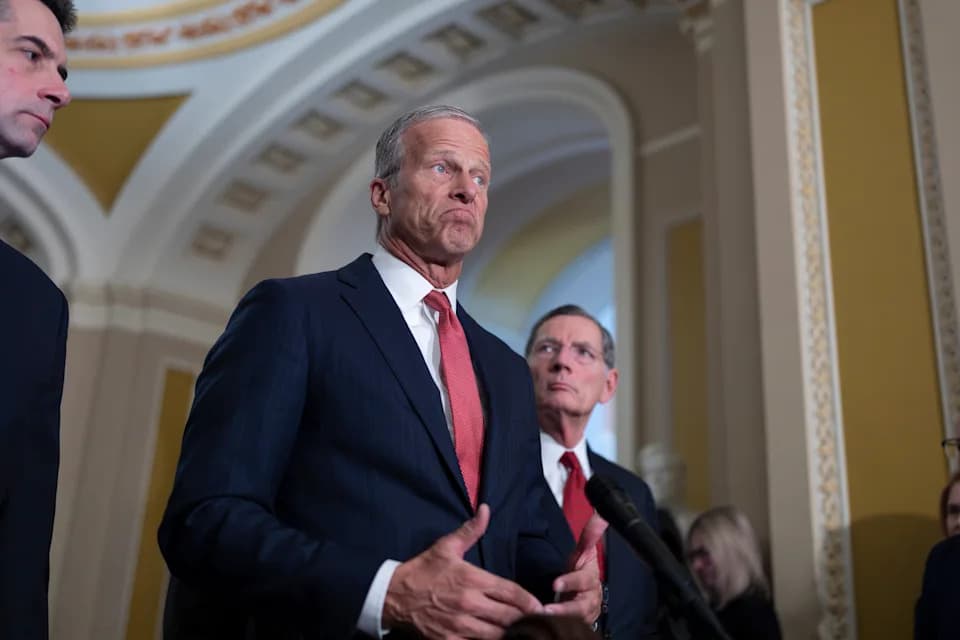
Senate Majority Leader John Thune, R-S.D., flanked by Sen. Tom Cotton, R-Ark., left, and Sen. John Barrasso, R-Wyo., speaks to reporters following a closed-door party meeting, at the Capitol in Washington, Tuesday, April 21, 2026. (AP Photo/J. Scott Applewhite)(ASSOCIATED PRESS)
The Senate took initial steps early Thursday to reopen the Department of Homeland Security by approving a reconciliation budget framework that would fund U.S. Immigration and Customs Enforcement (ICE) and Customs and Border Protection (CBP) despite Democratic objections, and sent the plan to the House.
The measure — a roughly $70 billion, three-year funding resolution for ICE and Border Patrol — uses the budget reconciliation process, which requires only a simple majority in the Senate and therefore bypasses the 60-vote threshold normally needed to overcome a filibuster. Republicans hold 53 seats in the chamber.
How The Process Works
Reconciliation allows Republicans to advance the funding package on party-line votes, but it remains subject to close scrutiny by the Senate parliamentarian and to a potentially lengthy series of amendment votes at both the start and end of the process. If the House approves the reconciliation framework and the parliamentarian signs off, the two chambers can move to finalize passage.

Senate Minority Leader Chuck Schumer, D-N.Y., holds a news conference about the budget process that Republicans hope will fund Immigration and Customs Enforcement and Border Patrol, at the Capitol in Washington, Wednesday, April 22, 2026. (AP Photo/J. Scott Applewhite)(ASSOCIATED PRESS)
Partisan Stakes And Key Objections
Senate Majority Leader John Thune, R-S.D., framed the effort as a way to secure the nation's borders while preventing Democrats from cutting funding for key enforcement agencies. "We have a multistep process ahead of us, but at the end Republicans will have helped ensure that America's borders are secure," he said.
"Instead of pumping hundreds of billions of dollars into ICE and Border Patrol, Republicans should be working with Democrats to lower out-of-pocket costs," said Senate Minority Leader Chuck Schumer, D-N.Y., as Democrats offered amendments aimed at reducing health care and other consumer costs.
Democrats argue any DHS funding should include restraints on federal immigration enforcement — including clearer identification for officers and a greater use of judicial warrants — especially after the fatal shootings of two protesters, Renee Good and Alex Pretti, by federal agents in Minneapolis in January. Those incidents prompted Democrats to demand policy changes and led to the shutdown of the department in mid-February.
Legislative Backdrop And Next Steps
Earlier this year the Senate passed, by voice vote, a bipartisan bill to reopen the rest of DHS while separating ICE and Border Patrol funding. But House Republican leaders have refused to take up that bill until the Senate shows progress toward funding ICE and CBP as well.
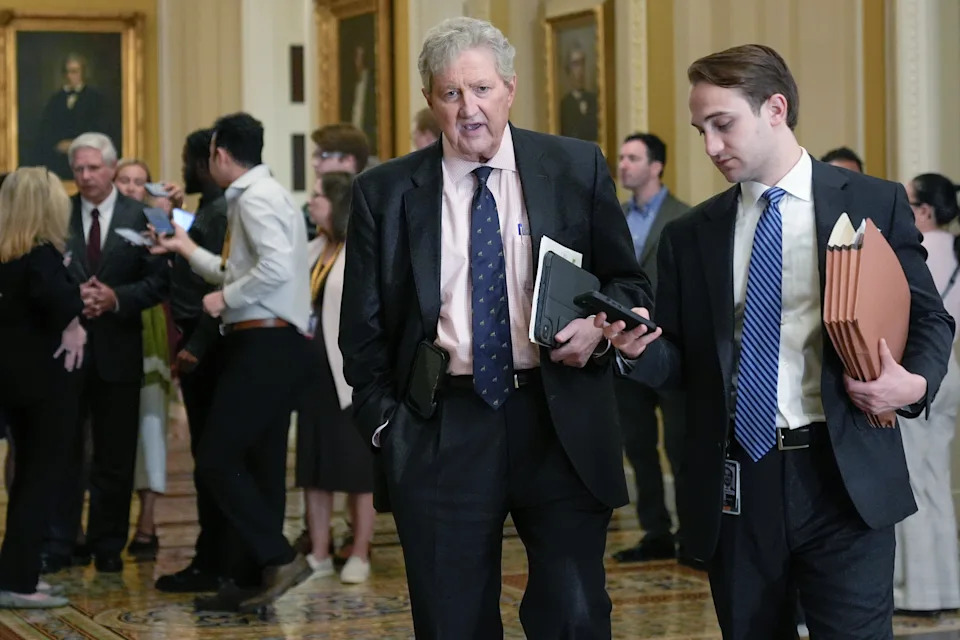
Sen. John Kennedy, R-La., center, speaks with a reporter, Tuesday, April 14, 2026, in Washington. (AP Photo/Mariam Zuhaib)(ASSOCIATED PRESS)
House Speaker Mike Johnson and Senate leaders outlined a two-track approach during a congressional recess: pass the Senate’s bipartisan bill for most of DHS under regular order, and use a party-line reconciliation bill to secure ICE and CBP funding. Some Republicans, including Sen. John Kennedy, R-La., briefly objected to the reconciliation sequence, pressing to add other GOP priorities such as the SAVE America proof-of-citizenship voting proposal or additional farm aid. Kennedy ultimately withdrew his objections and the votes proceeded.
The administration has used executive actions to continue some DHS pay in the interim, but the long-term status of those payments and the overall funding picture remain uncertain. The immediate next steps are House consideration of the reconciliation framework and review by the Senate parliamentarian before the measure can return to the Senate for final action.
Associated Press writer Kevin Freking contributed to this report.
Help us improve.