Vietnam hosted South Korean President Lee Jae Myung in Hanoi, where the two countries announced about a dozen cooperation agreements focused on technology, semiconductors and the development of nuclear power. Two-way trade exceeded $90 billion last year, and both governments aim for $150 billion by 2030. The pacts include a master plan for science, technology and innovation, plus accords on digital cooperation, intellectual property and nuclear projects as Vietnam pushes a "new growth model" to overcome the middle-income trap.
Vietnam, South Korea Seal Dozen Deals on Technology, Semiconductors and Nuclear Power
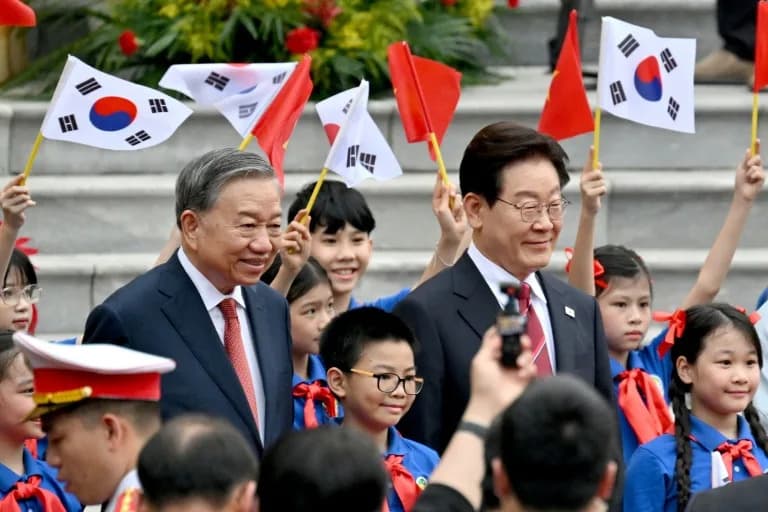
Vietnam's President To Lam and South Korean President Lee Jae Myung met in Hanoi for talks that were expected to lead to multiple cooperative agreements (Nhac NGUYEN)(Nhac NGUYEN/POOL/AFP)
Vietnam's top leader, To Lam, hosted South Korean President Lee Jae Myung in Hanoi on Wednesday as the two countries announced about a dozen cooperation agreements focused on technology, advanced electronics and the development of nuclear power plants.
South Korea remains Vietnam’s largest source of foreign direct investment and a key trading partner: two-way trade topped $90 billion last year, and both sides have set an ambitious target of $150 billion by 2030.
At the presidential palace, Lam said Lee’s visit reflected a "high political trust" between the countries and added: "Vietnam welcomes South Korean companies to make new investments and expand existing projects, with a focus on infrastructure, smart cities, semiconductors, AI data centres, nuclear power and smart seaports."
Among the agreements signed was a framework to develop a Vietnam–South Korea master plan on cooperation in science, technology and innovation. Other accords cover digital cooperation, intellectual property and steps toward developing nuclear power plants.
Cooperation For Development
Hanoi is actively courting more South Korean investment in infrastructure, advanced electronics manufacturing, semiconductors, artificial intelligence and renewable energy. The master-plan framework aims to coordinate public- and private-sector projects, research collaboration and technology transfer across these priority sectors.
Lam, who this month assumed the presidency in addition to his role as Communist Party chief, is promoting a "new growth model" that prioritises digital and technological innovation as Vietnam strives to move beyond the so-called "middle-income trap." The World Bank’s 2024 development report notes countries often face such a trap when per-capita income approaches a certain threshold relative to advanced economies, which can be hard to surpass without upgrading productivity and technology.
South Korean corporate investment is already substantial: Samsung is Vietnam’s largest foreign corporate investor, with more than $23 billion invested to date, and recent reports indicate Samsung Electronics plans to add about $4 billion for a chip-packaging plant in northern Thai Nguyen province.
President Lee, pointing to "geopolitical uncertainty at unprecedented heights" and rising technological competition, urged that "peoples, businesses and governments of both countries will build on the quantitative achievements we have forged together," signalling a desire to deepen strategic economic ties amid global tensions.
What This Means: The agreements deepen bilateral cooperation across high-tech industries and infrastructure, reinforce South Korea’s role as a major investor in Vietnam, and support Hanoi’s strategy to accelerate technological upgrading and sustainable growth.
Help us improve.