Researchers analyzed insurance records for more than 10 million people from over five million families and found that firstborns were more likely to be diagnosed with autism, ADHD and allergies, while second-borns showed higher rates of substance use disorders, shingles and certain gastrointestinal conditions. Smaller sibling age gaps (under four years) were linked to lower allergy and asthma rates, supporting a hygiene-hypothesis explanation. The study used within-family comparisons and sensitivity checks but relied on insurance-claims data and excluded uninsured and Medicaid-covered families, so diagnostic and access biases may affect the results.
Why Firstborns May Have Higher Rates Of Autism, ADHD And Allergies — Large Study Examines Birth-Order Risks
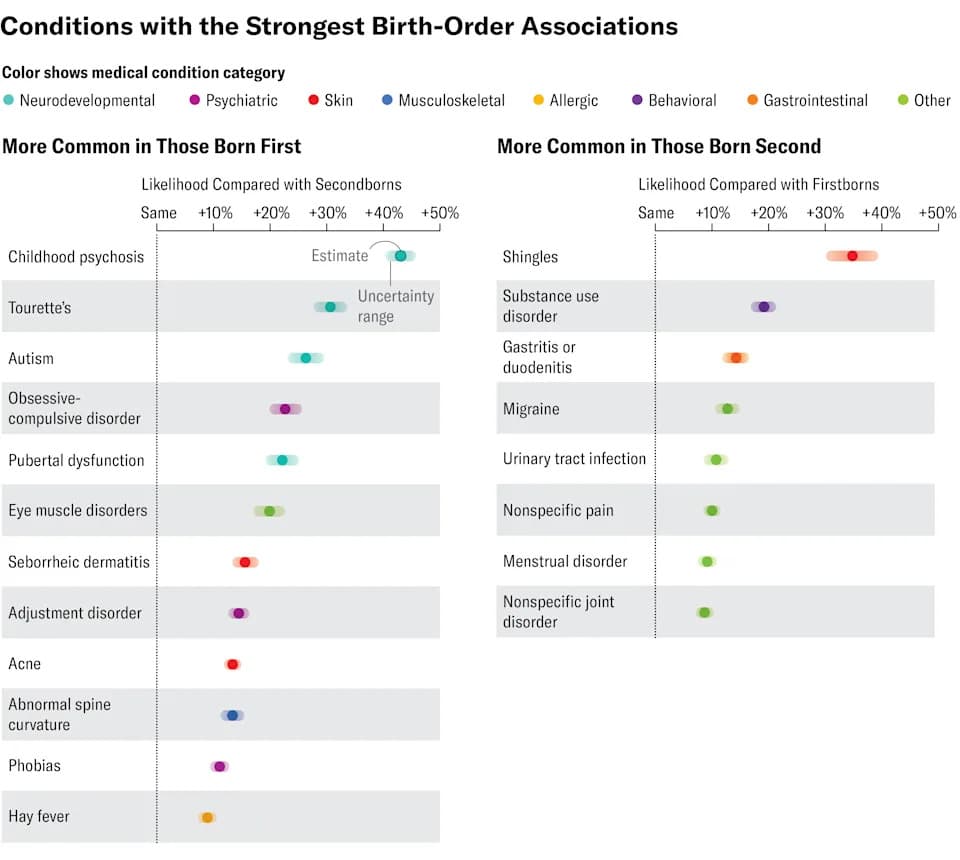
Amanda Montañez; Source:“Birth Order and Disease Risk across the Human Phenome: Evidence from 10 Million Siblings,” by Benjamin Kramer et al. Preprint posted to medRxiv on March 27, 2026(data)
I grew up as the youngest child and long accepted the lower expectations and relative invisibility that often come with that role. New research now offers some validation for long-suspected birth-order effects: investigators analyzed records for millions of siblings to explore whether birth order is linked to later health diagnoses.
What The Study Did
The team behind the preprint titled "Birth Order and Disease Risk across the Human Phenome: Evidence from 10 Million Siblings" (Benjamin Kramer et al., posted to medRxiv, 27 March 2026) scanned insurance-claims data across 569 diagnostic categories for more than 10 million individuals from over five million families. They used both within-family and between-family comparisons to try to separate birth-order effects from shared genetics and socioeconomic factors.
Key Findings
- Firstborn children had higher recorded diagnosis rates of neurodevelopmental conditions such as autism and ADHD, and were also more likely to have allergies. Small increases were also observed for childhood psychoses and acne among firstborns.
- Second-born children showed higher recorded rates of substance use disorders, shingles, and several gastrointestinal conditions.
- Smaller sibling age gaps (especially under four years) were associated with lower rates of allergies and asthma, a pattern consistent with the hygiene hypothesis: close-in-age siblings share microbes more often, which may help train the immune system and reduce allergic overreactions.
Possible Explanations
Researchers and commentators propose several mechanisms. For allergies and asthma, reduced early-life exposure to microbes for firstborns or only children may increase allergic risk. For substance use disorders among later-born children, earlier exposure to older siblings' alcohol or drug use may be a plausible pathway.
Limitations And Caveats
- The study is a preprint and has not yet been peer reviewed.
- Analyses relied on administrative insurance-claims data rather than direct measurement of disease prevalence. Claims reflect diagnoses parents seek and clinicians record — so differences may partly reflect help-seeking behaviour, parental vigilance, or diagnostic bias (parents may be more likely to pursue evaluations for a firstborn than for subsequent children).
- The dataset excluded uninsured families and those on Medicaid, likely skewing the sample toward wealthier populations with better access to care. This limits generalizability.
- Effect sizes for individual outcomes were generally modest, though small differences can add up at the population level.
- The authors ran sensitivity checks — for example, addressing "reproductive stoppage" (when parents stop having children after a first child receives a severe diagnosis) — and the primary autism association for firstborns remained after those checks.
Bottom Line
The study provides robust, large-scale evidence that birth order correlates with certain diagnosis patterns: firstborns are more likely to appear in claims data with autism, ADHD and allergies, while later-born children show higher rates for some other conditions. However, these findings do not prove causation. Diagnostic practices, access to care, and family behaviours likely influence recorded rates. The results are interesting and hypothesis-generating, but they should be interpreted cautiously until replicated and peer-reviewed.
Citation: Benjamin Kramer et al., "Birth Order and Disease Risk across the Human Phenome: Evidence from 10 Million Siblings," preprint posted to medRxiv (27 March 2026). Submitted to Nature Health. Findings not yet peer-reviewed.
Help us improve.