Researchers at the University of Rochester and RIT built a squeezed phonon laser by levitating a 100 nm silica bead in vacuum and driving two transverse vibration modes with a 150 mW, 1064 nm laser. By rotating the trapping potential and applying nonlinear parametric cooling, the system crosses a threshold from thermal motion to coherent phonon emission. The experiment also demonstrates two-mode thermomechanical squeezing — a peak squeezing ratio of 15.8 ± 0.8 near threshold — while remaining a classical, not yet quantum, result. The platform could enable lower-noise nanoscale sensing and future quantum experiments.
Researchers Build a 'Squeezed' Phonon Laser Using a Levitated Nanoparticle
University of Rochester optics professor Nick Vamivakas and physics Ph.D. candidate Levi Neukich perform experiments with optically levitated nanodiamonds in Wilmott Hall June 14, 2013. The process allows researchers to test fundamental physics questions related to quantum mechanics as well as provide a tool to perform high sensitivity nanoscale force sensing. (CREDIT: J. Adam Fenster / University of Rochester)
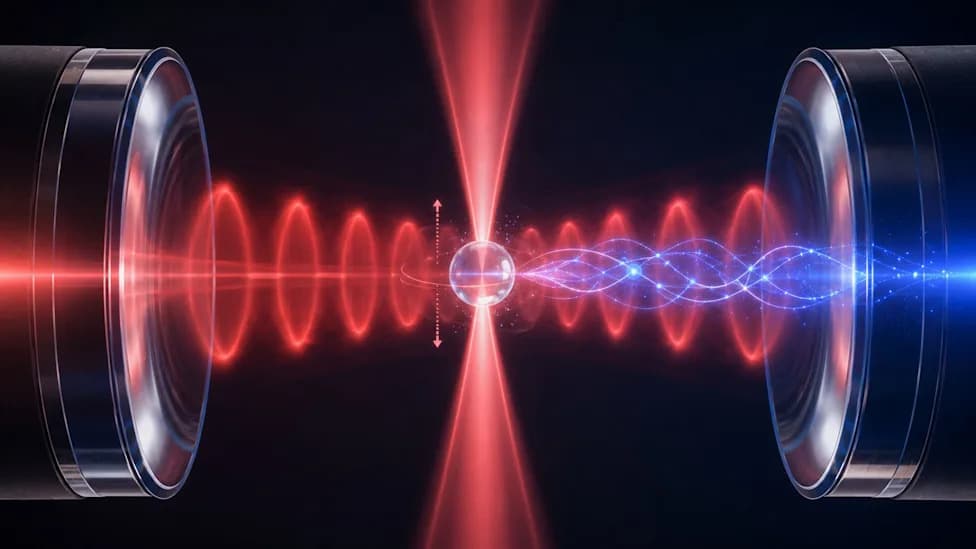
A silica bead just 100 nanometers across is held aloft in vacuum and driven to vibrate by a tightly focused laser beam. Those mechanical oscillations form the active medium of a new type of laser that emits coherent phonons — quantized packets of mechanical motion — rather than photons.
Teams from the University of Rochester and the Rochester Institute of Technology report in Nature Communications the creation of a squeezed phonon laser. The device combines laser-like coherence with reduced noise in a levitated-nanoparticle platform, demonstrating a new way to generate low-noise mechanical signals at the nanoscale.

Illustration of a nanoparticle optically levitated by a trapping laser beam (TB) inside a vacuum chamber (VC), with a probe beam (PB) measuring its position. (CREDIT: Nature Communications)
Experimental Setup
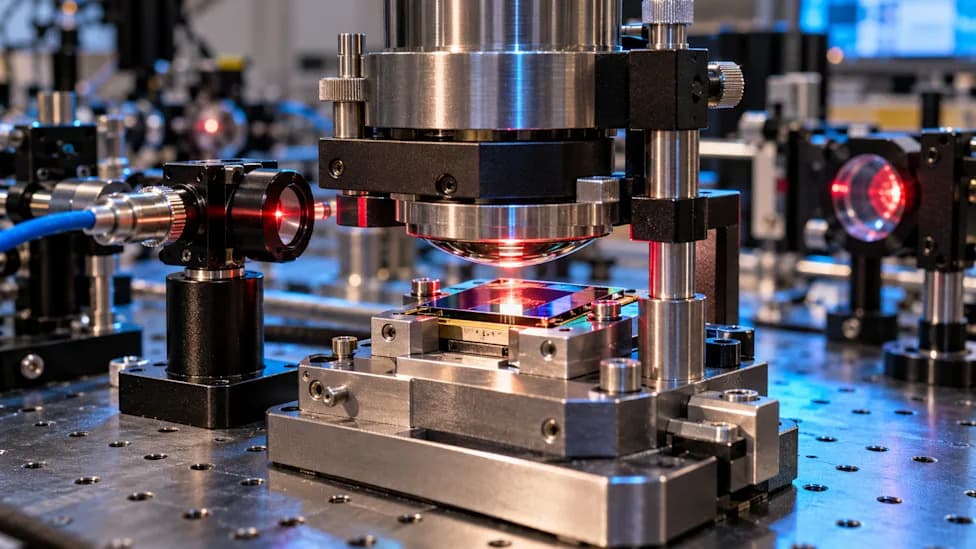
The experiment traps a 100 nm silica bead in vacuum with a tightly focused 150 mW laser at 1064 nm inside a chamber evacuated to about 1 × 10⁻⁵ mbar to minimize gas collisions. Because the trapping beam is linearly polarized, the optical potential is slightly asymmetric and supports two distinct transverse vibration modes, approximately 115 kHz and 130 kHz.
How It Works
The team coupled the two modes by periodically rotating the trapping potential. When the drive frequency matched the sum of the two mode frequencies, the system drove correlated phonon generation through a parametric down-conversion process: one driving input simultaneously fed energy into both vibrational modes. To prevent runaway growth of the oscillation amplitude (which would eject the particle), the researchers applied nonlinear parametric cooling — engineered dissipation that balances the drive and stabilizes the motion.

Two-mode phonon laser characterization. Evolution of the mean phonon number as a function of time. (CREDIT: Nature Communications)
What They Observed
With weak coupling each mode behaved like a thermal oscillator dominated by Brownian noise. Above a clear threshold the modes transitioned to coherent, laser-like behavior: the mean phonon number rose and then settled, phase-space distributions evolved from origin-centered disks to annular shapes consistent with phase-diffused coherent states, and the phonon-number statistics shifted away from thermal statistics.
The team tracked the change using a normalized second-order phonon autocorrelation function, g2. As coupling increased the measured value fell from about 1.8 toward 1 (values near 2 indicate thermal statistics; values near 1 indicate coherent, laser-like statistics).

Two-mode squeezing in a levitated nanoparticle. The normalized variances of the two nanoparticle quadratures as a function of normalized modulation. (CREDIT: Nature Communications)
Squeezing and Noise Reduction
An important advance is the observation of thermomechanical two-mode squeezing in a levitated nanoparticle system. Coupling linked the fluctuations of the two modes: fluctuations in the difference between their amplitudes decreased while fluctuations in their sum increased. Near threshold the strongest squeezing reached a ratio of 15.8 ± 0.8, falling to 5.2 ± 0.6 above threshold. In practice this means the device can act as a bright source of coherent, classically correlated phonons with reduced noise in a targeted quadrature.
Limits and Outlook
The authors stress that the demonstration is classical and does not show quantum entanglement; it is a step toward future quantum phonon control rather than a finished quantum technology. Potential applications include improved acceleration sensing, precision force and gravity measurements, and components for navigation hardware that do not rely on satellites. More broadly, this work expands the toolkit for levitated optomechanics and offers a controllable platform for experiments that aim to reach the quantum regime.
The full results are reported in Nature Communications.
Help us improve.