Two experiments with 1,300+ U.S. adults found that people typically assume short personal messages are human-written unless told otherwise. When AI authorship was disclosed, senders suffered a clear reputational penalty—described as "lazy" or "insincere"—even though identical text believed to be human was rated positively. Frequent AI users showed only a slightly smaller penalty, and everyone assumed human authorship by default. The findings raise ethical and practical questions about trust, disclosure, and how we evaluate written communication.
Study Finds Most People Assume Personal Messages Are Human—But Admitting AI Use Hurts Reputation
People tend to be offended when they get a personal note written by AI – if they know.Ekaterina Buravleva/iStock via Getty Images
Two experiments with more than 1,300 U.S. adults tested how people form impressions from short personal messages in the era of ChatGPT. Participants, aged 18 to 84, read AI-generated notes (for example, an apology sent by email) under four authorship conditions: no information about the author, told the text was written by a human, told it was AI-generated, or told it could be either.
Key Findings
We observed a clear AI disclosure penalty. When participants were told a message had been generated by AI, they judged the sender far more negatively—using descriptors such as "lazy," "insincere," or showing "lack of effort." The identical text, when believed to be written by a person, elicited more positive labels like "genuine," "grateful," and "thoughtful."
Surprisingly, participants in the no-information condition formed impressions just as positive as those who were explicitly told the message was human-written. In other words, absent any cue about AI involvement, recipients tended to assume a human author and rated messages favorably.
Role of Personal AI Use
We also examined whether participants who regularly use generative AI judged messages differently. Frequent AI users (those who reported using it at least every other day) showed a slightly smaller reputational penalty when AI authorship was disclosed. However, heavy users were not more skeptical by default: when no authorship information was provided, heavy users, light users and nonusers all typically assumed the message was human-written and produced essentially the same impressions.
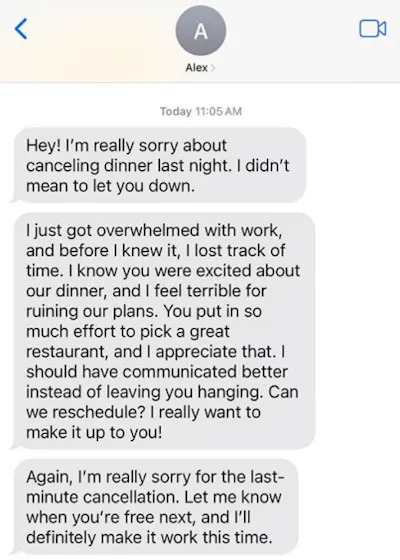
An AI-generated fictional apology sent via text was one of the messages participants evaluated in a recent study.Zhu & Molnar (2026)
Why This Matters
People constantly draw social conclusions from written text. Recipients interpret the apparent time and effort behind a message as a signal of sincerity, authenticity, or competence. Those impressions influence choices in friendships, dating, hiring and other workplace decisions.
This pattern creates a moral and practical dilemma. People who use AI privately can enjoy its benefits with little risk of detection, while those who disclose AI use face reputational costs. Over time, widespread but unrecognized AI use could change what writing signals in everyday life. Readers may begin to treat written messages as a less reliable indicator of character or effort and instead rely more on in-person interaction, recommendations, or other signals. For example, some employers have already begun to discount the value of cover letters and put greater weight on personal recommendations or in-person networking.
Evidence From Other Research
Other studies corroborate that disclosure tends to reduce perceived desirability, competence and creativity. Research has found that:
Job applicants who disclose AI assistance are viewed as less desirable; employees are seen as less competent; creative work is judged as less authentic; and personal or corporate apologies generated with AI are perceived as less effective. In general, disclosing AI use can undermine trust and legitimacy.
Meanwhile, without disclosure, most people struggle to reliably detect AI-generated text—even when using detection tools—especially for content that mixes human and AI contributions. Confidence in the ability to spot AI often appears to be a self-affirming illusion rather than an accurate skill.
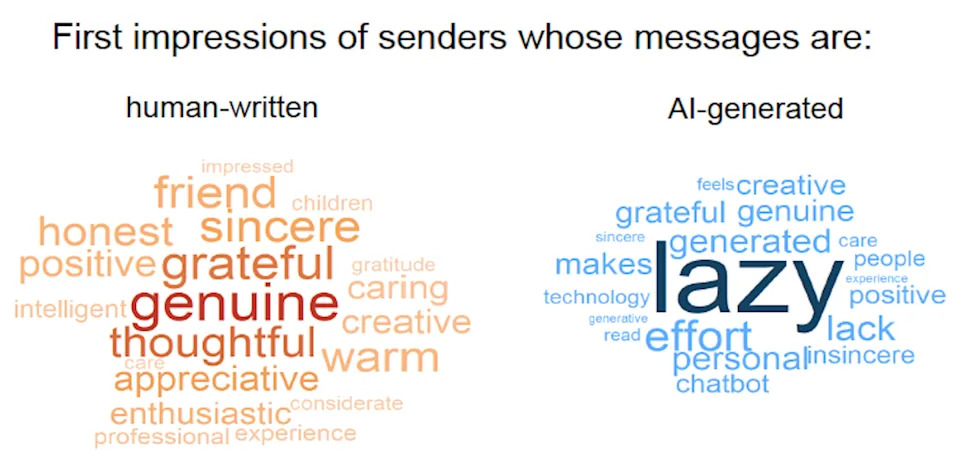
Word clouds depict participants’ first impressions of senders who wrote messages themselves, left, and those who used AI, right.Andras Molnar
Next Steps and Practical Advice
Our experiments do not imply people never suspect AI in real-world settings. Certain contexts, such as academic work, can make recipients more vigilant. Future research will investigate when and why people naturally begin to suspect AI use and what shifts readers from trust to doubt.
Until we better understand those triggers, if you want a personal message to read as heartfelt, the safest options remain: make a phone call, leave a voicemail, or speak in person.
Author: Andras Molnar, University of Michigan.
Disclosure: Andras Molnar reports no conflicts of interest or financial ties to organizations that would benefit from this research beyond his academic appointment.
Help us improve.