David Gross warned that humanity’s "half-life" could be about 35 years, citing an increase in the annual risk of nuclear war from roughly 1% to 2%. Game theory—developed by John von Neumann and Oskar Morgenstern—offers tools to model strategic choices and mixed strategies, but it cannot force rational behavior. Historical examples (including wartime target selection and Cold War debates) show the limits of theory alone. Recent initiatives such as the 2024 Mainau Declaration and a Nobel Laureate Assembly proposal urge concrete institutional safeguards—like two-person authorization—to reduce nuclear risk.
Why Game Theory Could Be Crucial to Preventing a Nuclear Catastrophe
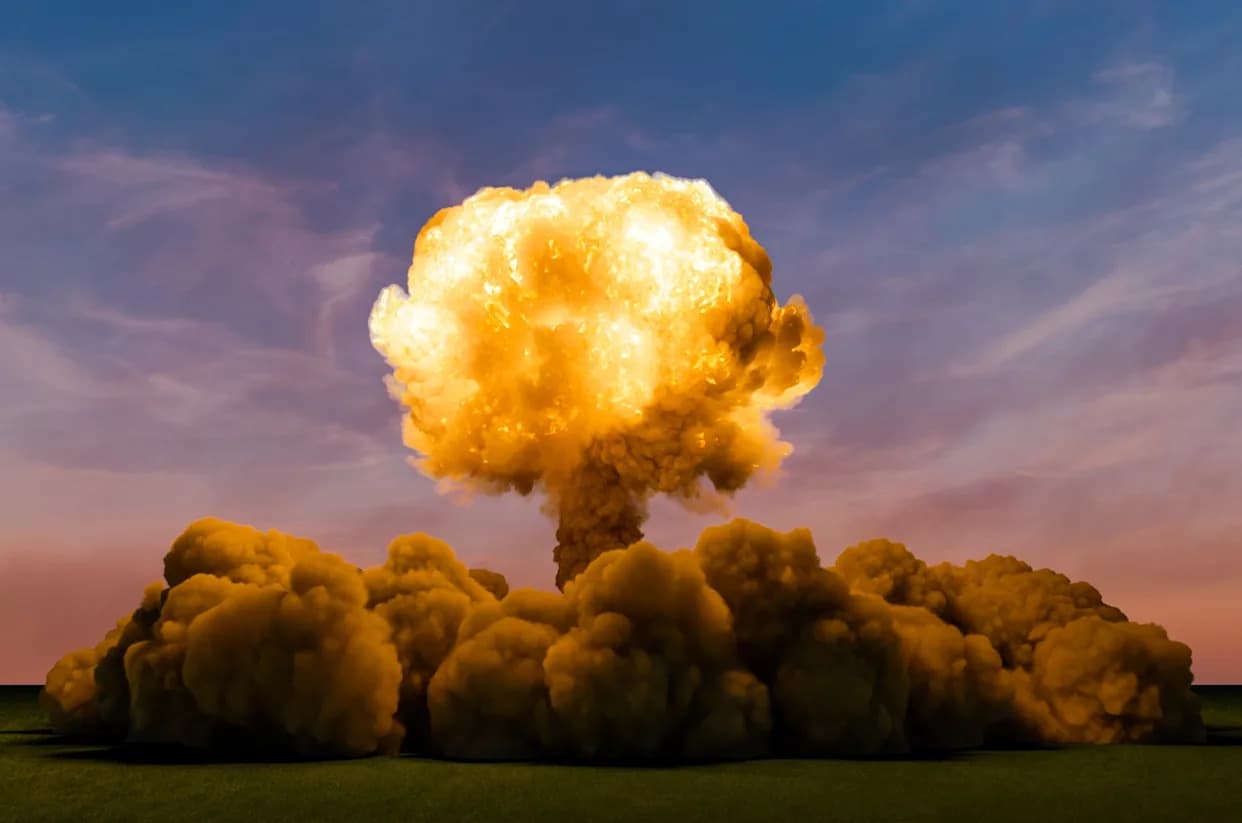
“The half-life of humanity is currently around 35 years,” Nobel laureate David Gross warned at a German Physical Society conference in Erlangen, estimating that the annual probability of a nuclear war has risen from roughly 1% to about 2%. His stark projection left the audience visibly unsettled—and focused attention on how we think about choices, risks and deterrence at the highest levels.
Game Theory: A Powerful Tool, Not a Magic Bullet
Game theory, pioneered by John von Neumann and Oskar Morgenstern, provides a rigorous framework for modeling strategic interactions. Analysts assign numerical payoffs to outcomes, compute best responses and explore equilibria. These tools help clarify trade-offs and expose hidden incentives—but they do not make actors rational. Human error, misperception, emotion and political pressures can all derail even the best theoretical prescriptions.
How Game Theory Models Decisions
In simple models, payoffs (for example on a scale from –10 to +10) represent the relative value of outcomes for each player. Consider a chess-like example: if Player A captures a pawn on square 1 with no adverse consequence, that might be assigned +10 for A and –10 for B; if the capture causes A to immediately lose a queen, the payoff could instead be –4 for A and +4 for B. Such bookkeeping makes trade-offs explicit.
To avoid infinite regress—A reasons about B, B reasons about A’s reasoning—game theorists often consider mixed (randomized) strategies or repeated-play averages. Randomization (a biased coin, for instance) can prevent predictable patterns that an adversary could exploit and can identify robust strategies when no pure best move exists.
History Shows Limits and Risks
Von Neumann’s legacy is complicated. He helped found game theory and contributed to early computing, quantum mechanics and information theory—but historical accounts also link him to U.S. wartime planning and to advice that favored strong military options. Reports indicate he was among those consulted during wartime target selection in 1945, when planners considered Kokura, Hiroshima, Yokohama, Niigata and Kyoto before the bombings of Hiroshima and Nagasaki—attacks that killed an estimated 200,000 people and helped bring about Japan’s surrender.
In the early Cold War von Neumann reportedly advocated for preemptive options against the Soviet Union. Fortunately, policymakers did not follow such counsel to an open nuclear exchange; the Cold War ended without global nuclear catastrophe. That history underscores that strategic brilliance does not guarantee humane or safe policy—nor that sound models will be followed.
Why This Matters Today
Rising geopolitical tensions and renewed conflicts involving nuclear-armed states have revived existential concern. The 2024 Mainau Declaration, initiated by David Gross and other Nobel laureates, warns of the danger that these weapons might be used deliberately or accidentally and calls for urgent action. A parallel document from the Nobel Laureate Assembly for the Prevention of Nuclear War recommends concrete safeguards, including requiring at least two people to authorize a nuclear launch—an important fail-safe that is not uniformly codified across nuclear-armed states.
What Game Theory Can Contribute
Game theory can inform policy in several practical ways: clarifying incentives for escalation or de-escalation, testing how command-and-control rules affect stability, and designing verification and signaling mechanisms that reduce miscalculation. Models can suggest structural changes (institutional checks, transparency measures, de-alerting systems) that make accidental or impulsive use less likely.
Bottom line: Game theory sharpens our understanding of risk and strategy, but preventing nuclear catastrophe requires institutions, norms and political will in addition to elegant models.
This article is adapted from a German original published in Spektrum der Wissenschaft and translated with editorial review.
Help us improve.