Trump announced a 10-day midnight ceasefire in Lebanon after a predicted call with Lebanon’s president did not take place, effectively limiting Prime Minister Netanyahu’s immediate options. The declaration — delivered on social media — followed security-cabinet meetings in Israel and came after IDF leadership had approved additional war plans. Analysts say the pause provides breathing room but does not resolve deeper conflicts with Hezbollah or Iran.
Trump Announces Lebanon Ceasefire, Once Again Forcing Netanyahu’s Hand
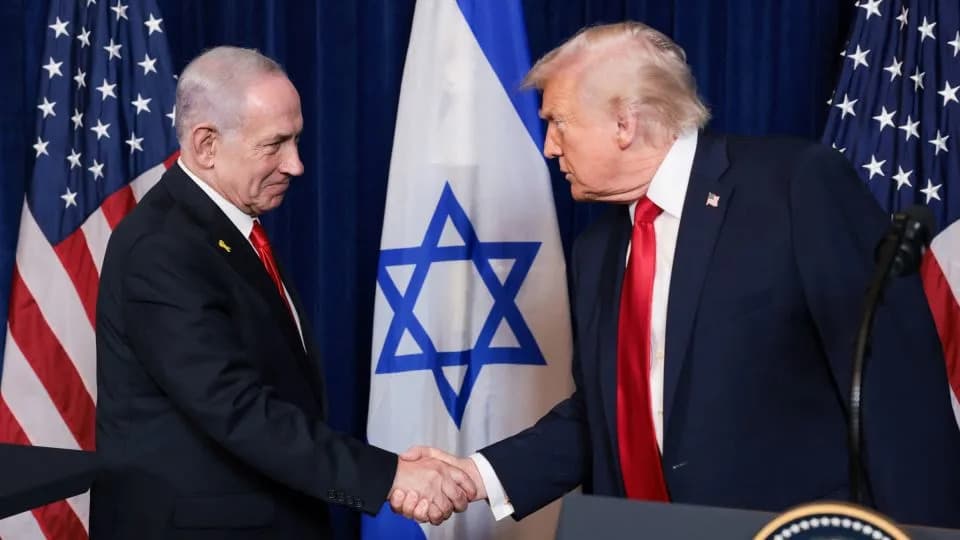
Israeli Prime Minister Benjamin Netanyahu and US President Donald Trump meet at Trump’s Mar-a-Lago club in Palm Beach, Florida, on, December 29, 2025. - Jonathan Ernst/Reuters/File
US President Donald Trump announced a midnight ceasefire in Lebanon after a predicted phone call with the Lebanese president failed to materialize, leaving Prime Minister Benjamin Netanyahu with little practical choice but to accept the pause.
On Thursday morning Trump said Mr. Netanyahu would speak with Lebanon’s president to provide "a little breathing room." Reports said the expected call did not take place amid ongoing hostilities between Israel and the Iranian-backed Hezbollah. Hours later, Trump declared on social media that a 10-day ceasefire would begin at midnight — a move that effectively constrained Israel’s immediate military options.
Netanyahu had signaled a continued campaign against Hezbollah just days earlier. "We are still fighting them," he said, adding that it was "not over yet." Israel Defense Forces (IDF) Chief of Staff Lt. Gen. Eyal Zamir had also approved additional contingency plans for operations in Lebanon and Iran before the announcement.
Still, without the US president’s apparent endorsement, Israeli leaders found their freedom of action limited. The temporary truce is meant to last 10 days, and Trump made clear he expected it to hold. "It has been my Honor to solve 9 Wars across the World, and this will be my 10th," he wrote on social media.
Israeli officials raised a temporary ceasefire in a security-cabinet meeting the night before, but they did not hold a formal vote or publicly acknowledge that a pause was imminent. Netanyahu convened the security cabinet again shortly before Trump’s announcement; many Israelis — politicians and ordinary citizens alike — first learned of the ceasefire from the US president’s post rather than from Israeli authorities.
"At this stage of the war, which he entered into largely due to Netanyahu’s persuasion, Trump has become the final, if not the exclusive, arbiter,"
— Amos Harel, Haaretz military analyst
This episode follows a pattern in which Trump’s public interventions have repeatedly shaped Israeli decisions: he pressed for a ceasefire with Hamas in Gaza, pushed for de-escalation in earlier clashes with Iran, and publicly intervened after an Israeli strike in Doha that prompted an apology to Qatar.
Those episodes have yielded territorial gains for Israel — expanded presence in parts of Gaza, Lebanon and Syria — but not the decisive outcomes Netanyahu promised. Hamas still controls much of Gaza not occupied by Israel, Hezbollah remains able to strike across the border, and Iran continues to exert strategic influence in the region. Some reports have suggested shifts or succession discussions within Iran’s leadership, but analysts caution against treating those reports as definitive.
Danny Citrinowicz, an Iran specialist at Israel’s Institute for National Security Studies, said Tehran will enter future negotiations from a position of relative strength. "Given its demonstrated willingness, and capability, to impose significant costs on its neighbors and on the global economy, Tehran is unlikely to concede under pressure alone," he wrote on social media.
On Friday, Netanyahu released a statement saying he had accepted the temporary ceasefire "at the request of my friend, President Trump," while warning that Israel stood ready to resume operations. Twenty minutes later, Trump posted again that "Israel will not be bombing Lebanon any longer. They are PROHIBITED from doing so by the U.S.A. Enough is enough!!!"
The announcement underscores how public diplomacy, social media and the US president’s declarations can shape the strategic choices of close allies during crises. The ceasefire gives a temporary pause, but many of the conflict’s deeper challenges — territorial disputes, asymmetric threats and regional rivalries — remain unresolved.
Help us improve.