Australia will raise defence spending to 3.0% of GDP by 2033 amid a rise in global conflicts and strategic pressure. The change requires about Aus$53 billion more over the next decade and Aus$14 billion in the next four years, with Canberra adopting a NATO-style budget definition that includes military pensions. The plan accelerates AUKUS-related shipbuilding and adds up to Aus$5 billion for drones, but critics warn of potential capability gaps during the transition.
Australia to Raise Defence Spending to 3.0% of GDP by 2033 Amid Rising Global Threats
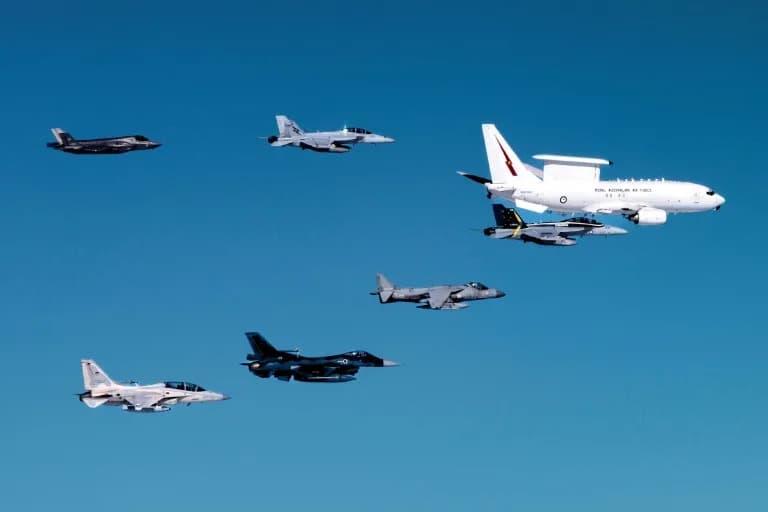
This handout image taken on July 23, 2024 and released by the Australian Defence Force shows a Royal Australian Air Force (RAAF) E-7A Wedgetail airborne early warning and control aircraft (top R) in formation flight with an RAAF EA-18G Growler electronic warfare aircraft (bottom R), RAAF F/A-18F Super Hornet (top C), a Spanish Navy AV-8B Harrier II (bottom C), an F-35 Lightning II (top L), a Japan Air Self-Defense Force Mitsubishi F-2 (bottom 2nd L), and a Philippine Air Force FA-50 Golden Eagle (bottom L) over northern Australia during Exercise Pitch Black 2024. Australia will deploy a long-range military reconnaissance plane to the Gulf to protect civilians, Prime Minister Anthony Albanese said on March 10, 2026 (Handout)(Handout/AUSTRALIA DEFENCE FORCE/AFP)
Australia announced on Thursday it will increase defence spending to 3.0 percent of gross domestic product by 2033, citing a global uptick in armed conflict and mounting strategic pressures. The move reflects a major budgetary shift and adjustments to how Canberra counts defence costs.
Details of the Plan
Defence Minister Richard Marles said the decision responds to what he described as the erosion of “international norms that once constrained the use of force and military coercion.” The government has revised an earlier forecast that had expected defence spending to reach 2.3% of GDP by 2033.
Officials say the updated target requires an additional Aus$53 billion (about US$38 billion) over the coming decade compared with the 2024 defence strategy, with roughly Aus$14 billion extra planned across the next four years. To help meet the 3.0% goal, Canberra has adopted a NATO-style accounting definition that brings items such as military pensions into the defence totals.
AUKUS, Shipbuilding and New Capabilities
Australia is accelerating construction of a major shipbuilding yard in Western Australia to support nuclear-powered submarines under the AUKUS partnership with the United States and United Kingdom. AUKUS aims to transfer nuclear-powered submarine capability to the Royal Australian Navy within 15 years.
At the same time, Canberra is investing in autonomous submarine concepts and new fighter designs (referred to domestically as Ghost Shark and Ghost Bat) and has announced up to Aus$5 billion in additional drone funding in response to lessons from recent conflicts in the Middle East and Ukraine.
Reactions and Risks
The 3.0% target is substantial but still below calls from some US officials for a 3.5% commitment. Critics argue AUKUS does not guarantee Australia will receive submarines on a definitive timeline and warn of a potential capability gap during the transition to nuclear-powered vessels.
On the strategic context: “More countries are engaged in conflict today than at any time since the end of World War II, and this is occurring across every region of the world,” Defence Minister Richard Marles said in a prepared speech.
Defence planners say the extra funding aims to strengthen deterrence, sustain domestic defence industry and accelerate priority programmes. Delivering the promised capabilities will require careful management of procurement schedules, workforce capacity and long-term sustainment costs.
Help us improve.