Philippine officials said lab tests confirmed cyanide in bottles seized from Chinese vessels operating near Second Thomas Shoal, warning the toxic chemical could devastate fish stocks and weaken the reef supporting a grounded Philippine warship. China dismissed the claim as a "stunt," accusing Manila of harassing fishermen and manufacturing the incident. The finding deepens existing tensions over resupply missions after a June 17 clash that injured a Filipino sailor, even as both countries hold limited talks on cooperation and confidence-building at sea.
Philippines Says Cyanide Found On Chinese Boats Near Disputed Shoal, Calls It 'Sabotage'
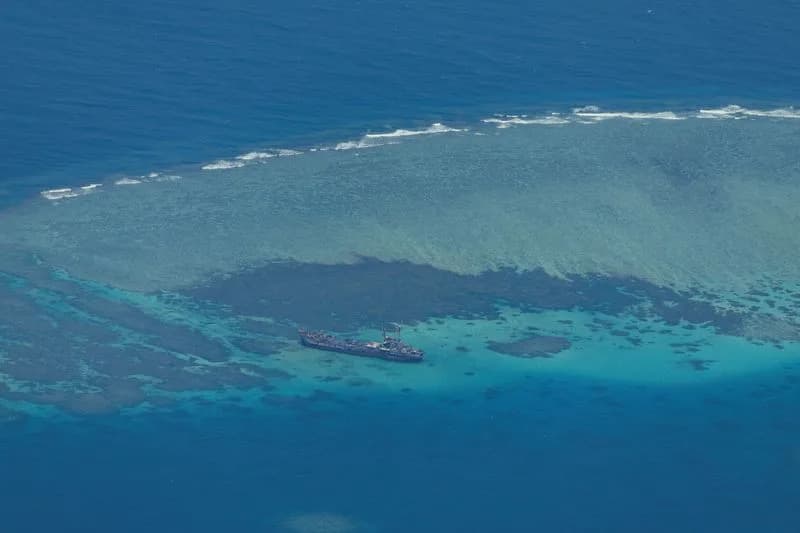
An aerial view shows the BRP Sierra Madre on the contested Second Thomas Shoal, locally known as Ayungin, in the South China Sea, March 9, 2023.
Philippine security officials said on April 13 that laboratory tests detected cyanide in bottles seized from Chinese vessels operating around Second Thomas Shoal, a contested feature in the South China Sea where Manila has deliberately grounded a naval vessel to bolster its maritime claim.
Authorities said the samples were taken during Philippine Navy operations at the shoal last year. Officials warned that the presence of the highly toxic chemical could devastate local fish populations and damage the coral reef that helps support the grounded vessel.
"The use of cyanide in Ayungin Shoal is a form of sabotage that seeks to kill local fish populations, depriving Navy personnel of a vital food source," National Security Council spokesperson Cornelio Valencia told reporters, using the Philippines' name for Second Thomas Shoal. Valencia added that cyanide could harm the reef and "ultimately compromise" the stability of the grounded ship.
The Chinese foreign ministry rejected the Philippines' account, calling the allegation a "stunt." Spokesperson Guo Jiakun said the Philippine side had "illegally harassed the Chinese fishing boats," seized supplies and manufactured the incident, and that the Philippine narrative lacked credibility.
Second Thomas Shoal (known in the Philippines as Ayungin Shoal and in China as Ren'ai Reef) lies within the Philippines' 200-nautical-mile exclusive economic zone and is roughly 1,300 km (808 miles) from mainland China. Manila has maintained a presence there by keeping a naval vessel grounded on the reef to assert its territorial claims.
Tensions in the area have included disruptions of resupply missions to the ship. Manila cited a June 17, 2024 encounter that turned violent and resulted in a Filipino sailor losing a finger; China denies acting aggressively and says Philippine vessels entered waters Beijing considers its own. That June confrontation led to a provisional understanding to allow resupply missions to continue.
Last month, Beijing and Manila held high-level talks exploring early cooperation on oil and gas and discussing confidence-building measures at sea, including coast guard communication. The Philippine foreign ministry said any coast guard cooperation would be narrowly defined, would "not contemplate cooperation in sensitive operational areas," and that there had been no discussions of joint patrols.
China claims nearly the entire South China Sea, including waters claimed by Brunei, Malaysia, the Philippines, Taiwan and Vietnam. A 2016 international arbitral tribunal ruled that Beijing's broad claims have no legal basis under international law — a decision China rejects. More than $3 trillion in ship-borne commerce passes through the waterway annually.
Reporting: Karen Lema. Editing: Kate Mayberry.
Help us improve.