This experiment demonstrates that laser wakefield acceleration can produce coherent extreme ultraviolet (XUV) light and amplify it with a compact beamline and undulator. Osaka University and collaborators improved injection control, laser wavefront stability and gas flow to generate ~400 MeV electron beams with sub‑1% energy spread and high pointing stability. A 9‑metre beamline and 2‑metre undulator produced roughly 20× FEL gain at 27–50 nm — an important step toward table‑top x‑ray free‑electron lasers.
Desktop Accelerators Produce Coherent Extreme Ultraviolet Light — A Key Step Toward Table‑Top X‑Ray FELs
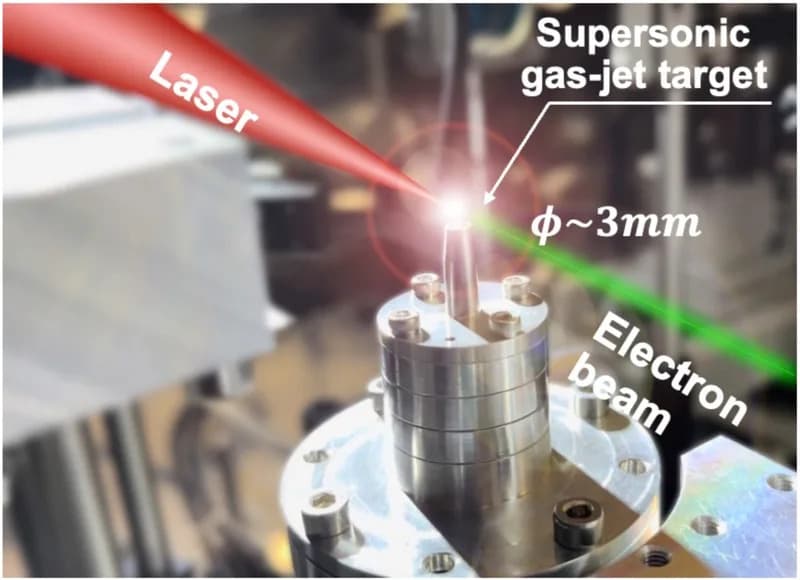
Laser-driven plasma acceleration brings free-electron lasers closer to compact lab-based instruments. (CREDIT: Physical Review Research)
A narrow electron beam traversed only a few millimetres of plasma and produced coherent light in the extreme ultraviolet (EUV/XUV) band at wavelengths between 27 and 50 nanometres. The result, achieved by a team led at Osaka University, demonstrates that laser wakefield acceleration can generate electron beams clean enough to drive free-electron laser (FEL) amplification — an important milestone on the path toward much smaller, laboratory-scale x‑ray FELs.
What the team did
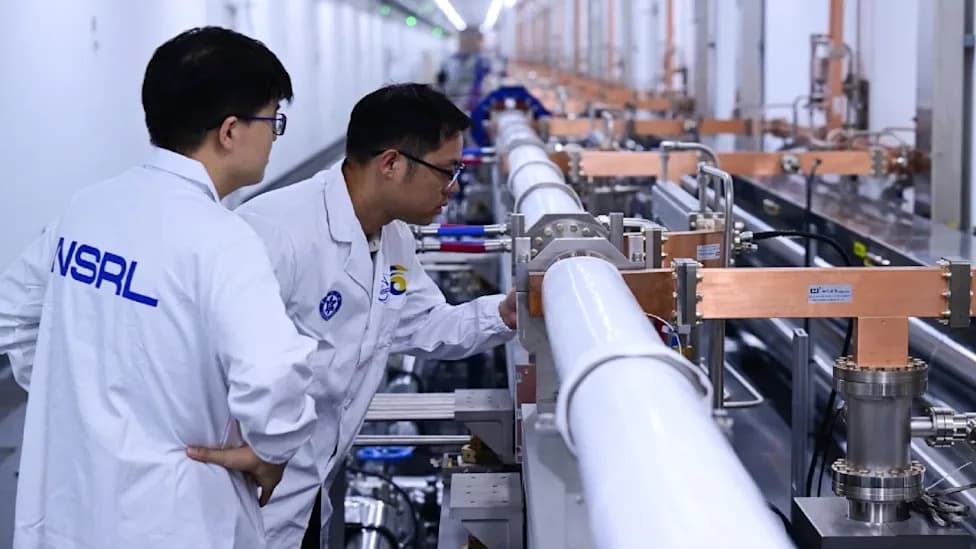
Researchers at Osaka University's Institute of Scientific and Industrial Research, in collaboration with the Kansai Institute for Photon Science, the National Institutes for Quantum Science and Technology, the RIKEN SPring‑8 Center and KEK, used laser wakefield acceleration to create ultra-short, high-quality electron beams. In this technique, an ultraintense laser pulse drives a plasma wake; electrons surf the wake and can be accelerated to high energy over millimetres instead of metres.
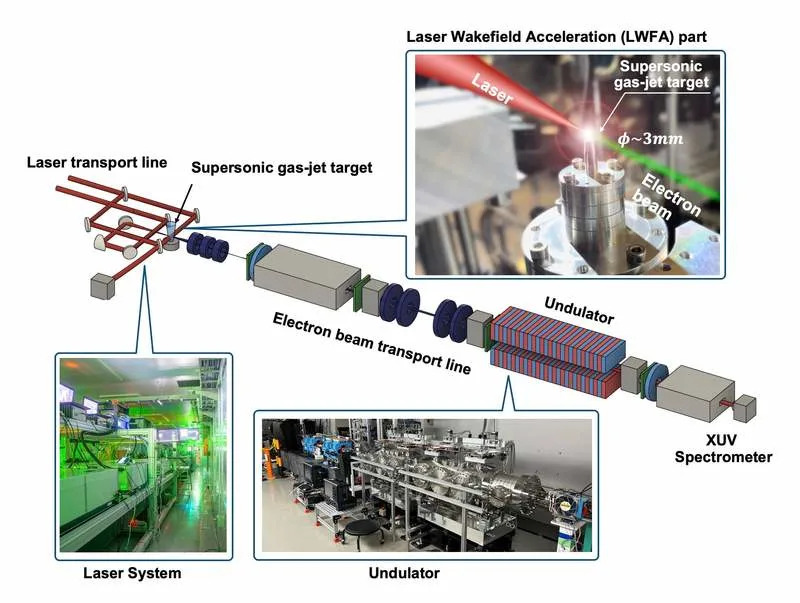
Proof-of-concept experimental setup used to generate an extreme ultraviolet (XUV) free-electron laser (FEL) driven by a laser wakefield acceleration (LWFA) electron beam. (CREDIT: University of Osaka)
Key technical advances
The group made several concurrent improvements to stabilize and clean the beam:
- Shock-controlled injection: A supersonic hydrogen gas jet with a knife edge created a sharp, well-defined injection region, reducing the energy spread of the injected electrons.
- Laser wavefront optimization: Adding a circular mask before the focusing mirror cut wavefront instability by about 50% (laser energy dropped from ~800 to ~600 mJ), which dramatically improved beam pointing stability from ~10 mrad to ~1.3 mrad.
- Gas-flow engineering: Redesigned nozzles and a longer stilling chamber reduced turbulence, improving gas-density stability by ~4× and shock-position stability by nearly an order of magnitude.
Beam performance and FEL demonstration
By carefully balancing injected charge, beam loading and phase rotation, the researchers produced monoenergetic electron beams with central energies near 400 MeV, energy spread below 1% (a best measured 0.7% that could deconvolve to ≈0.2% pending higher-resolution confirmation), pointing stability under 0.5 mrad, and energy stability below 6%.
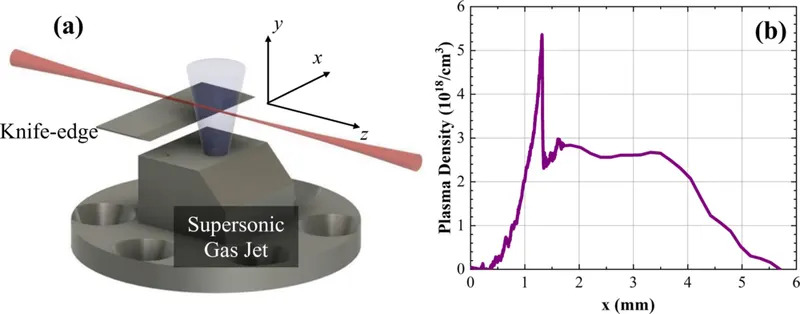
(a) Sketch of shock injection target setup. (b) Plasma-density distribution along laser axis, measured with a Mach-Zehnder interferometer. (CREDIT: Physical Review Research)
The beam was transported along a 9‑metre beamline into a 2‑metre undulator with 80 periods. There the team observed a free‑electron laser gain of roughly 20× in the 27–50 nm XUV range — demonstrating coherent amplification rather than purely spontaneous emission.
Verification and limitations
To verify the effect, the researchers inserted a thin aluminium foil to deliberately degrade the electron beam; under that condition the radiation reverted to the expected linear spontaneous emission, confirming that the stronger nonlinear growth in the main runs represented genuine FEL amplification.
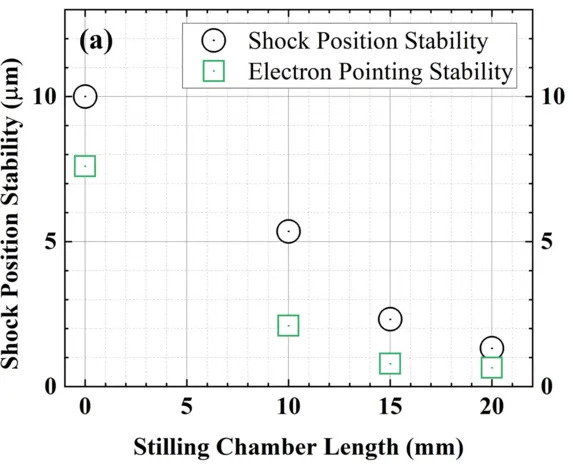
Electron beam’s pointing stability improves with longer stilling chamber. (CREDIT: Physical Review Research)
However, the demonstration has limits: amplification still varied shot to shot, the system remained sensitive to alignment, laser quality needs further improvement, and some simulation inputs (for example assumed energy spread) had to be adjusted to reproduce the measured gain. The team emphasized that a higher-resolution spectrometer is needed to confirm the lowest claimed energy spread.
Implications
While this experiment does not yet produce a compact x‑ray FEL, it shows that laser wakefield accelerators can reach the XUV regime with FEL amplification — a crucial step toward shorter wavelengths and truly table‑top x‑ray sources. If matured and made reliable, compact accelerators and x‑ray FELs could broaden access to ultrafast, ultra‑bright light for life sciences, materials research, semiconductor development and quantum science, moving capabilities from a few large national facilities into ordinary laboratories.
Publication: The study is published online in Physical Review Research.
Help us improve.