
ST40 filmed at 16,000 fps reveals vivid deuterium plasma and crimson-to-green lithium traces at the plasma edge. High-speed color imaging helps scientists track where impurities radiate energy, enabling the X-Point Radiator (XPR) approach to reduce heat loads on divertors. Early ST40 tests show radiating regions crossing the X-point can lower divertor heat; upgrades (molybdenum armor, lithium coating systems, new diagnostics) are planned to refine this technique.
Watch Colorful Plasma and Lithium Sparks in a Tokamak — 16,000 FPS Inside ST40
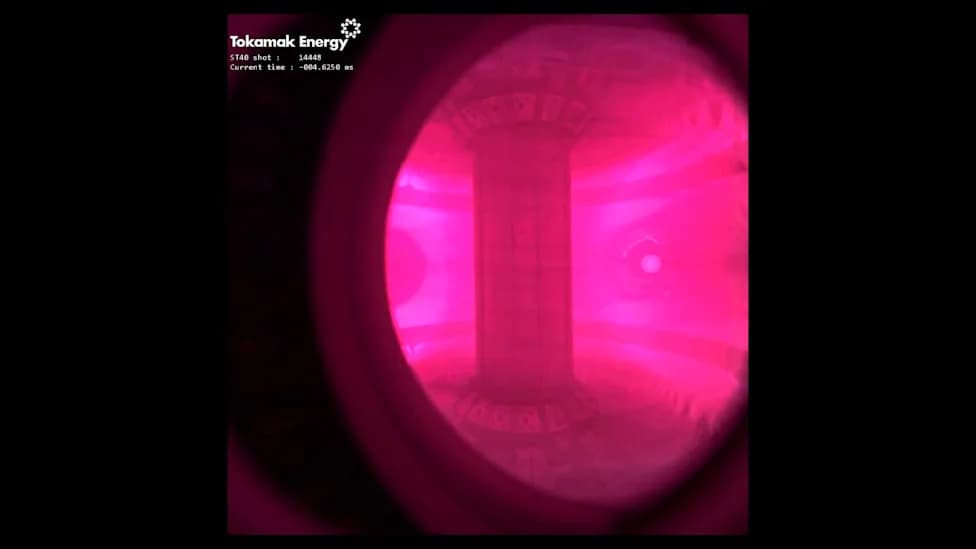
The glow of deuterium and lithium inside Tokamak Energy's ST40 fusion reactor. (Tokamak Energy/YouTube)
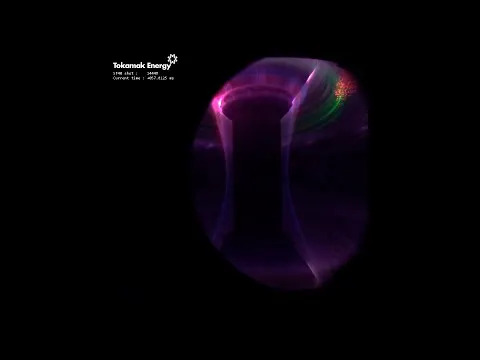
When Tokamak Energy's ST40 powers up, its interior transforms into a fireworks-like display captured in stunning detail by a color camera running at 16,000 frames per second. Deuterium plasma blooms a vivid pink around the toroidal chamber; sand-sized lithium grains enter that edge plasma as crimson points and then streak green-yellow as they ionize and follow magnetic field lines.
How the Colors Form
The visible colors come from relatively cool edge plasma, not the fusion-hot core. The pink glow is from injected deuterium, which emits a blend of red and blue wavelengths. Neutral lithium atoms in the cooler outer layers radiate deep crimson when excited. As lithium atoms lose electrons and become Li⁺ ions deeper in the plasma, they emit greenish-yellow light. Because the ions are charged, they trace the magnetic field lines — turning each streak into a visual map of otherwise invisible fields.
YouTube Thumbnail
Why This Imaging Matters
Plasma confinement is never perfect: some energy escapes the hot core and must be handled by components called divertors. In future continuous fusion power plants, divertors will need to survive sustained, punishing heat loads. ST40 experiments have measured localized heat fluxes up to about 150 megawatts per square meter — one reason heat exhaust is a central research focus.
The X-Point Radiator Concept
Researchers are testing the X-Point Radiator (XPR) idea: encourage controlled radiation from impurities at the magnetic X-point near the divertor so energy is shed before it reaches plasma-facing components. If impurities radiate in the right place, they can reduce the divertor heat load while leaving the core hot enough for fusion to continue.
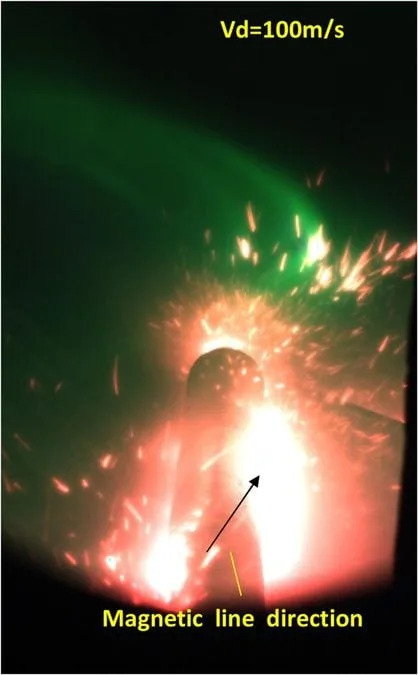
High-speed color imaging of plasma interacting with a lithium limiter in Russia's T-11M tokamak. The bright streaks are lithium droplets ejected from the limiter during an instability, traveling at around 100 meters per second. (Lazarev et al.,Fusion Eng. Des., 2016)
High-Speed Color Imaging: What It Adds
High-speed color footage complements spectroscopy and other diagnostics by revealing where specific atoms and ions travel and how quickly transient structures evolve. Earlier work on Russia's T-11M used a color camera at 1,000 fps and concluded that >10,000 fps would be needed to follow lithium filaments — a gap the ST40 system (16,000 fps) fills.
Early Results and Ongoing Work
Preliminary ST40 results are encouraging: teams have produced radiating regions that sweep across the X-point and measurably reduce heat reaching the divertor. Many early radiation signals appear to come from carbon eroded from internal walls rather than deliberately injected lithium, so experiments adding lithium and neon are underway to refine control of where radiation occurs.
YouTube Thumbnail
Planned Upgrades to ST40
To advance these studies, Tokamak Energy plans several upgrades for ST40: replace carbon plasma-facing armor with molybdenum, add systems that can coat surfaces with lithium in a controlled way, and install new diagnostics to scrutinize edge plasma behavior. Modeling suggests lithium could be concentrated near the divertor to provide localized cooling without contaminating the core.
Why it matters: High-speed color imaging turns graceful plasma colors into practical tools, helping researchers learn how to steer cooling to the right place — a key step toward durable components and a viable fusion power plant.
Help us improve.





















