Colleges Reintroduce Oral Exams To Verify Learning: As generative AI produces near-perfect written work, professors are increasingly using oral defenses and live questioning to test true understanding. Old And New Methods: Institutions from Cornell to NYU and Penn pair oral checks with papers and explore AI-driven interview agents. Trade-Offs: Oral exams can expose genuine comprehension and build communication skills but may stress shy or anxious students unless well structured.
Perfect Homework, Blank Stares: Colleges Revive Oral Exams To Counter Generative AI
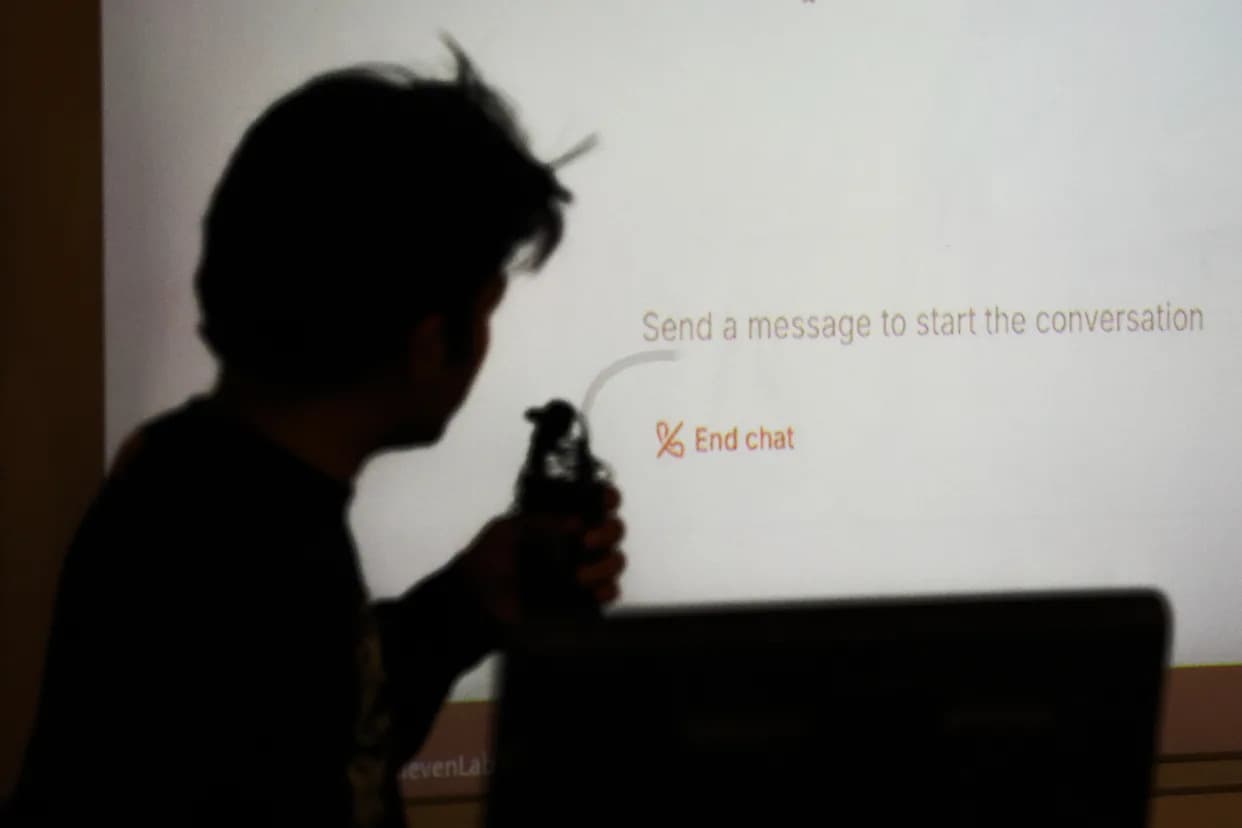
Student Surya Newa is silhouetted while using an oral AI agent during class at NYU Stern School of Business, March 4, 2026, in New York. (AP Photo/Heather Khalifa)
The assignment comes with strict limits: no laptop, no chatbot and no technology of any kind — not even pen and paper. Instead, students in Chris Schaffer’s biomedical engineering course at Cornell University must speak directly with an instructor in what he calls an “oral defense.”
This centuries-old assessment style, rooted in Socratic dialogue, is seeing a resurgence as generative AI tools make written work appear flawless. Across campuses, professors are pairing oral checks with written work and experimenting with both low-tech and AI-assisted oral formats to verify student understanding.
Why Oral Exams Are Returning
Many instructors say the question is no longer whether students will use AI to complete assignments, but how to learn what students actually understand. Faculty report a concerning pattern: take-home essays and problem sets now arrive near-perfect, but students often struggle to explain or defend their answers in person.
“You won’t be able to AI your way through an oral exam,” says Schaffer, who introduced the oral defense last semester.
Educators worry that bypassing the hard work of thinking risks eroding critical reasoning, creativity and the problem-solving skills students need for advanced study and careers.
Examples From Campus
At the University of Pennsylvania, Associate Professor Emily Hammer pairs oral defenses with seminar papers. She bans AI on written assignments but acknowledges enforcement is difficult; the face-to-face defense raises the stakes and makes outsourcing less attractive. Penn’s Center for Teaching and Learning has begun running faculty workshops on oral exams.
At Cornell, Schaffer requires 20-minute, Socratic-style sessions after written problem sets. With 70 students, he shares the workload with teaching assistants who now grade the oral defenses rather than the written submissions. Cornell’s Center for Teaching Innovation highlights his course in a new “Oral Assessment Workshop.” Other Cornell faculty have adopted “final conversations” and brief mock interviews as alternatives to traditional exams.
During the COVID-19 pandemic, some U.S. colleges piloted oral assessments to respond to concerns about online cheating. Huihui Qi, an engineering professor at UC San Diego, launched a three-year study during that period to explore how to scale oral exams; she has since been invited to run workshops at other universities.
Low-Tech And High-Tech Approaches
New York University professors are increasing live interactions — mandatory office-hour check-ins, presentations and cold-calling — to gauge student comprehension. Some instructors prefer human-to-human exchanges; others are experimenting with AI. Panos Ipeirotis at NYU’s Stern School of Business deployed an AI-powered oral exam for an AI product-management class, partnering with ElevenLabs to build a voice agent that interviews students remotely.
The AI agent greets each student, asks for identification, probes details of a final group project and follows up based on responses. If a student falters, the agent provides hints, critique and encouragement. Ipeirotis uses AI-assisted grading alongside his own review to detect free-riding or AI outsourcing.
Student feedback to the AI approach was mixed: some found the cloned voice convincingly human but the conversation awkward or stilted. Others appreciated the additional accountability, even as they recognized students will likely try to exploit AI tools.
Benefits And Challenges
Proponents argue oral exams reveal genuine comprehension, build communication skills and reintroduce accountability into assessment. Opponents warn oral testing can intimidate students who are shy or suffer from anxiety. Educators recommend clarifying formats in advance, starting with simpler questions, and offering practice runs to reduce stress.
Carolyn Aslan, who leads Cornell’s oral exam training, notes that one-on-one conversations sometimes allow quieter students to shine and can produce meaningful breakthroughs in understanding.
Looking Ahead
Interest in oral assessments appears likely to persist. Some instructors want oral checks paired with every written assignment; others see them as one tool among many in a reassessed pedagogy for the AI era. As universities experiment with both traditional and AI-augmented oral formats, research into scaling, fairness and student well-being will shape how broadly they are adopted.
Reporting note: This piece is adapted from reporting on higher education practices and pilot programs at several U.S. universities, including Cornell, Penn, NYU and UC San Diego.
Help us improve.