The partial remains of a warp-weighted loom discovered at Cabezo Redondo in southern Spain and dated to about 3500 BCE provide rare direct evidence of ancient textile production. Preserved Aleppo pine timbers, plant-fiber ropes, and distinctive clay weights allowed researchers to partially reconstruct the loom and suggest it could produce open tabby and possibly denser weaves such as early twills. Although the date falls in the late Neolithic/Chalcolithic period (predating Iberia's main Bronze Age), the find advances our understanding of early weaving technology and the later shift toward wool and more varied textiles.
3,500-Year-Old Loom from Spain Rewrites Early Textile History
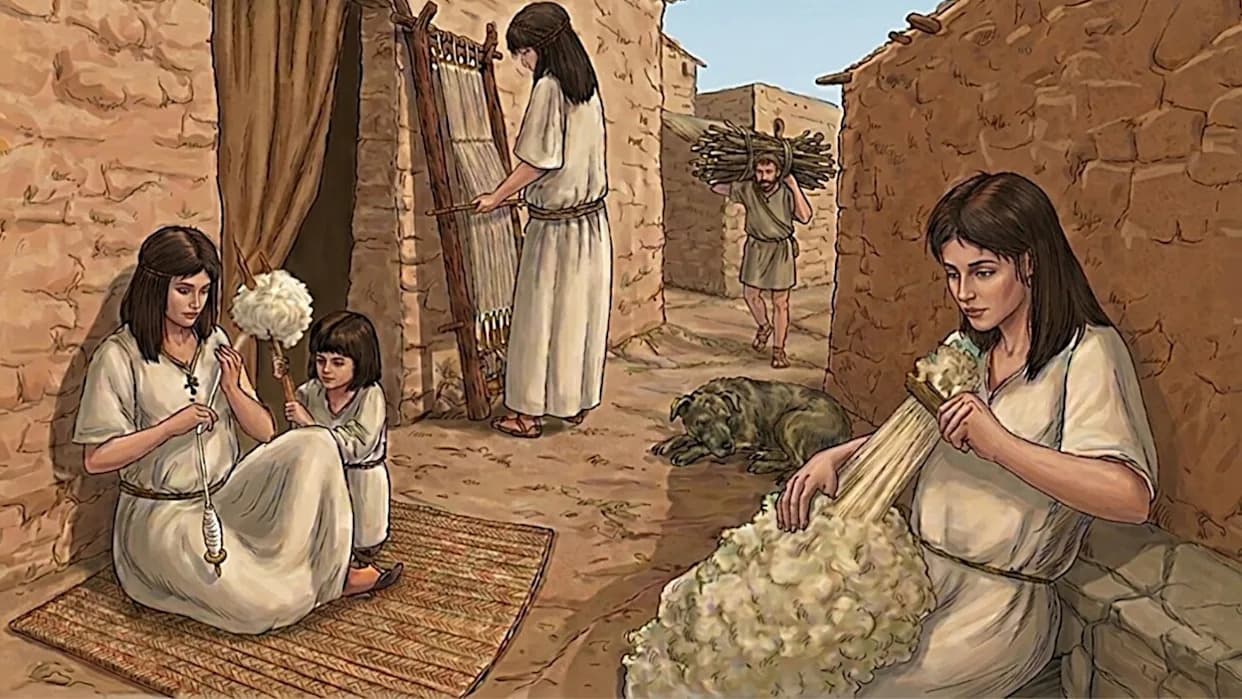
Recreation of an area of activities related to textile work as documented at Cabezo Redondo.
Clothing has kept humans warm for millennia, but the tools and techniques behind ancient textiles are only rarely preserved. Excavations at the Cabezo Redondo site in southern Spain have recovered charred timbers, plant-fiber ropes, and clay loom weights that together form one of the best-preserved warp-weighted looms from the western Mediterranean. Dated to about 3500 BCE and reported in the journal Antiquity, the find sheds new light on early textile technology and the transition to more complex fabrics.
Warp-weighted looms were widespread across prehistoric Europe and the Mediterranean. They use hanging weights—typically stone or clay—attached to the lower ends of vertical warp threads to keep the warp taut while weaving. Because loom frames and textiles were usually made of wood and plant fibers, they seldom survive. Archaeologists therefore rely on surviving loom weights and spindle whorls to infer how looms worked.
“The existence of textile production in Bronze Age south-eastern Iberia was well established, particularly through the study of loom weights and spindle whorls,” said Ricardo E. Basso Rial, an archaeologist at the University of Granada and a co-author of the study. “However, the wooden components of looms themselves are rarely preserved, which has severely limited our ability to reconstruct loom morphology, spatial organisation, and weaving practices in detail.”
At Cabezo Redondo the team found charred timbers of Aleppo pine alongside plant-fiber ropes and neatly associated clay loom weights. The researchers interpret these remains as parts of a wooden warp-weighted loom—possibly one of the oldest such wooden looms recovered in the region. Because the wooden elements and ropes were preserved in charcoal, they provide rare direct evidence of loom construction and use.
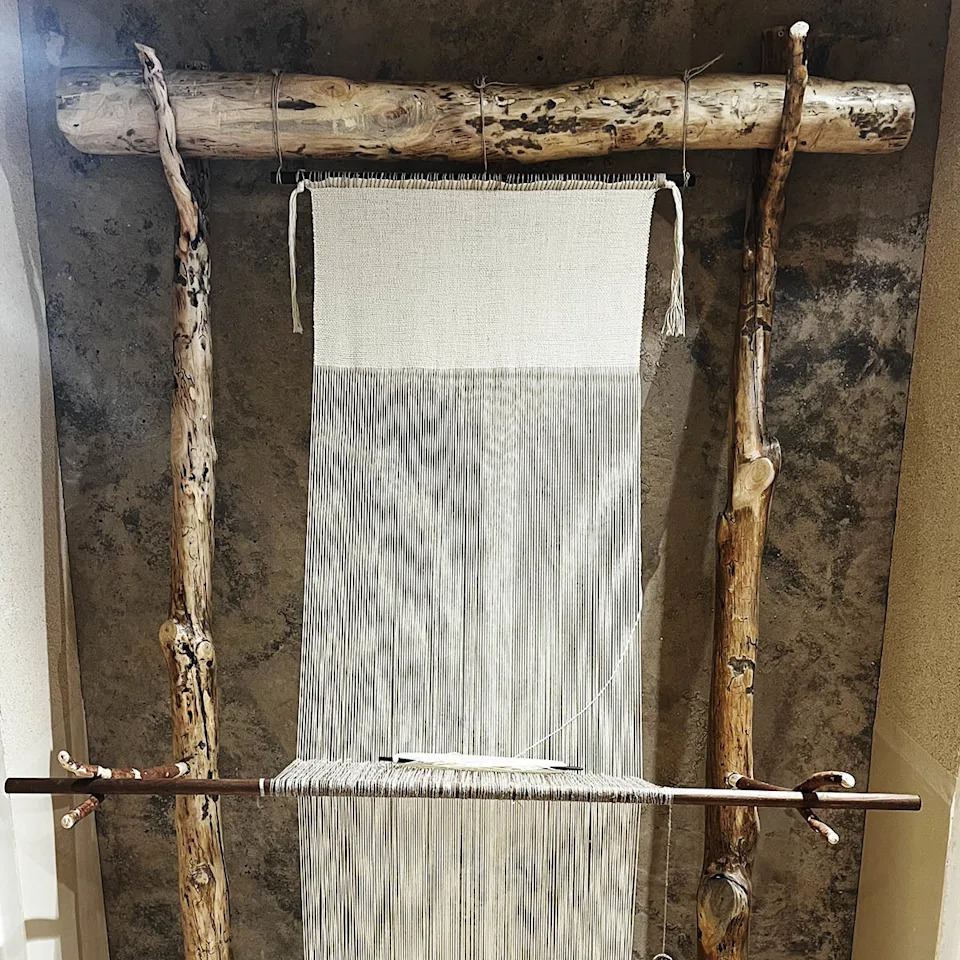
Based on wood beams recovered from under ancient rubble, archaeologists think a prehistoric loom discovered in southern Spain might have looked like this reconstruction.Image: Archaeological Museum of Alcoi
Reconstruction and Technical Implications
Analysis of the timber and the shape of the clay weights allowed a partial reconstruction of the loom. The timber pieces fit the expected form of warp-weighted loom frames, while the distinctive geometry of the weights suggests they could support a wider range of fabric densities than more basic weight types. The authors propose that this loom was capable of producing open tabby fabrics and may have supported denser, more technically complex weaves, possibly including early twill patterns.
“The characteristics of the loom weights suggest that this loom was capable not only of producing open tabby fabrics, but also potentially denser and more technically complex textiles, probably including early twill weaves,” Basso Rial said. “This represents a notable advance in our understanding of Bronze Age textile technology in Iberia.”
It is important to note a chronological nuance: the 3500 BCE date places the loom in the late Neolithic/Chalcolithic horizon in Iberia, predating the region's main Bronze Age by many centuries. If the loom did support twill-like textiles or finer yarns, it would push back aspects of textile complexity and the later shift toward widespread wool use, which became more common by around 1000 BCE.
Why This Matters
The Cabezo Redondo loom offers a rare, near-complete snapshot of everyday craft technology "frozen" at the moment of destruction. Direct evidence of wooden loom parts and associated weights allows researchers to move beyond inference from isolated weights and to reconstruct weaving practices, spatial arrangements in craft spaces, and potential changes in fiber and weave technologies. These insights contribute to a richer understanding of how prehistoric communities made, used, and diversified textiles—an essential element of social, economic, and cultural life.
Publication: The discovery and its analysis are detailed in Antiquity. The research team includes Ricardo E. Basso Rial of the University of Granada and collaborators who specialise in archaeobotany, woodworking, and textile archaeology.
Help us improve.