Rice University researchers developed magnetoARPES, which combines a small tunable magnetic field with ARPES while preserving momentum resolution. Applied to a cesium–vanadium–antimony kagome crystal (CsV3Sb5), the method revealed momentum-space signatures consistent with loop currents and time-reversal symmetry breaking linked to a charge density wave that precedes superconductivity near 3 K. The observed effects cannot be explained by ordinary Zeeman shifts because the applied fields were far too weak, implying an intrinsic origin. MagnetoARPES creates a new experimental pathway to probe symmetry breaking and magnetic responses across unconventional superconductors and other quantum materials.
Inside the Quantum Loop: Magneto-ARPES Reveals Time-Reversal Symmetry Breaking in a Kagome Superconductor
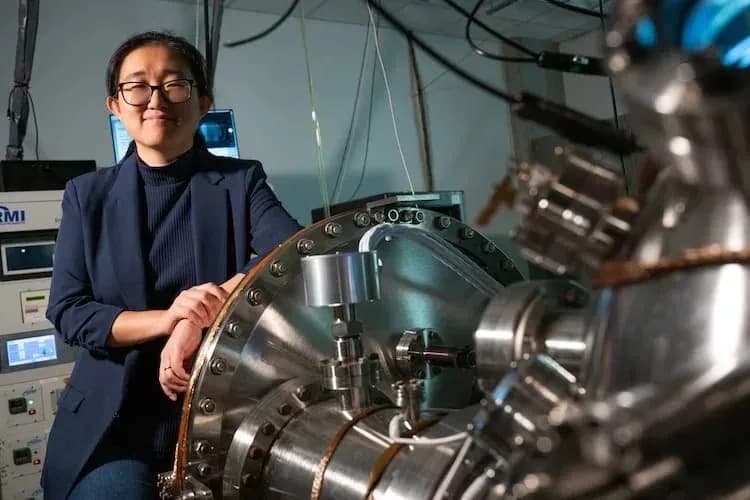
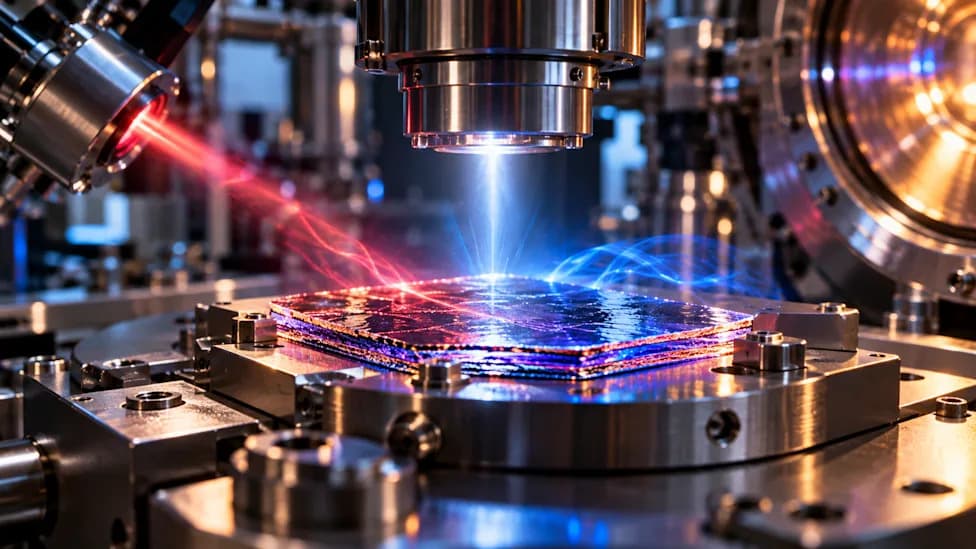
Rice University researchers developed magnetoARPES to directly observe time-reversal symmetry breaking in a kagome superconductor, offering new insight into unconventional superconductivity. (CREDIT: Rice University)
Superconductors remain among physics’ most intriguing materials: they conduct electricity with zero resistance, but only under specific conditions scientists are still trying to fully explain. In the subset known as unconventional superconductors, standard theoretical accounts often fail and the microscopic mechanisms behind superconductivity remain contested.
Researchers at Rice University have developed a powerful new experimental capability—magnetoARPES—that adds a small, tunable magnetic field to angle-resolved photoemission spectroscopy (ARPES) while preserving momentum-resolved information. Applying this tool to a cesium–vanadium–antimony kagome crystal (CsV3Sb5) produced the first direct momentum-space signatures consistent with loop-current states and time-reversal symmetry breaking tied to a charge density wave that precedes superconductivity.
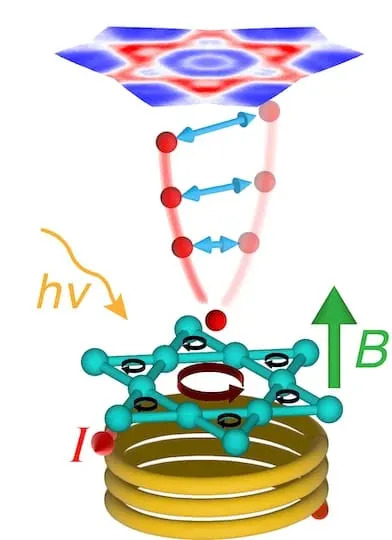
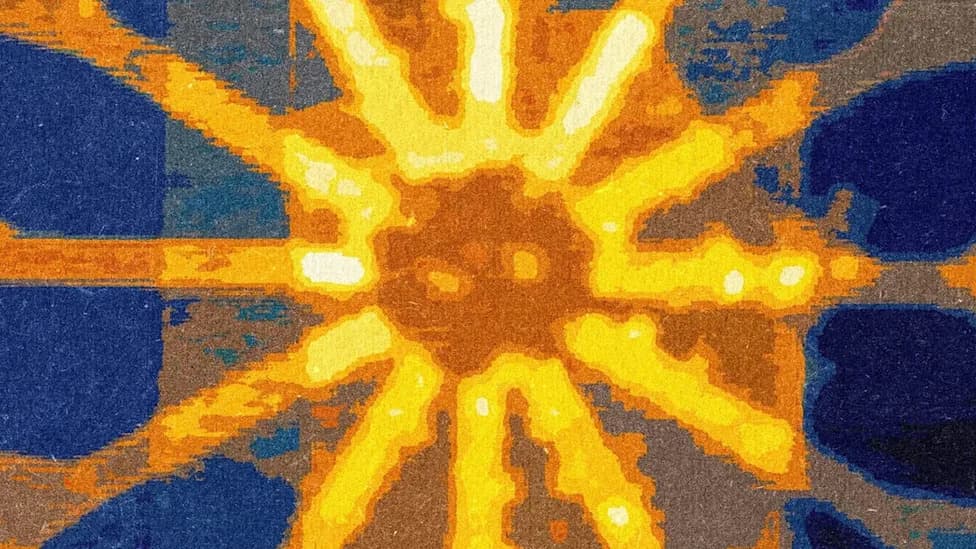
Magneto-ARPES allows for the alignment of electrons. (CREDIT: Rice University)
What Magneto-ARPES Does
ARPES maps how electrons move inside solids by shining photons on a sample and measuring the energies and exit angles of ejected electrons. Those angles encode the electrons’ momenta, making ARPES one of the most powerful probes of electronic structure in quantum materials.
Magnetic fields are a central probe in condensed matter physics: they can align spins, reveal hidden orders, and discriminate competing phases. Historically, however, applying a magnetic field during ARPES was considered impractical because the field deflects ejected electrons and scrambles momentum information.
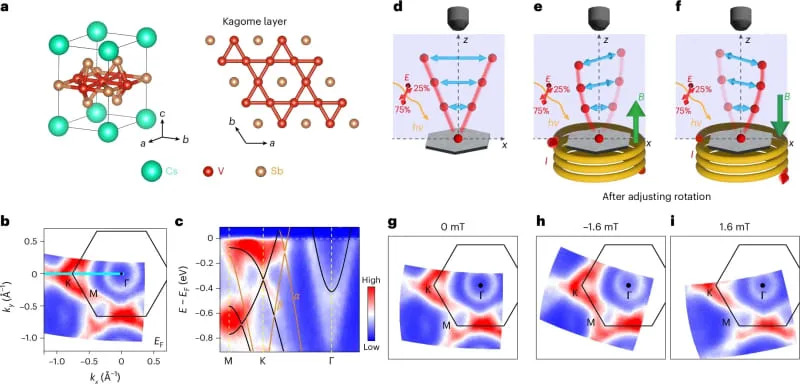
Magneto-ARPES experimental set-up and the measured electronic structure of CsV3Sb5. (CREDIT: Nature Physics)
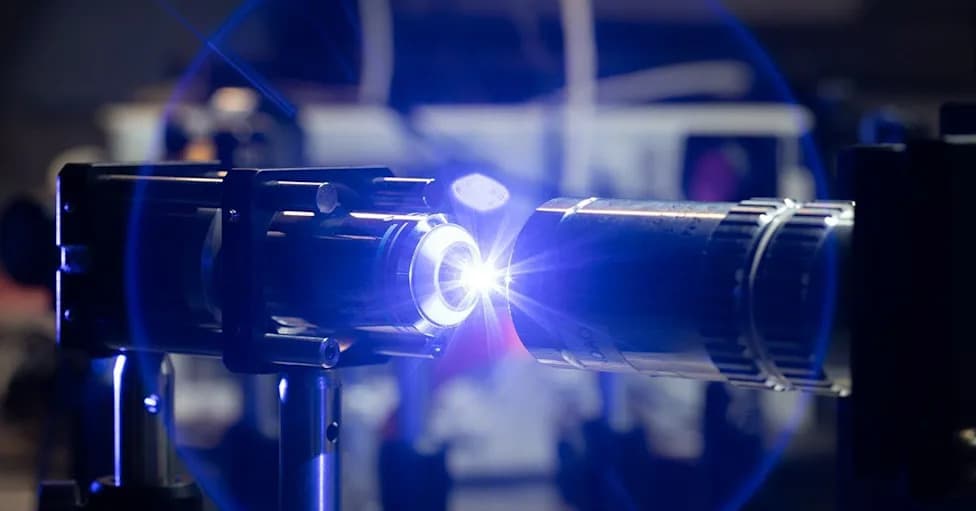
Yi and Huang at Rice overcame this limitation by using a carefully controlled, low-strength coil field applied at the sample. At these low fields the extrinsic deflection of ejected electrons is predictable and correctable, allowing momentum-resolved spectra to be recovered while the sample experiences a tunable magnetic environment.
“This project started as a small exploratory exercise,” said Ming Yi, associate professor of physics and astronomy and corresponding author. “A series of simulations and tests showed that a small tunable magnetic field, generated by a coil, could allow momentum-resolved electronic spectral information to be largely retained.”
Probing a Contested Kagome Material
The team applied magnetoARPES to a kagome-structured material—a lattice pattern named after a Japanese basket-weave motif that produces flat bands and unusual electronic features that amplify interactions. The sample they studied becomes superconducting below roughly 3 K and first undergoes a charge density wave (CDW) transition, where electrons form a periodic pattern.

Jianwei Huang
Prior experiments (including muon spin and scanning tunneling work) hinted that the CDW phase in this material may break time-reversal symmetry. One proposed microscopic mechanism is loop currents: electrons circulating in tiny closed loops with neighboring loops flowing in opposite directions, producing an internal magnetic texture.
Momentum-Space Evidence For Symmetry Breaking
Using magnetoARPES the Rice team observed that in zero external field the vanadium-derived electronic bands exhibited the sixfold rotational symmetry expected from the kagome lattice. Introducing a small magnetic field broke that symmetry: specific branches of the spectrum broadened and dimmed while others remained sharp, and this pattern reversed when the field direction was flipped. This odd-in-field response is a hallmark of time-reversal symmetry breaking.

Ming Yi
Antimony-derived bands behaved differently: they became elliptically distorted by the applied field, and that ellipticity persisted even above the CDW transition temperature. The distinct responses indicate that vanadium- and antimony-derived electronic states are governed by related but not identical physics—something previously difficult to resolve experimentally.
Both effects tracked the CDW transition with temperature, supporting the conclusion that the observed symmetry breaking is intrinsic to the ordered phase rather than an unrelated artefact.
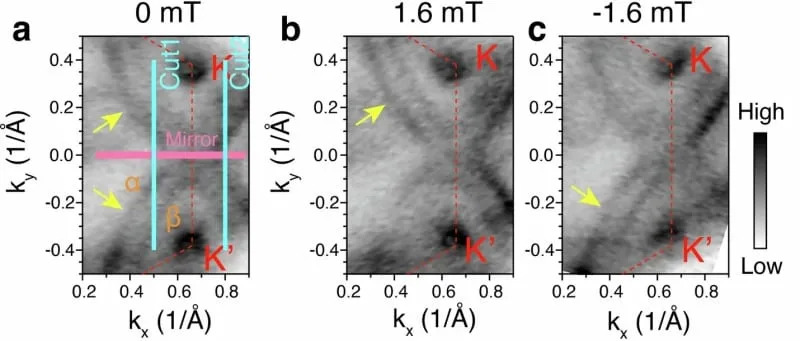
Electronic response of CsV3Sb5 around the K point under a magnetic field. (CREDIT: Nature Physics)
Crucially, the researchers showed the applied fields were about five orders of magnitude too weak to produce the observed changes via the ordinary Zeeman interaction. That rules out a trivial field-induced explanation and implies the response reflects an internal property of the material that a tiny external field can align and amplify.
Broader Implications
By delivering momentum-resolved magnetic response, magnetoARPES opens a new experimental axis for studying unconventional superconductors and other quantum materials where electronic structure and magnetic order are intertwined. The method can help discriminate competing theories about how charge order, symmetry breaking, and electron pairing relate—insights that are relevant to the long-term goal of designing materials that superconduct at higher temperatures.
Beyond kagome systems, magnetoARPES should be valuable for topological materials, magnetic metals, and any system where a controlled magnetic perturbation can reveal hidden electronic textures. The technique is already inspiring independent development across the community.
Publication: The team’s results are published online in Nature Physics.
Help us improve.