LeMaMa is a compact, paper-thin levitated magnetometer that detects magnetic fields down to the femtotesla (10−15 T) level while operating at room temperature. The 0.4 mm sensing magnet floats stably thanks to an opposing levitating magnet and diamagnetic materials beneath it, removing the need for cryogenic cooling or heavy magnetic shielding. In lab tests LeMaMa registered femtotesla fluctuations despite Earth's much stronger field and has already improved sensitivity in axion dark-matter searches within a specific mass range. Its small size and sensitivity point to applications in brain research, geological mapping, and mineral exploration.
Paper-Thin Levitated Magnet Picks Up Faint Magnetic Signals — A New Tool for Dark-Matter Searches and Brain Mapping
Balancing an egg: How scientists built a floating magnet to hunt dark matter
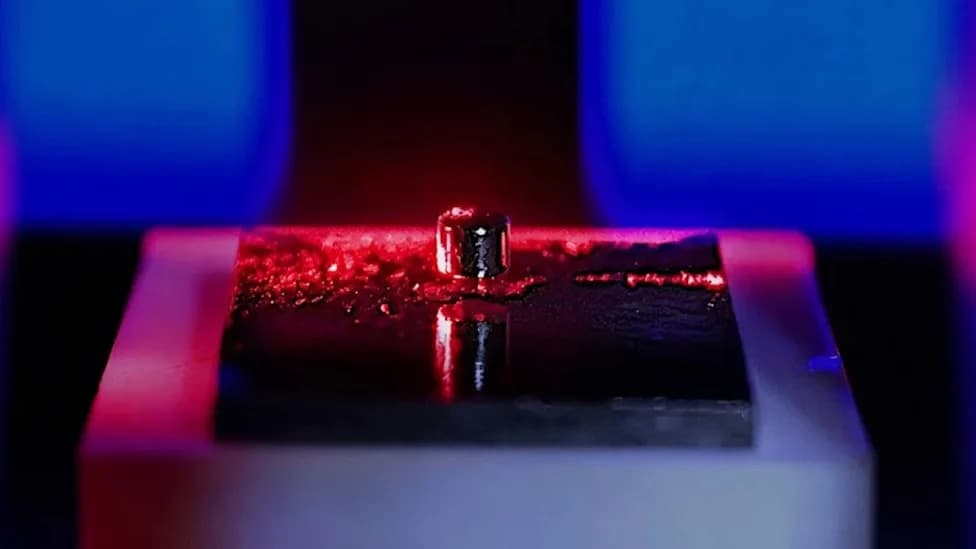
A magnet no thicker than a few sheets of paper now hovers in mid-air with almost no friction and can register magnetic signals a billion times weaker than Earth's field. The instrument, called the Levitated Magnet Magnetometer (LeMaMa), was developed by researchers at Peking University in collaboration with Johannes Gutenberg University Mainz. The team published their results in Science on August 6.
How LeMaMa Works
At the heart of LeMaMa is a sensing magnet just 0.4 millimetres thick (about 400 micrometres). A second, opposing magnet placed above the sensing element supplies an upward force that counters gravity; by itself, a single magnet cannot stably support the thin sensing element. To stabilize the system the researchers placed engineered diamagnetic materials beneath the sensing magnet. These materials repel the magnet slightly and act like an invisible palm, providing passive support from below.
With both the levitating magnet above and the diamagnetic support below, the sensing element floats stably in mid-air and behaves like a compass needle without a pivot. External magnetic fields nudge the levitated needle; tracking those tiny angular deflections lets the team infer ambient magnetic-field strengths and variations.
Sensitivity and Design Advantages
LeMaMa reaches magnetic sensitivity in the femtotesla range (1 femtotesla = 10−15 tesla), a quadrillionth of a tesla. Achieving this required minimising environmental noise: the sensing magnet sits inside a vacuum chamber roughly the size of a lunchbox, and the entire apparatus rests on a vibration-isolation stage.
This approach avoids two major constraints of existing ultra-sensitive magnetometers. Superconducting quantum interference devices (SQUIDs) match or exceed this sensitivity but require cryogenic cooling with bulky liquid helium systems. Spin-exchange relaxation-free (SERF) atomic magnetometers reach similar performance but need heated atomic vapor and heavy magnetic shielding, forcing measurements into dedicated shielded rooms. LeMaMa operates at room temperature, requires no bulky magnetic shielding, and is compact enough to be used outside specialized labs.
Applications and Early Results
In laboratory tests the team detected femtotesla-level magnetic fluctuations even against Earth's much stronger magnetic field. According to the researchers, LeMaMa has already been applied to searches for axion dark matter, improving sensitivity by multiple orders of magnitude within a specific mass window compared with earlier experiments.
Because the core sensor measures only a few hundred micrometres across, LeMaMa combines high sensitivity with genuine compactness. Potential applications include measuring neural magnetic signals for brain research and neurological diagnostics, high-precision magnetic mapping for geophysical surveys, and mineral prospecting.
Note: While LeMaMa shows promising lab results and improved sensitivity for a targeted axion mass range, broader deployment and real-world testing will be needed to confirm its practical performance across varied applications.
Help us improve.