This study of 15 bilingual mother‑child pairs found that interbrain synchrony during play increased when pairs interacted together, regardless of whether they spoke their native language or English. Researchers recorded activity with fNIRS caps in the prefrontal cortex and temporoparietal junction and observed the strongest synchrony in the prefrontal cortex. The findings suggest that differences in language acquisition timing do not prevent neural alignment, and that bilingualism can support healthy communication and bonding.
Brain Bonding Survives Language Barriers: Mothers And Children Synchronize Even In Non‑Native Speech

(OR Images/DigitalVision/Getty Images)
A recent study finds that mothers and their children show synchronized brain activity while playing together — and this neural alignment persists even when they use a non‑native language. The research, led by neurologists at the University of Nottingham and published in Frontiers in Cognition, suggests that the brain-to-brain connection that supports social bonding and coordinated behavior is robust to language differences.
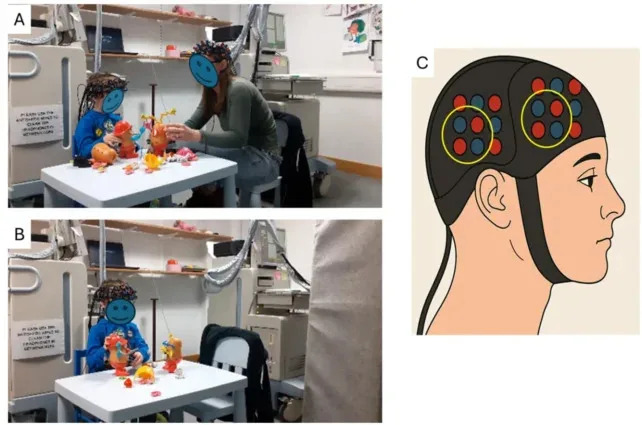
The play conditions (A and B), and the fNIRScap (C). (Papoutselou et al.,Front. Cognit., 2026.)
How the Study Was Done
The researchers recruited 15 bilingual mother-child pairs and observed them in a controlled lab setting across three conditions: (1) playing together while speaking their shared native language, (2) playing together speaking only English (their non‑native language), and (3) playing independently and silently with a screen separating them. During each condition both mothers and children wore fNIRS (functional near‑infrared spectroscopy) caps that recorded neural activity in two regions linked to social interaction: the prefrontal cortex and the temporoparietal junction.

Subscribe to ScienceAlert's free fact-checked newsletter
Key Findings
The fNIRS data showed a clear increase in interbrain synchrony when mother-child pairs played together compared with when they played apart. Crucially, the boost in synchrony occurred regardless of whether pairs used their native language or English. Synchrony was strongest in the prefrontal cortex — a region involved in executive functions, decision‑making and expressive behavior — and weaker in the temporoparietal junction, which supports social cognition, language processing, and perspective‑taking.
'[Second‑language] speakers often report a sense of emotional distancing when using their non‑native language, which may influence how they express affection, discipline, or empathy in parent‑child interactions,' the authors note. Despite this subjective feeling, it did not prevent measurable neural alignment between parents and children.
Implications And Future Directions
These results suggest that differences in the timing of language acquisition between parents and children — for example, children becoming bilingual early while parents add a second language later — do not necessarily disrupt the neural mechanisms that support bonding and behavioral coordination. The authors recommend follow‑up studies that include families where parents have lower fluency in the non‑native language, children who learned a second language later, and comparisons with more distant social partners such as teachers or strangers. They also urge experiments designed to disentangle verbal from nonverbal contributions (eye contact, gestures, facial expression) to interbrain synchrony.
Overall, the study offers encouraging evidence that speaking a non‑native tongue does not block the neural processes that underpin parent‑child connection — in short, the brain’s capacity to bond appears resilient across languages.
Help us improve.