Hungarian researchers used EEG to compare how 20 humans and 20 companion dogs process continuous, unsegmented speech. Both species showed stronger neural synchronization to streams where consonant patterns defined word-like units — demonstrating a consonant bias in dogs for the first time. The bias appeared even in dogs raised outside speech-rich homes, suggesting simple pattern learning from exposure can produce speech-tuning neural patterns.
Dog Brains Segment Speech Like Humans — EEG Study Reveals a Consonant Bias
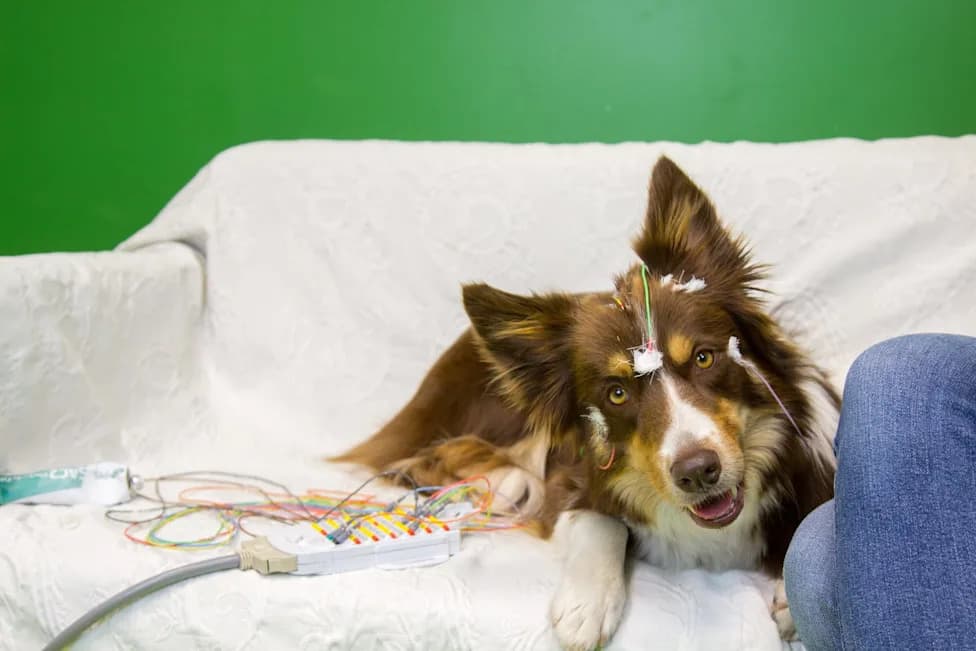
Dog brains segment speech into words in a way previously seen only in humans, a new study from Hungary finds. (Sarolta Szilágyi via SWNS)
New research from Hungary shows that dogs' brains can break continuous speech into word-like units in a way previously documented only in humans. Using noninvasive EEG, researchers found that both dogs and humans display stronger neural tracking when consonant patterns define word structure — a phenomenon known as the consonant bias.

(Photo by Leon Natan via Pexels)
Study Design and Methods
The team tested 20 human participants and 20 companion dogs. Subjects listened to continuous, unsegmented speech streams in which consonants and vowels alternated without pauses. The streams fell into three types: (1) consonant-structured streams, where recurring consonant sequences formed three-syllable word skeletons while the intervening vowels varied; (2) vowel-structured streams, where repeating vowels formed the skeletons; and (3) a control stream with no recurring patterns (random syllables).

(Photo by Roy Serafin via Pexels)
Researchers recorded brain activity using electroencephalography (EEG) and analyzed neural synchronization — the tendency of brain rhythms to entrain to the rhythms present in the sounds listeners hear. Stronger synchronization to the rhythm of the hidden ‘‘words’’ indicates that the brain has segmented the continuous stream into units.

(Photo by Dominik Gryzbon via Pexels)
Key Findings
Both species synchronized more strongly to the rhythm of words when the streams were consonant-structured than when they were vowel-structured or random. In other words, dog brains, like human brains, showed a consonant bias: they tracked word-like units more reliably when consonant patterns provided the structure.
Importantly, the effect emerged even in dogs that had spent their first three months in shelters or on the street rather than in speech-rich family homes, suggesting the bias does not depend on an early, narrowly timed critical period. Timing analyses also indicated a difference in processing resolution: humans appear to treat individual speech sounds (phonemes) as the smallest processing units, whereas dogs seem to operate with whole syllables as their basic units.
Attila Andics, Eötvös Loránd University: "Although vowels are louder and more noticeable, consonants usually form the skeleton of words. The results suggest that regular exposure to speech alone can reshape neural processing, even in species without human-like language abilities."
Implications
The findings, published in the journal Science, suggest that efficient speech tuning — specifically a consonant bias — can arise from repeated exposure and relatively simple pattern-learning mechanisms, not necessarily from a brain pre-wired for language. This expands our understanding of how neural systems can adapt to complex auditory patterns and highlights dogs as a useful comparative model for studying speech processing.
Source: Study published in Science; research led by teams at Eötvös Loránd University, Hungary.
Help us improve.