A multinational ReDLat study of 2,928 Spanish-speaking adults developed a machine-learning "speech clock" that predicts age from acoustic and linguistic features and computes a speech‑age gap (SAG). Larger SAGs were linked to older-looking brain age from combined MRI (r = 0.53), weaker but positive associations with DNA‑methylation clocks (r ≈ 0.20–0.21), poorer cognition and higher dementia diagnoses. The work is cross-sectional: it shows promising associations but cannot yet predict future dementia; longitudinal and cross-linguistic validation are needed before clinical application.
Speech Patterns Reflect Brain and Biological Aging, Large Latin American Study Finds

A speech clock links voice and language patterns with brain aging, cognition and dementia in 2,928 Latin American adults. (CREDIT: Shutterstock)
A large multinational study of 2,928 Spanish-speaking adults across five Latin American countries found that everyday speech carries measurable signals linked to brain aging, cognitive performance and molecular markers of biological age. Researchers developed a machine-learning "speech clock" that estimates a person’s age from acoustic and linguistic features and used the difference between predicted and actual age—the speech‑age gap (SAG)—to probe links with brain imaging, blood biomarkers and life-course social conditions.
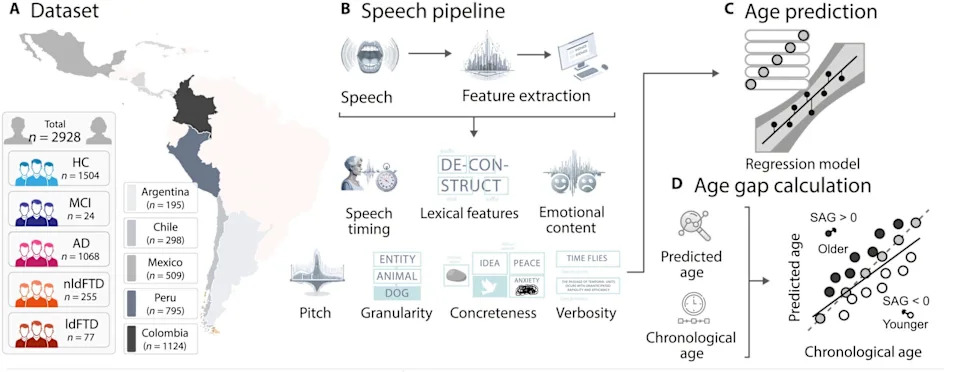
Researchers analyzed speech from 2,928 participants across five Latin American countries, including healthy adults and people with MCI, Alzheimer's, and frontotemporal dementia. Speech features were used to predict age, revealing whether linguistic aging appeared accelerated, delayed, or preserved. (CREDIT: Agustin Ibanez et al, Science Advances 2026)
What the Study Did
Organized by the Multi-Partner Consortium to Expand Dementia Research in Latin America (ReDLat) and published in Science Advances, the study pooled standardized speech recordings and clinical data from participants in Argentina, Chile, Colombia, Mexico and Peru. The cohort included 1,504 cognitively healthy adults and 1,424 people with clinical diagnoses (24 with mild cognitive impairment, 1,068 with Alzheimer’s disease and 332 with frontotemporal dementia syndromes).
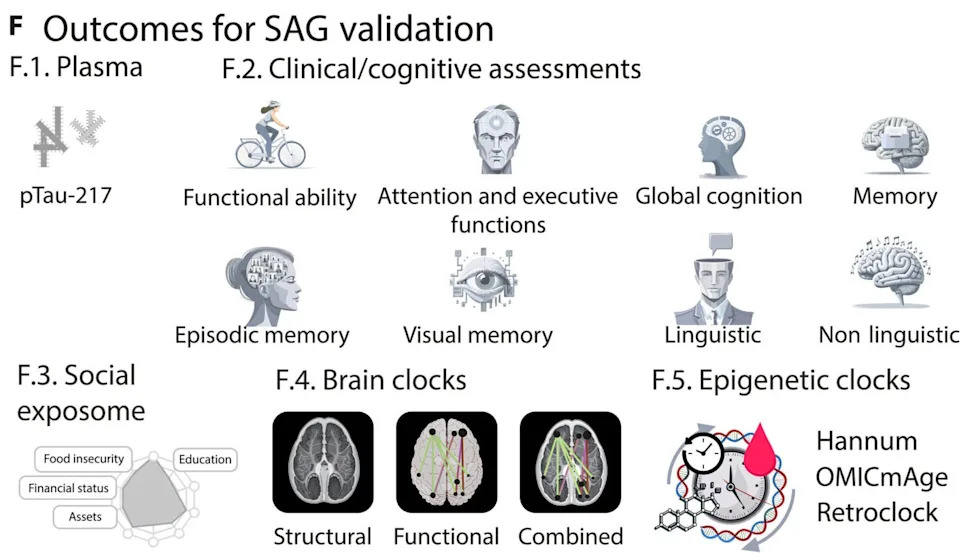
Associations between SAGs and independent, well-established clocks and biomarkers were examined. (CREDIT: Agustin Ibanez et al, Science Advances 2026)
How the Speech Clock Worked
The team trained models on hundreds of acoustic and linguistic features—speaking rate, pause patterns, pitch, emotional tone, vocabulary diversity, semantic precision and total verbal output—to predict chronological age. One composite model explained 44% of the variance in chronological age and had a mean absolute error of 9.04 years, indicating that the tool captures population-level aging signals but is not precise for exact individual age estimation.
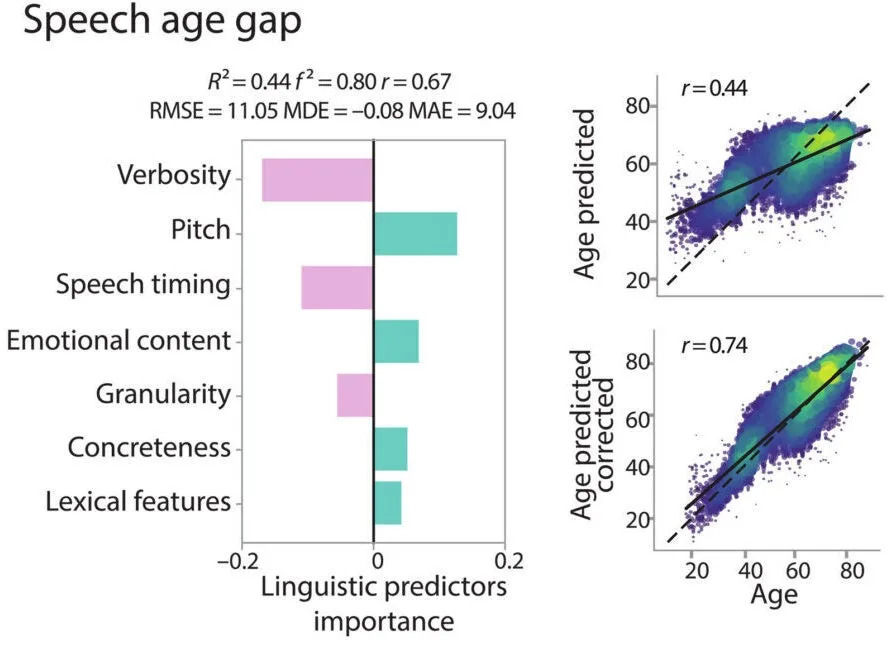
SAG performance and feature importance across speech domains. Verbosity, timing, and granularity indexed delayed/preserved aging, whereas pitch, emotion, and concreteness mainly indexed accelerated aging. (CREDIT: Agustin Ibanez et al, Science Advances 2026)
Key Findings
Researchers computed each person’s speech‑age gap (SAG) by subtracting actual age from model-predicted age: positive values indicate relatively older-appearing speech; negative values indicate relatively younger-appearing speech.
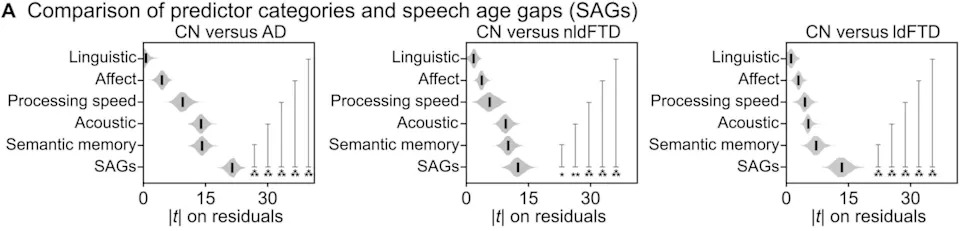
Comparing predictor categories and SAGs across diagnostic contrasts. Violin plots depict the bootstrap distributions (n = 1000) of absolute t statistics (|t|) derived from group comparisons on demographically adjusted residuals (age, sex, and education) for each predictor category. (CREDIT: Agustin Ibanez et al, Science Advances 2026)
- SAGs correlated with brain-age gaps from MRI. The combined structural+functional MRI measure correlated r = 0.53 with SAG; structural MRI alone correlated r = 0.42 and functional MRI alone r = 0.49.
- SAGs showed modest positive associations with three DNA-methylation clocks (Hannum, Retroclock and OMICmAge), with correlations around r ≈ 0.20–0.21.
- Healthy participants had smaller SAGs than clinical groups. Language-dominant frontotemporal dementia showed the largest SAGs among diagnostic groups.
- Larger SAGs were linked to worse global cognition, executive function, functional ability and several memory measures. In Alzheimer’s disease, larger SAGs correlated modestly with higher blood p‑tau217 (within-group r = 0.18).
- SAGs were larger among participants with more adverse lifelong social conditions (a composite "social exposome" of education, finances, food insecurity, healthcare access and early-life factors), though this association varied across diagnostic groups.
Interpretation and Limitations
These results suggest that multiple speech dimensions partly converge on signals of brain and biological aging, but speech recordings are not equivalent to an MRI or definitive molecular test. The study is primarily cross-sectional, so it cannot determine whether an older-appearing speech profile predicts future cognitive decline or reflects an ongoing acceleration of aging. Other limitations include variability in microphones and recording environments, possible cultural or dialect biases in automated tools, mood or medical influences on speech, missing biomarker data for some participants, and small numbers in some diagnostic subgroups (notably the 24-person MCI group).
"Our voice appears to contain much more information about aging than we previously recognised," said Agustin Ibanez, senior author. He and colleagues emphasize that speech-based tools could become an accessible complement to other assessments, but require longitudinal and cross-linguistic validation before clinical use.
Next Steps
Future work should test these methods longitudinally, expand to other languages and more natural conversational settings, and evaluate real-world robustness across recording devices and cultural contexts. Until then, the speech clock is a promising research tool that highlights how everyday speech relates to brain and molecular markers of aging.
Publication: Agustin Ibanez et al., Science Advances (2026). Data drawn from ReDLat cohorts in Argentina, Chile, Colombia, Mexico and Peru.
Help us improve.