The Republic of the Congo holds a presidential vote this weekend in which long‑time leader Denis Sassou Nguesso is widely expected to win amid tight control over institutions and a fractured opposition. The country is wealthy in oil and biodiversity but faces deep poverty, high youth unemployment and accelerating deforestation. Young challenger Melaine Deston Gavet Elengo has generated interest as a potential sign of generational change. Much of the post‑vote focus will shift to an intense succession struggle within the ruling elite.
Republic of the Congo Presidential Vote: Who’s Running, What’s at Stake — and the Succession Fight
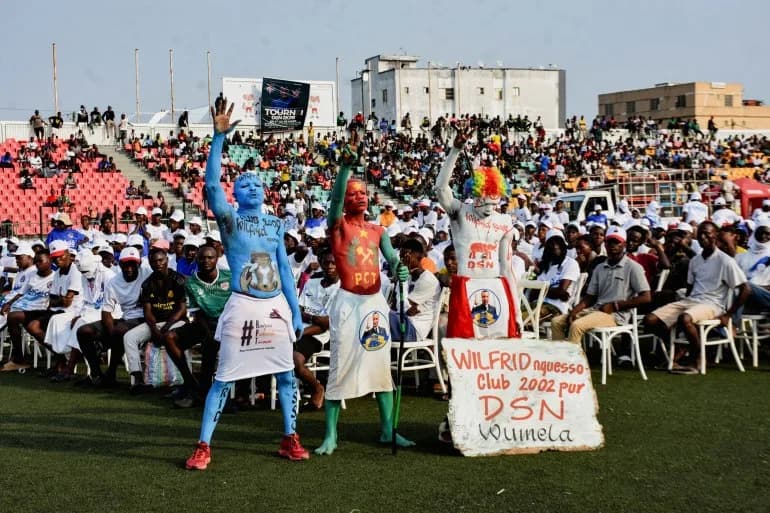
Supporters of outgoing President Denis Sassou Nguesso, who is running for re-election, take part in a campaign rally before the March 15 presidential election, in Brazzaville, Republic of Congo, March 7, 2026 [Roch Bouka/Reuters]
Voters in the Republic of the Congo head to the polls this weekend to choose a president amid wide expectations that long‑time ruler Denis Sassou Nguesso will secure re‑election. The country combines significant natural wealth — notably oil and rainforest — with entrenched political control, deep poverty and growing environmental pressures.
Key Context
Political climate: Denis Sassou Nguesso has dominated Congolese politics for decades and is widely seen as the likely winner. Civil liberties are severely constrained: Freedom House assigns the country a score of 17/100. Critics say the electoral framework, the judiciary and the national electoral commission (CENI) operate under strong presidential influence.
Economy and environment: The Republic of the Congo is Africa’s third‑largest oil exporter, producing roughly 236,000–252,000 barrels per day. Oil accounts for more than 80% of export revenue, leaving the economy vulnerable to price shocks. The country also contains large tracts of Congo Basin rainforest — the world’s second‑largest — but deforestation nearly doubled between 2010 and 2020 compared with the prior decade.
When and How
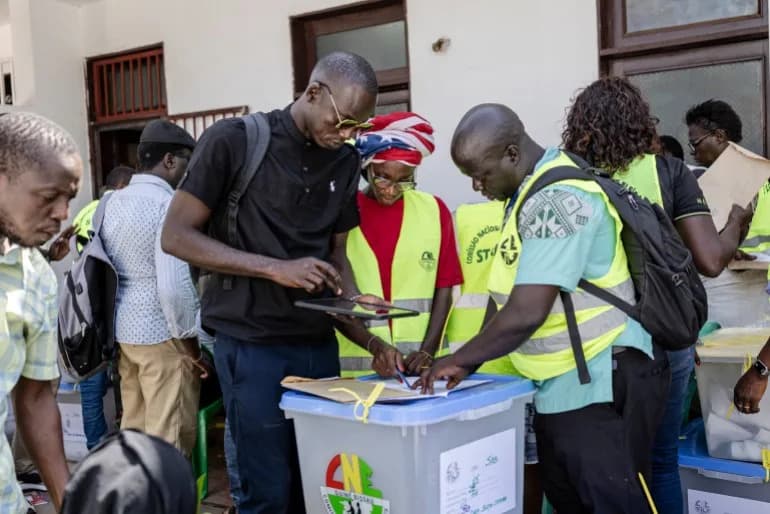
Polling stations will open on Saturday, March 15, running through the day. More than 2.6 million registered voters are eligible to cast ballots. Under current practice, a candidate who wins an absolute majority is declared president; run‑offs are rare. Presidential terms last five years; a 2015 constitutional change removed previous two‑term and age limits.
Main Candidates
Denis Sassou Nguesso (82): First president in 1979 and, after a period out of power, regained control in 1997. His rule is associated with continuity of leadership, strong state control and allegations of corruption and human rights abuses. International scrutiny of assets linked to his family has resulted in investigations and seizures in Europe.
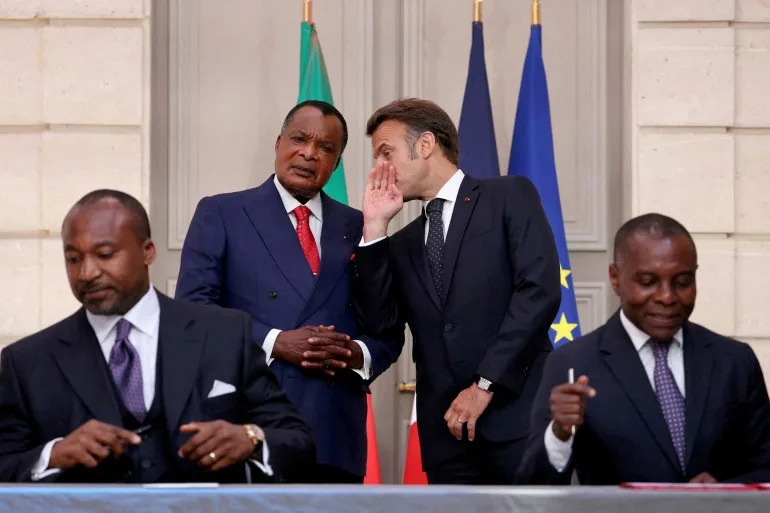
France’s President Emmanuel Macron speaks with President of Congo Denis Sassou Nguesso during the signing of a letter of intent by Denis Christel Sassou Nguesso, Congolese minister of international cooperation and promotion of partnership, and France’s Delegate Minister for Francophonie and International Partnerships Thani Mohamed Soilihi at The Elysee Presidential Palace in Paris on May 23, 2025 [File: Thomas Samson/Reuters]
Melaine Deston Gavet Elengo (35): An oil‑sector engineer and leader of the Republican Movement, Elengo is the youngest and most prominent challenger. Running on a platform of transparency, independent justice and inclusive development, he has attracted attention as a possible sign of generational change.
Joseph Kignoumbi Kia Mboungou (73): Veteran lawmaker and leader of The Chain, campaigning for economic diversification and anti‑poverty measures. His previous presidential bids attracted minimal support.
Uphrem Dave Mafoula (43): Economist and leader of New Start, advocating governance reforms, job creation and reduced inequality; he ran in 2021 as well.
Vivien Romain Manangou (43): Independent candidate and university lecturer focused on institutional reform and fiscal management.
Mabio Mavoungou Zinga (69): Former customs official running with the Alliance coalition on anti‑corruption and human‑rights themes.
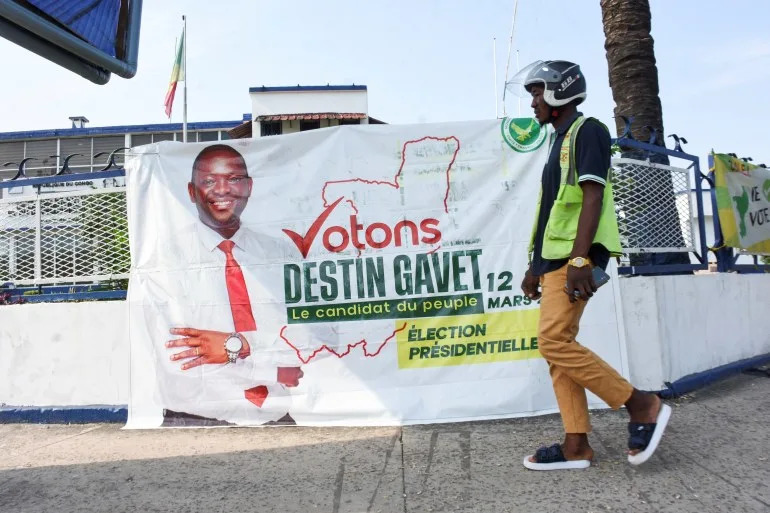
A man walks past a campaign banner of presidential candidate Destin Gavet, before the presidential election scheduled for March 15, in Brazzaville, Republic of Congo, March 11, 2026 [Roch Bouka/Reuters]
Anguios Nganguia Engambe (~60): Head of the Party for Action of the Republic, standing for a fourth time with a platform emphasising political dialogue.
Opposition, Repression and the Succession Question
Several prominent opposition figures are jailed or live in exile. Notable cases include Jean‑Marie Michel Mokoko and André Okombi Salissa, both convicted on national security charges and given long sentences. Analysts say the combination of a constrained opposition, a pliant judiciary and control over the electoral commission has helped the ruling party consolidate power.
With an expected Nguesso victory, attention has shifted to the internal succession battle. Denis‑Christel Sassou Nguesso, the president’s son and a minister, is widely seen as a frontrunner, but he faces rivals within the presidential circle, including national security chief Jean‑Dominique Okemba and minister Jean‑Jacques Bouya.
Economic and Social Challenges
Despite oil wealth, roughly half the population lives below the poverty line. Urban areas such as Brazzaville and Pointe‑Noire have better access to services, but rural communities face severe deficits in roads, electricity and healthcare. Youth make up a large share of the population — nearly half are under 18 — yet unemployment and underemployment remain high, with many degree holders unable to find formal jobs. Agriculture remains underexploited: although the country may have up to 10 million hectares of arable land, only a small share is cultivated.
The government has promoted increased hydrocarbon investment and launched liquefied natural gas (LNG) exports, but analysts warn that diversification away from oil is essential for long‑term stability.
What to Watch
Observers will monitor voter turnout, the conduct of polling and counting, any restrictions on protests or media, and post‑vote reactions from opposition groups and international partners. The outcome will also shape the discreet but consequential contest over who controls power within the presidential circle after the vote.
Help us improve.