New models show that moons orbiting rogue, starless planets could maintain surface liquid water for up to 4.3 billion years when tidal heating from an eccentric orbit is paired with a thick hydrogen atmosphere. This duration far exceeds previous CO2-atmosphere estimates of about 1.6 billion years and approaches Earthlike timescales for complex life to evolve. While direct observation is not yet possible, the result broadens the set of environments considered potentially habitable.
Rogue Moons Could Harbor Liquid Water for Billions of Years, New Study Suggests
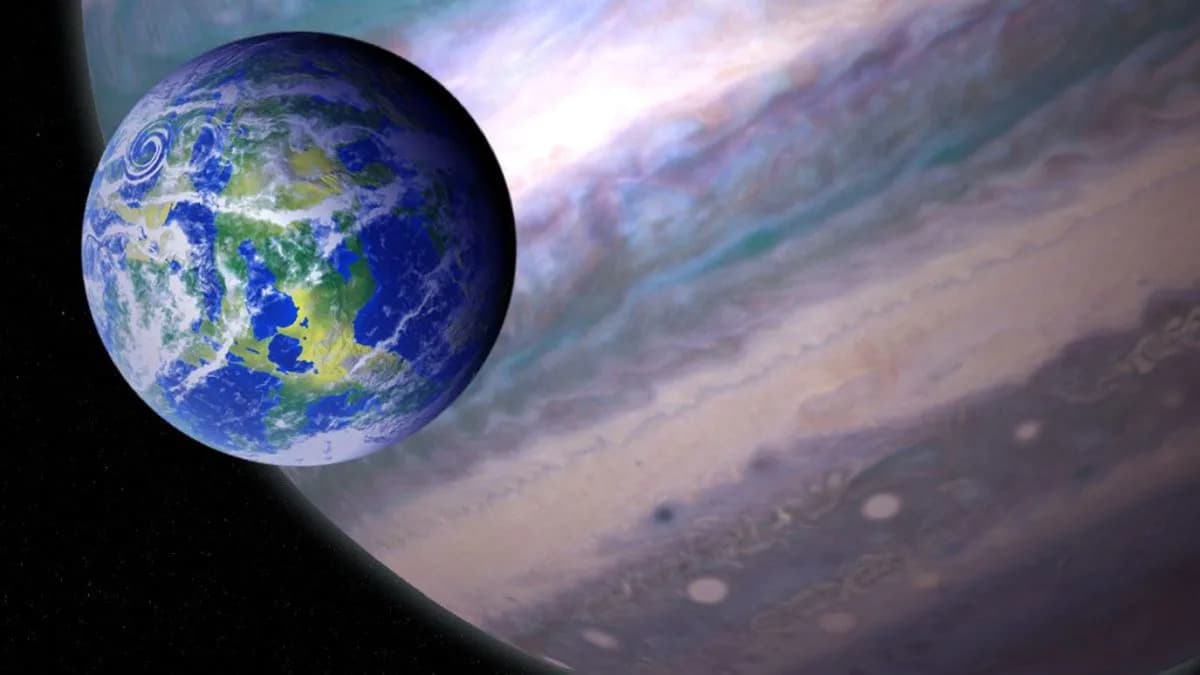
An artist's impression of a habitable exomoon. (NASA GSFC/Jay Friedlander and Britt Griswold)
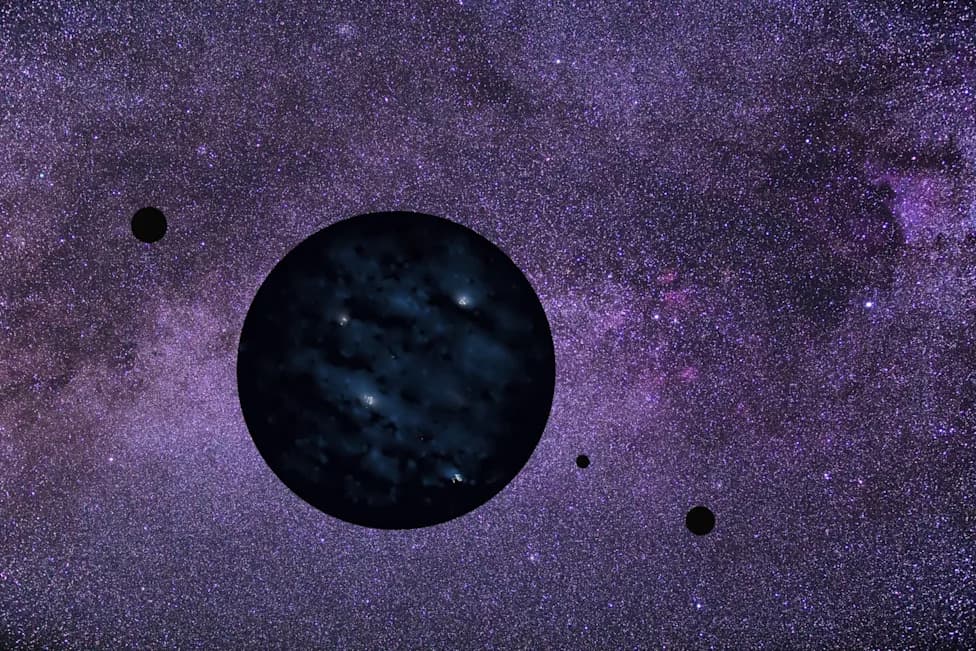
Planets flung free from their parent stars — so-called rogue planets — may still host moons that can support liquid water for extraordinarily long periods, according to new modeling by a team led by astrophysicist David Dahlbüdding of the Max Planck Institute for Extraterrestrial Physics. The study shows that a combination of sustained tidal heating and a thick hydrogen atmosphere can keep an exomoon warm enough for surface liquid water for up to 4.3 billion years in some scenarios.
How It Works
When a planet is ejected from its star system, any surviving moon can be left in an eccentric (oval) orbit. That varying distance produces changing gravitational forces that flex the moon's interior, generating internal heat through tidal dissipation. By itself, tidal heating raises internal temperatures but is inefficient at keeping a surface warm unless the heat is trapped.
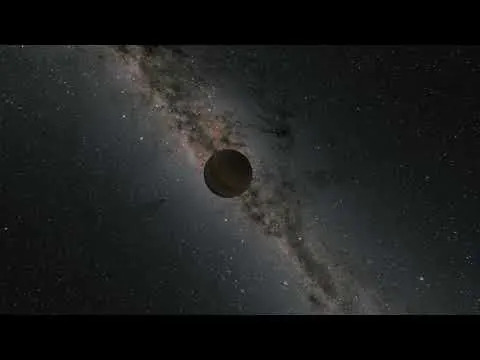
YouTube Thumbnail
Previous models considered carbon dioxide atmospheres as the insulating layer, but CO2 tends to condense and become inefficient in the very low temperatures expected far from stars. A 2023 study estimated that a CO2-dominated atmosphere could sustain liquid water for roughly 1.6 billion years — possibly long enough for simple life to start but likely too short for complex, multicellular life to evolve.
Why Hydrogen Helps
Molecular hydrogen remains gaseous at much lower temperatures than CO2. Under high pressures a hydrogen-rich atmosphere can absorb and trap thermal radiation through collision-induced absorption, effectively acting as a long-lived blanket. When the team combined realistic tidal heating from an eccentric orbit with a dense hydrogen envelope in their models, surface temperatures compatible with liquid water persisted for as long as 4.3 billion years in some cases.

Subscribe to ScienceAlert's free fact-checked newsletter
Implications and Limits
That timespan is comparable to the age of Earth and could, in principle, allow for the emergence and long-term evolution of complex life — though many other factors would also need to be favorable (chemical composition, energy sources, stability of conditions, etc.). The work expands the range of environments considered potentially habitable by showing that a nearby star is not an absolute requirement for long-lived liquid water.
Rogue planets are difficult to detect, but some estimates suggest they could be numerous; a 2023 estimate placed the population at about 17 to 21 rogue planets per star, implying potentially trillions across the galaxy. A 2025 study indicates that larger rogue planets can form or retain moon systems, and computer models show moons can sometimes remain bound after ejection.
Observational Outlook: Detecting and probing atmospheres of exomoons orbiting rogue planets is beyond current capabilities. The authors note that future theoretical work should explore more complex atmospheric compositions and dynamical histories to test the robustness of their results.
The findings are published in the Monthly Notices of the Royal Astronomical Society.
Help us improve.