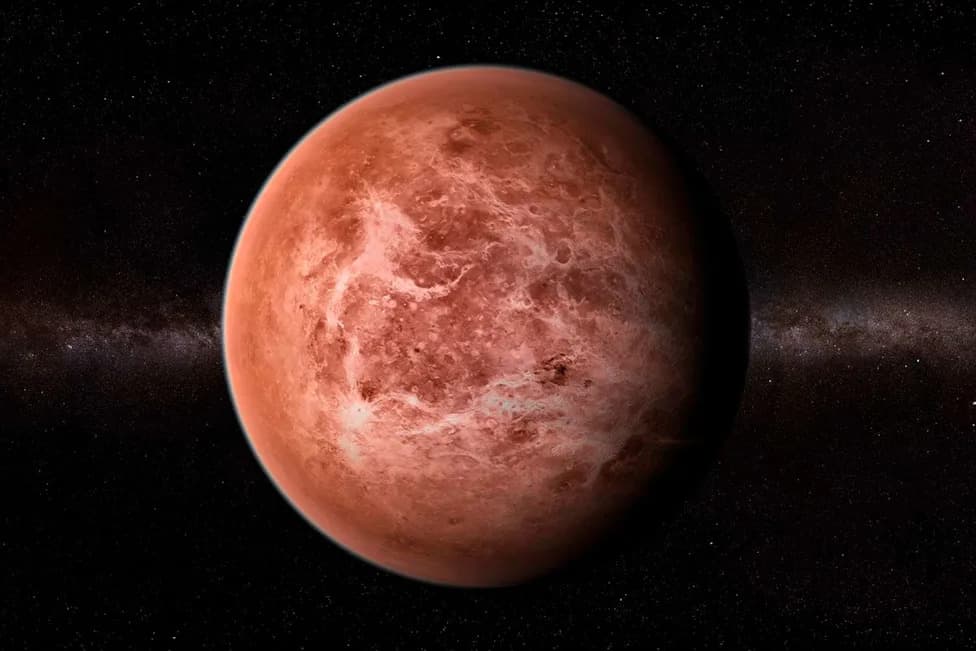
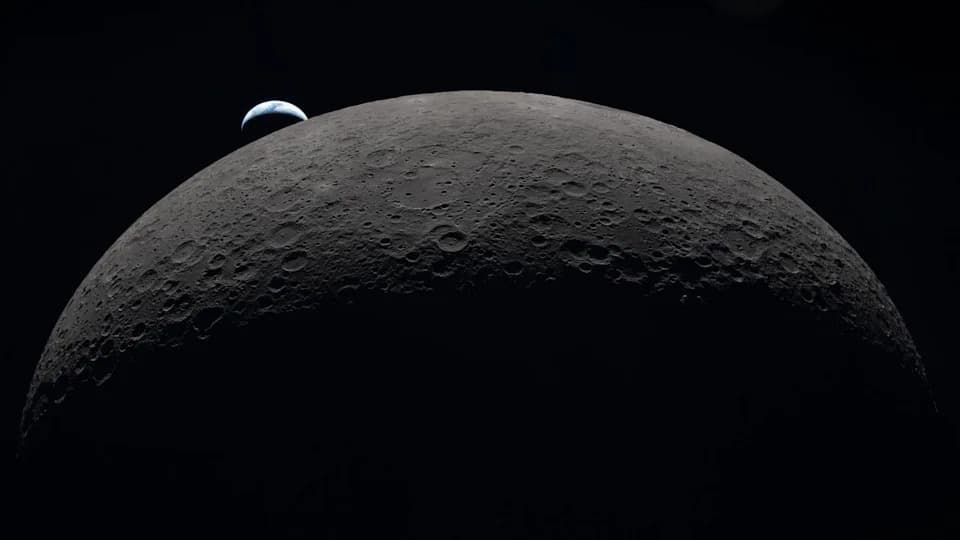
New models show an impact‑formed moon could have orbited early Venus for millions to billions of years before tidal interactions reversed its outward migration and forced it inward. The outcome depends on Venus's initial spin (5–100 hr), moon mass (0.01–10 M_Moon), orbital eccentricity and the planet's tidal dissipation. Two simplified tidal prescriptions (constant‑Q and constant‑time‑lag) produce different fates, so Venus's lack of a moon today does not rule out a vanished satellite. NASA's DAVINCI mission may one day find indirect chemical clues.
Tidal Forces Could Have Doomed an Ancient Moon Around Venus
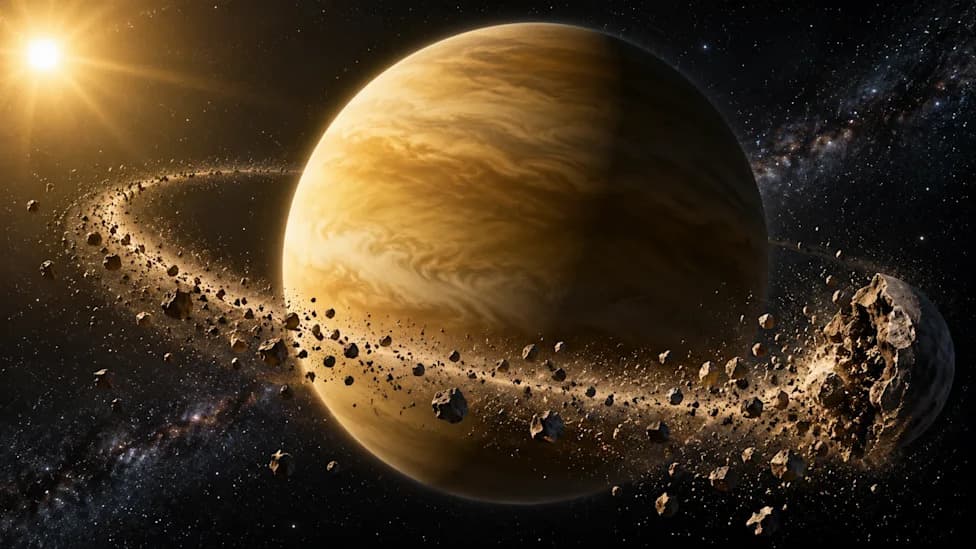
Models show a hypothetical ancient Venusian moon could reverse its orbit, break apart and disappear through tidal evolution. (CREDIT: Shutterstock)
Although Venus has no moon today, new theoretical work shows that an impact‑born satellite could have formed and orbited the planet for millions to billions of years before tidal interactions reversed its outward migration and sent it plunging inward.
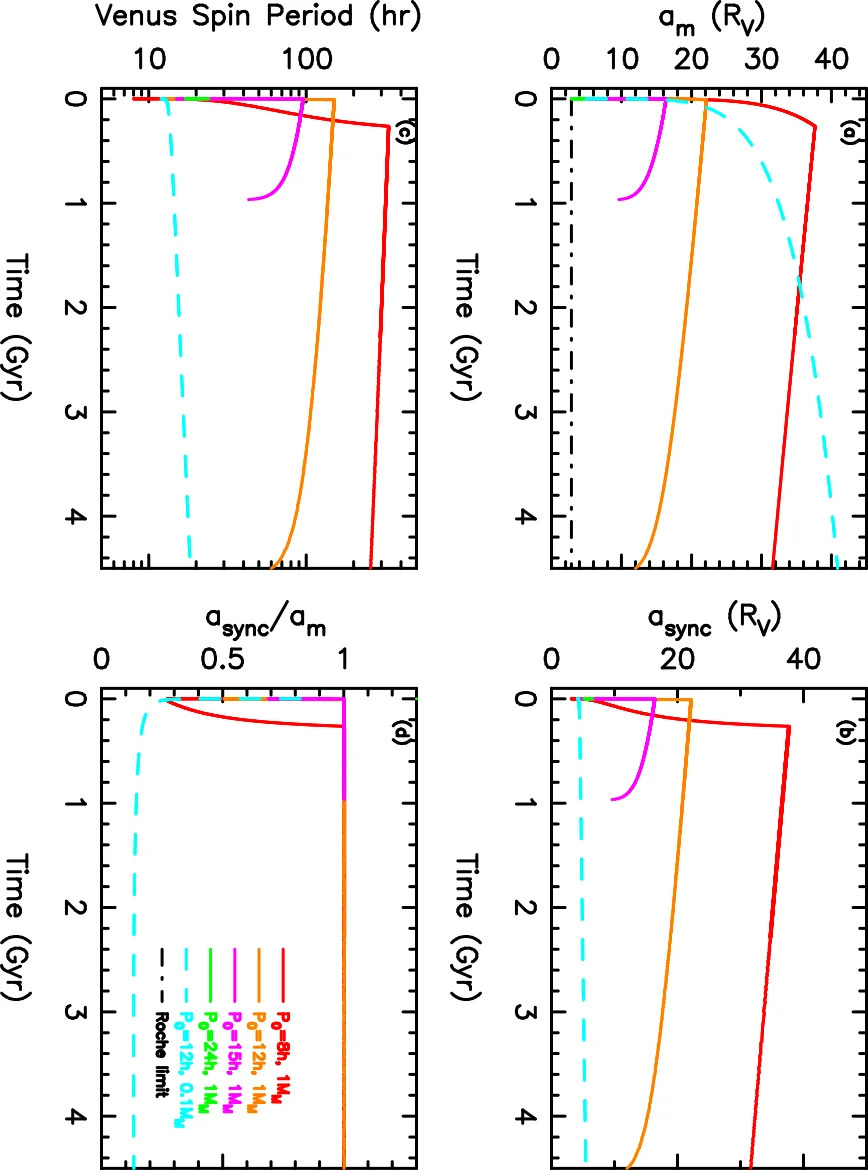
Tidal evolution of a hypothetical Venus moon in the constant-Q model (Q_V = 50, a_m,0 = 5 R_V). (CREDIT: Stephen R. Kane et al, arXiv)
What the Study Examined
Led by Stephen Kane (University of California, Riverside) with Franck Selsis, Jeremy Leconte and Sean Raymond, the team explored whether an impact‑generated moon could plausibly form around early Venus and then be removed by ordinary tidal evolution. Their paper, accepted for posting on arXiv, does not claim a moon actually existed; rather, it maps possible fates across a broad range of initial conditions.
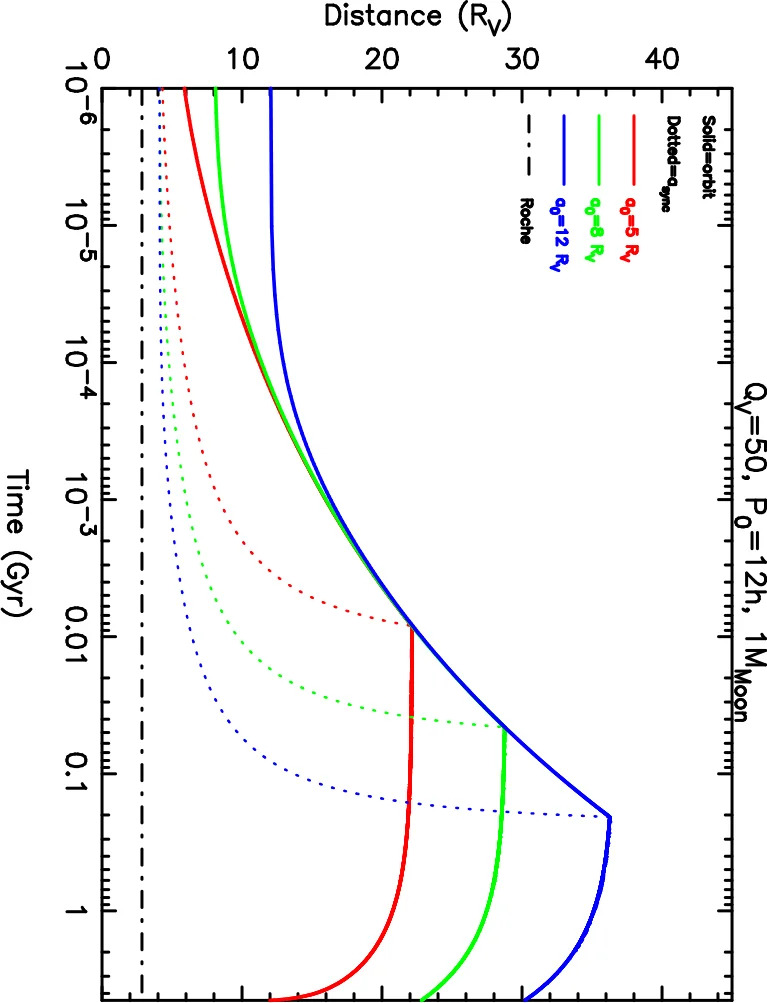
Dependence of the tidal evolution on the initial semi-major axis (Q_V = 50, P₀ = 12 hr, Mₘ = 1 M_Moon). Solid lines show the moon's orbital distance and dotted lines show the corresponding synchronous radius for aₘ,₀ = 5 (red), 8 (green), and 12 R_V (blue). (CREDIT: Stephen R. Kane et al, arXiv)
How Planetary Tides Move Moons
On Earth, the planet spins faster than the Moon orbits. The resulting tidal bulge transfers rotational angular momentum to the Moon, slowing Earth's rotation and driving the Moon outward. A similar process could have acted on an early, faster‑spinning Venus — but the evolving exchange of angular momentum between planet and satellite can produce more complex outcomes.
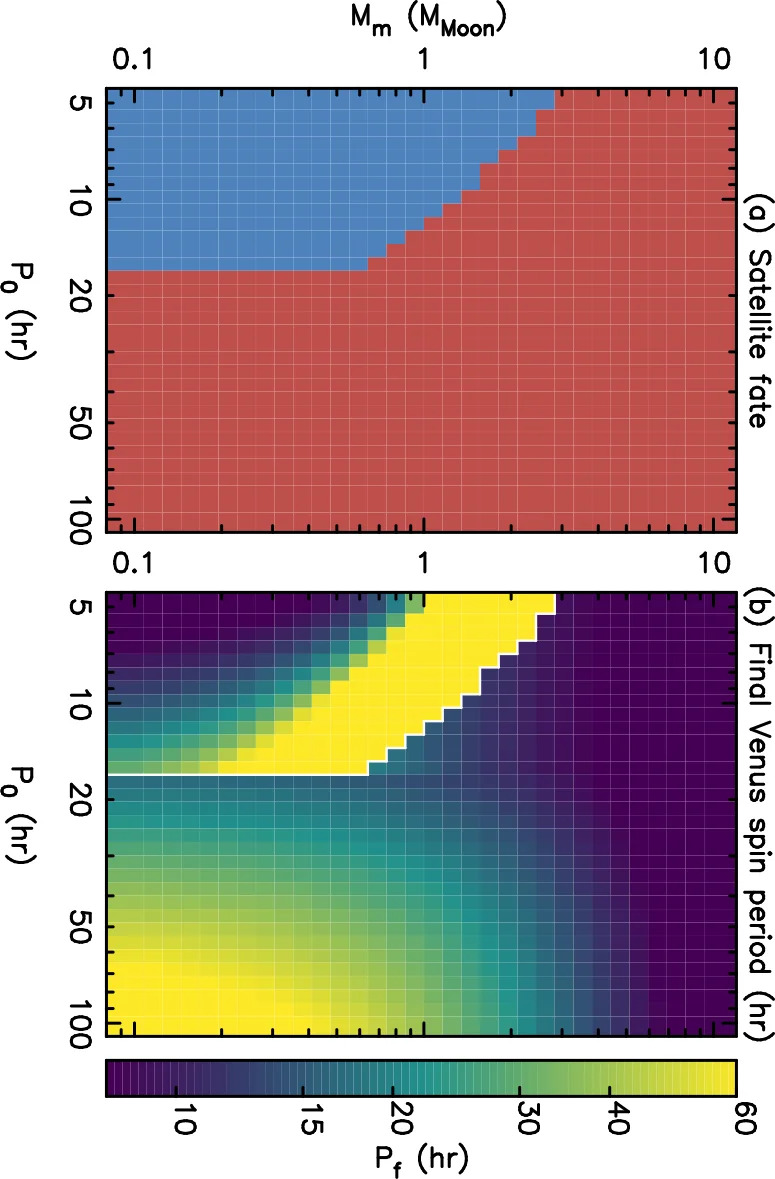
Two-constraint view of the constant-Q model (Q_V = 50, a_m,0 = 5 R_V), as a function of initial spin period and satellite mass. (CREDIT: Stephen R. Kane et al, arXiv)
Models, Parameters And Key Results
The researchers modeled initial Venus rotation periods from 5 to 100 hours, moon masses from 0.01 to 10 times the mass of Earth's Moon, and standard starting orbits at 5 Venus radii (an orbital period ≈ 16.1 hours). They tested two simplified tidal prescriptions:
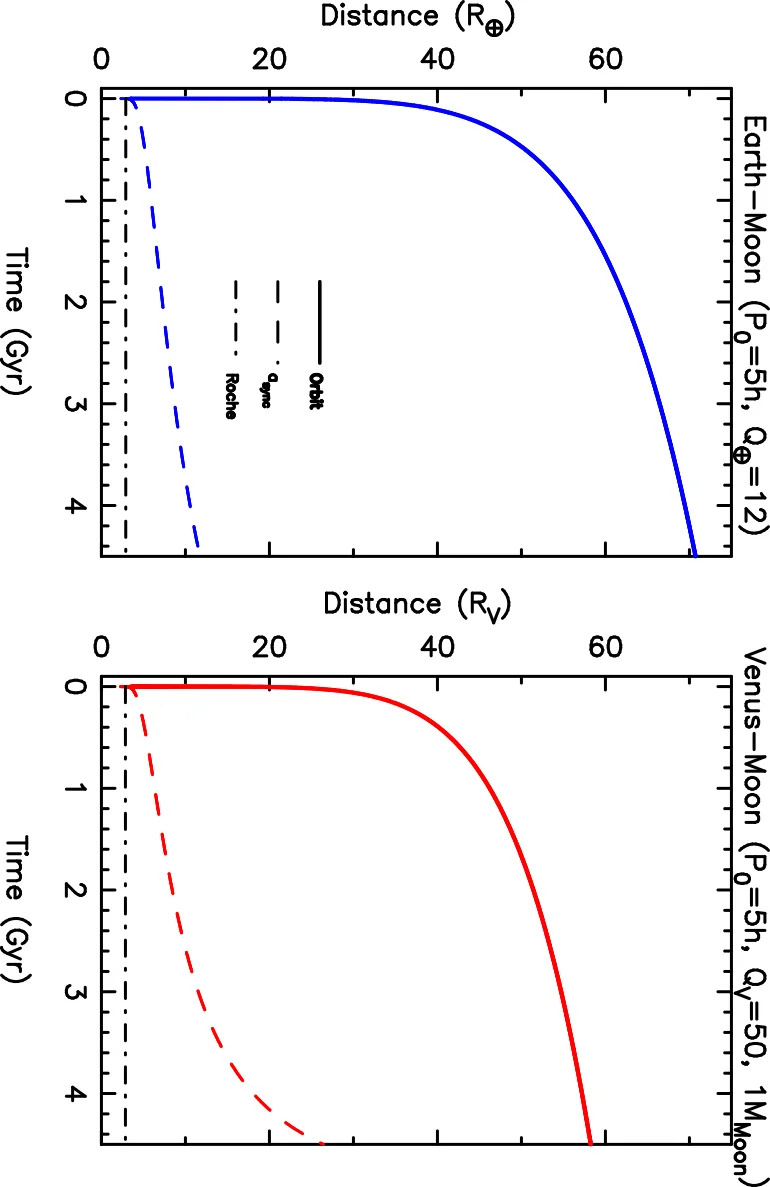
Comparison of the Earth-Moon system (left, blue) and an analogous Venus-moon system (right, red), both starting from P₀ = 5 hr, aₘ,₀ = 3.5 Rₚ, and Mₘ = 1 M_Moon. (CREDIT: Stephen R. Kane et al, arXiv)
Constant‑Q model (frequency‑independent dissipation), which can produce a sharp reversal in migration near synchronization.
Constant‑Time‑Lag (CTL) model, where tidal torque weakens smoothly as synchronization is approached.
Because the moon's tides also brake the planet, Venus's synchronous radius (where orbital period equals planetary day) can move outward and overtake the satellite. If that happens, the moon's outward migration reverses and it spirals inward toward the planet.
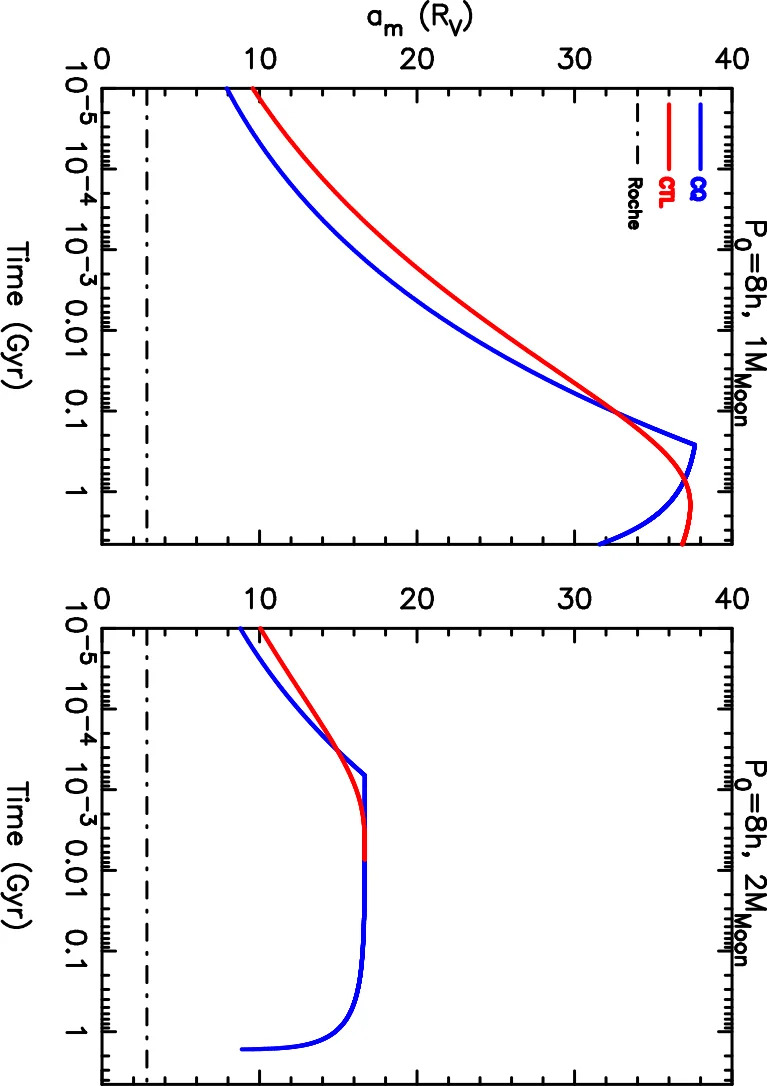
Comparison of the constant-Q (blue) and CTL (red) tidal models for P₀ = 8 hr and aₘ,₀ = 5 R_V. Left panel: Mₘ = 1 M_Moon, where both models agree and the moon survives. (CREDIT: Stephen R. Kane et al, arXiv)
Notable Quantitative Findings
- A 2× Moon‑mass satellite around a Venus initially spinning every 8 hours reached the Roche limit in roughly 1.7 billion years under one constant‑Q setup; if Venus instead began with a 12‑hour day, the same moon survived only ~33 million years.
- A Moon‑mass satellite on circular orbits often survived 4.5 billion years across many tested conditions in both tidal models — a striking result because Venus today has no such moon.
- Outward migration scales approximately with moon mass (∝ M), while the outward motion of the synchronous radius scales roughly with the square of the moon mass (∝ M²), so increasing moon mass can paradoxically make destruction more likely.
- The Roche limit for a rocky satellite around Venus is about 2.85 Venus radii (~17,000 km from Venus's center); crossing it would allow tidal disruption, possible ring formation and eventual reaccretion of debris.
Interpretation And Caveats
Neither the constant‑Q nor the CTL model perfectly captures a rocky planet's true rheology. The real behavior of Venus's mantle and how it dissipated tidal energy likely lies between these simplified extremes. As a result, outcomes vary widely: constant‑Q runs can predict inward collapse on timescales from tens of millions to billions of years, while CTL runs can trap massive moons in long‑lived near‑synchronous states.
Implications For Venus's History And Habitability
If a large moon were destroyed, its debris could form a transient ring and much of that material would likely rain back onto Venus. Such an event early in the planet's history could have returned large amounts of rock and energy to the surface and atmosphere, with potential consequences for atmospheric evolution and water loss. Climate models suggest early Venus may once have had temperate conditions and liquid water, so a moon's presence — or its violent removal — could have influenced that trajectory. The current tidal calculations, however, do not demonstrate that moon destruction caused Venus's putative runaway greenhouse.
Observational Prospects
Direct geological evidence of an ancient moon would be hard to find because Venus's surface has been extensively resurfaced by volcanism. Still, future missions such as NASA's DAVINCI atmospheric probe could provide indirect clues: measurements of noble gases, isotopes and atmospheric chemistry might record signatures of a major early reaccretion event, although later volcanism and atmospheric escape could obscure those clues.
Context And Historical Note
The idea that tidal evolution can remove moons from inner planets dates back decades. Joseph Burns (1973) argued that the absence of moons around Venus and Mercury today does not rule out past satellites. More recent impact simulations (e.g., a 2025 Astronomy & Astrophysics study) show that many collision scenarios place debris too close to form a stable moon, while others could produce a satellite that survives for some time before tides change its fate.
Conclusion
Venus may never have possessed a permanent moon — but these new tidal models demonstrate clear and plausible pathways by which an impact‑formed satellite could form, live for millions to billions of years, and then be destroyed by tidal evolution. The result helps explain why Venus is moonless today without requiring that it never experienced large impacts.
Further Reading: The authors' results are available on arXiv. See also the cited studies on giant impacts (Astronomy & Astrophysics, 2025), Joseph Burns (1973), giant‑impact Moon origin models (Nature, 2001), and climate modeling of early Venus (Geophysical Research Letters, 2016). The DAVINCI mission is described in The Planetary Science Journal (2022).
Help us improve.