Rogue planets—worlds drifting through interstellar space without a host star—challenge assumptions about where planets form and whether starlight is required for habitability. Observations show at least ~70 candidates and models suggest the Milky Way may host far more, potentially trillions. New surveys, notably NASA's Nancy Grace Roman Space Telescope, should detect hundreds more. Models indicate moons warmed by tidal heating and insulated by hydrogen‑rich atmospheres could retain surface liquid water for billions of years under the right conditions.
Rogue Planets Rewrite the Rules for Where Life Could Thrive
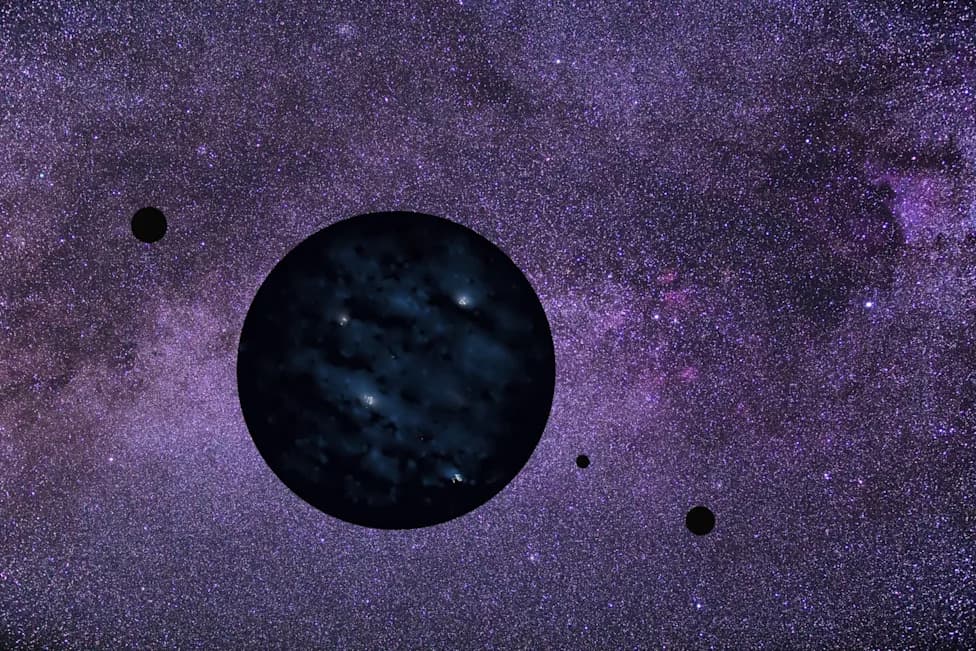
Rogue planets careen through interstellar space without the warmth of a star. Researchers wonder whether these wandering worlds or any moons that might orbit them could support life.Illustration by John R. Foster, Science Photo Library
Picture a planet and you probably picture a star nearby. In our solar system the Sun supplies the light and heat that make Earth habitable. But astronomers have discovered a population of worlds that roam the galaxy untethered to any star. These free‑floating objects—called rogue planets—challenge the idea that planets need starlight, and they are prompting scientists to reconsider whether life requires a nearby star.
How Rogue Planets Form
Rogue planets can arise in a few ways. Some may have formed in isolation from fragmented molecular clouds but never gathered enough mass to ignite nuclear fusion—blurring the line between planet and brown dwarf. More commonly, planets form around stars and are later ejected. Young planetary systems are dynamically chaotic: during the first few million years, protoplanets follow unstable orbits and can suffer close gravitational encounters that fling lower‑mass bodies out into interstellar space. These ejected objects are often Mars‑sized or smaller, or originate from a system's distant outskirts.
"Catastrophic encounters have probably occurred in every planetary system that formed," says Barbara Ercolano, an astrophysicist at Ludwig Maximilian University of Munich. "But ejection requires the right orbital conditions—stable systems like ours are less likely to lose planets now."
How Many Are Out There?
Observers have reported hints of at least 70 candidate rogue planets in the Milky Way, but theoretical estimates suggest there could be far more—perhaps roughly 20 times as many unbound planets as stars, amounting to trillions across our galaxy. This year, researchers precisely measured the mass and distance of a Saturn‑sized rogue planet about 10,000 light‑years away, marking the first definitive confirmation of a starless planetary system at that scale.
Could Rogue Worlds Host Life?
A cold, starless world is unlikely to retain surface liquid water for long: most primordial heat from formation radiates away. But scientists are exploring mechanisms that could sustain habitable conditions, especially on moons orbiting rogue planets. Internal heating from radioactive decay or convective transport of internal heat can keep subsurface environments warm. The most promising mechanism for surface or near‑surface habitability is tidal heating.
Tidal heating occurs when a moon follows an eccentric orbit and experiences varying gravitational pulls from its host planet. That flexing converts orbital energy into internal heat—an effect seen in our solar system on Jupiter's moon Io, which is intensely volcanic because of tidal stresses. If tidal heating is moderate (not extreme), it can keep water liquid without sterilizing the world.
Retention of heat also requires an insulating atmosphere. On Earth, CO2 produces a greenhouse effect, but in very cold environments CO2 can condense and fall out of the atmosphere. Dahlbüdding, Ercolano and colleagues modeled moons with hydrogen‑dominated atmospheres—hydrogen molecules can trap thermal radiation through collisional interactions. Their results indicate that a hydrogen atmosphere combined with sustained tidal heating could keep a moon's surface warm enough for liquid water for on the order of billions of years (models indicate roughly 4.3 billion years under favorable conditions), depending on surface pressure and orbital parameters.
Why This Matters
Studying rogue planets expands the range of environments considered potentially habitable and helps us revisit assumptions rooted in Earth's example. Some hypotheses for Earth's early chemistry involve hydrogen‑rich atmospheres and hydrogen‑utilizing metabolisms; understanding hydrogen‑insulated worlds could shed light on our own origins. "By studying these other worlds, we also learn about our own history," says Andrew Gould of Ohio State University.
Detecting These Dark Wanderers
Rogue planets are faint and difficult to find because they lack a host star. The primary detection method is gravitational microlensing: as a rogue planet crosses the line of sight to a distant background star, the planet briefly magnifies that star's light. Microlensing events are rare and often short—lasting hours or days—so ground‑based surveys must contend with weather, daylight and observational gaps.
Upcoming and recent facilities could change the discovery landscape. NASA's Nancy Grace Roman Space Telescope (launched in August) has a field of view about 100 times that of the Hubble Space Telescope and will survey target fields with high cadence—roughly every 12 minutes—making it capable of finding many microlensing events and possibly hundreds of rogue planets (some forecasts suggest up to ~400 Earth‑sized detections). China's proposed Earth 2.0 mission aims to survey tens of millions of stars toward the Galactic center and could identify more unbound objects. The Extremely Large Telescope (ELT) in Chile, expected to begin operations in the late 2020s, will be crucial for follow‑up studies of any candidates to probe temperature, atmosphere and composition.
Visiting a Rogue Planet
Interstellar distances make crewed missions to rogue planets unrealistic with present technology. Even traveling at one‑tenth the speed of light would require on the order of 100,000 years to reach nearby starless worlds. For now, exploring rogue planets remains a remote, long‑term scientific pursuit rather than a near‑term exploration goal.
Author: Kasha Patel, science journalist covering space and Earth science.
Help us improve.