Hungary's Foreign Minister Péter Szijjártó accused Ukraine of trying to meddle in Hungary's April 12 election while speaking at a protest outside the Ukrainian embassy in Budapest. The demonstration coincided with Hungary detaining seven employees of a Ukrainian state bank and seizing two armored cars carrying about $80 million, which Kyiv condemned as illegal. The row centers on suspended Russian oil flows through the Druzhba pipeline since Jan. 27 after reported damage, and has become a central issue in Prime Minister Viktor Orbán's re-election campaign. Allegations of Ukrainian interference remain unproven publicly and add to rising tensions between Budapest, Kyiv, Moscow and the EU.
Hungary's Foreign Minister Accuses Ukraine Of Election Interference Amid Druzhba Oil Dispute
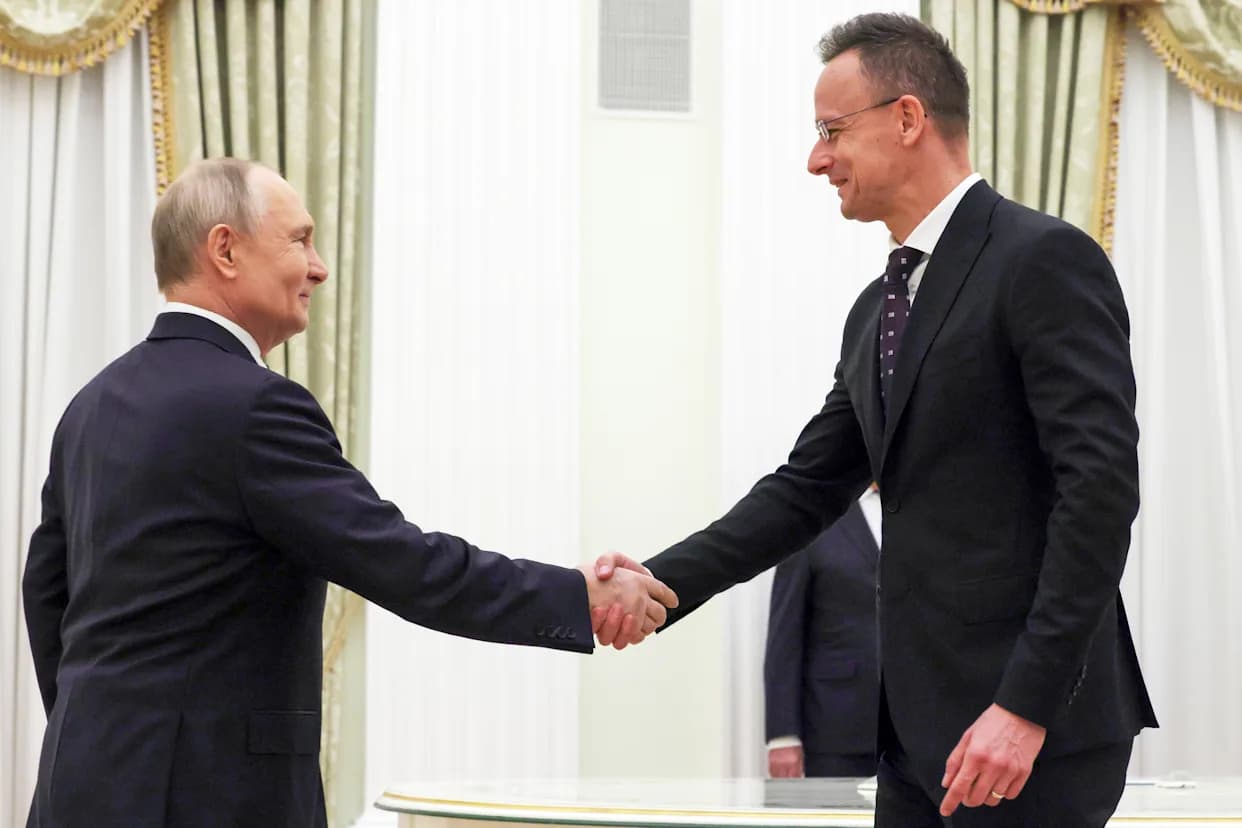
Russian President Vladimir Putin, left, and Hungarian Foreign Minister Peter Szijjarto shake hands during their meeting at the Senate Palace of the Kremlin in Moscow, Wednesday, March 4, 2026. (Mikhail Metzel, Sputnik, Kremlin Pool Photo via AP)(ASSOCIATED PRESS)
Budapest — Hungary's Foreign Minister Péter Szijjártó on Friday accused neighboring Ukraine of attempting to influence Hungary's upcoming April 12 election, addressing several hundred protesters outside the Ukrainian embassy in Budapest. The rally came the same day Hungarian authorities detained seven employees of a Ukrainian state-owned bank and seized two armored vehicles carrying about $80 million in cash, an action Kyiv condemned as illegal.
The demonstration was organized by a little-known pro-government group with ties to Prime Minister Viktor Orbán's Fidesz party. In his remarks, Szijjártó made a series of allegations — some unsubstantiated — that Ukraine had coordinated with the European Union and Hungary's opposition to block Russian oil deliveries to Hungary via the Druzhba pipeline.
"This will not happen in Hungary. There will be no pro-Ukraine government, and Hungary will not have a pro-Ukraine prime minister," Szijjártó said, adding: "Ukraine is fighting for itself, not for us and not on our behalf, so we owe absolutely nothing to Ukraine."
The protest, at which other ruling-party figures also spoke, unfolded amid sharply rising tensions between Budapest and Kyiv over Hungary's access to Russian crude transported across Ukrainian territory. Deliveries through the Druzhba pipeline have been suspended since Jan. 27 after a reported Russian drone strike damaged pipeline infrastructure. Ukrainian officials have said repairs carry risks to technicians and that the lines would remain vulnerable to further attacks.
Hungary's government accuses Ukraine of deliberately delaying Russian crude and has vowed countermeasures until flows resume. In recent months, Prime Minister Orbán has halted diesel shipments to Ukraine, vetoed a new round of EU sanctions on Russia, blocked a proposed €90 billion loan for Kyiv, and deployed troops to protect key energy infrastructure inside Hungary. Orbán has also publicly framed Ukraine as an electoral and security threat ahead of the vote.
Szijjártó traveled to Moscow earlier in the week for a cordial meeting with President Vladimir Putin, seeking assurances that Hungary would maintain access to Russian oil and gas despite disruptions from the Middle East conflict and the Druzhba interruption. On Friday he accused Ukraine of imposing what he called an "oil blockade" intended to hurt the government ahead of the election.
The allegations of Ukrainian election meddling have not been substantiated by independent evidence in public. The escalating dispute mixes energy security, geopolitical alignments and domestic politics, and could have broader repercussions for Hungary's relations with Ukraine, the EU and Russia.
Help us improve.