Experts say missed intervention—not demographic identity—is the central issue in many violent incidents. Behavioral threat assessments frequently reveal moments when schools, families or authorities could have acted. Advocacy groups point out that transgender perpetrators make up a vanishingly small share of mass shootings, while clinicians emphasize common psychological precursors and call for stronger early intervention and mental-health resources.
What’s Driving Violent Incidents Involving People Who Are Transgender? Experts Urge Prevention Over Politics

Covenant School shooter Audrey Hale walks past the Children's Ministry desk. (1:57)(Fox News)
As the nation again contends with a mass shooting reportedly committed by a person who identified as transgender, debate has resurfaced about whether warning signs were missed and whether institutions charged with preventing violence are falling short. Experts who study behavioral threat assessments say the pattern worth examining is not identity but missed opportunities to intervene.
What The Data Shows
Advocacy organizations caution against drawing broad conclusions from a handful of high-profile incidents. GLAAD, citing Gun Violence Archive statistics, notes that of 5,748 mass shootings recorded between Jan. 1, 2013 and Sept. 15, 2025, five confirmed perpetrators were transgender — representing less than 0.1% of incidents. That data highlights how rare such cases are relative to the total number of mass shootings.
Expert Perspectives
Retired FBI agent Jason Pack says long-running reviews of threat assessments reveal a recurring theme: a "crossing point" when authorities, schools or families could have intervened but did not. He emphasizes that threat-assessment teams focus on individual behavior and warning signs rather than demographic labels.
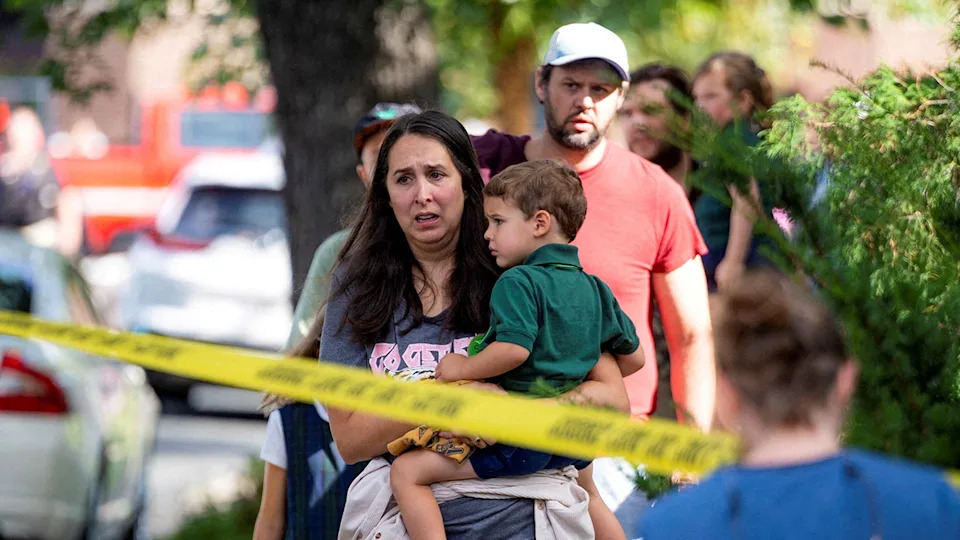
Families reunite outside the police barricades after a shooting at Annunciation Church, which is also home to an elementary school, in Minneapolis, Minnesota, Aug. 27, 2025.
"Whatever your views on gender identity...every human being in crisis deserves intervention before tragedy strikes," Pack said. "The pattern worth examining is not who these individuals were demographically, but what failed them and what failed the public before they ever picked up a weapon."
Forensic psychiatrist Dr. Carole Lieberman describes common psychological patterns that can precede mass violence: dysfunctional childhoods, social isolation or bullying, substance misuse, immersion in violent media, and a triggering life event such as rejection, job loss or bereavement. She argues for stronger early-intervention systems in schools and more consistent follow-up by mental-health professionals.
Prosecutor George Brauchler, who handled the 2019 STEM School Highlands Ranch case, urges avoidance of sensationalism. He calls for a sober, nonpartisan review of common precursors to mass casualty crimes and renewed focus on prevention.
Notable Incidents Often Cited In Public Debate
- 2018 – Aberdeen, Maryland: Snochia Moseley, identified as a transgender man, killed three co-workers at a Rite Aid distribution center and later died by suicide.
- 2019 – Highlands Ranch, Colorado (STEM School Highlands Ranch): Alec McKinney, identified as transgender, and Devon Erickson carried out a school shooting; McKinney told investigators bullying over gender identity was a factor.
- 2022 – Colorado Springs, Colorado: Anderson Lee Aldrich, described by authorities as nonbinary, opened fire in an LGBTQ+ nightclub, killing five people.
- 2023 – Nashville, Tennessee (Covenant School): Audrey Hale, identified by police as a transgender man, killed six people, including three children.
- 2025 – Minneapolis, Minnesota (Annunciation Catholic Church): Robin Westman, described by authorities as transgender, killed two children and later died by suicide.
- 2026 – Tumbler Ridge, British Columbia: Jesse Van Rootselaar, who police say identified as trans, allegedly killed eight people before dying by a self-inflicted gunshot wound.
- 2026 – Pawtucket, Rhode Island: Robert Dorgan, described by police as transgender and also known as Roberta Esposito, killed three family members before dying by suicide.
Policy And Prevention: Where Experts Say Focus Should Be
Across interviews and commentary, a few consistent recommendations emerge:
- Strengthen and fund multidisciplinary threat-assessment teams so warning signs do not fall through bureaucratic cracks.
- Improve access to school-based mental-health services, including more school psychologists and early-intervention programs.
- Ensure crisis hotlines and red-flag mechanisms reliably connect people in crisis to care.
- Avoid stigmatizing entire communities; focus on individual behavior and evidence-based risk factors.
Conclusion
While a few widely publicized cases have involved people who identified as transgender, available data indicate such perpetrators account for a tiny share of mass shootings. Experts urge policymakers, schools and families to prioritize prevention: identify and act on behavioral warning signs, strengthen mental-health response systems, and resist framing violent acts primarily through demographic lenses. Doing so, they say, would better protect potential victims and people in crisis alike.
Help us improve.