Key takeaway: New BEA data dispute President Trump’s claims that tariffs massively reduced the trade deficit and that fourth-quarter 2025 growth was unusually strong. Trade data show the overall 2025 deficit fell just 0.2% from 2024 while the goods deficit rose 2.1%. BEA’s GDP estimate put Q4 2025 annualized growth at 1.4%, far below the 5%–6% figures Mr. Trump promoted. The Supreme Court also struck down several tariffs, and the administration says it will pursue replacements under a different law.
BEA Data Blows Hole in Trump’s Tariff Narrative — Trade Deficit Flat, Q4 Growth Just 1.4%

A vessel passes a container ship loaded with shipping containers at the Port of Los Angeles on February 20, 2026. - Mario Tama/Getty Images
Two new Bureau of Economic Analysis releases this week undercut two of President Donald Trump’s central economic claims: that his tariffs sharply reduced the U.S. trade deficit, and that the economy delivered exceptionally strong fourth-quarter growth in 2025.
The first set of BEA figures, published early Thursday, showed the 2025 trade deficit in goods and services was essentially unchanged from 2024, falling only 0.2%. The deficit in goods — the category most affected by the administration’s global tariffs — actually rose 2.1% year-over-year. Those data stand in stark contrast to the president’s social-media assertion that the trade deficit had been reduced by 78% because of tariffs.
“THE UNITED STATES TRADE DEFICIT HAS BEEN REDUCED BY 78% BECAUSE OF THE TARIFFS BEING CHARGED TO OTHER COMPANIES AND COUNTRIES.”
That 78% figure was drawn from a short-term, out-of-date snapshot (October 2025 versus January 2025) and ignored expert warnings that the sharp October decline was driven by temporary swings in trade in gold and pharmaceuticals. The BEA’s annual comparison makes clear the change was not sustained.
Mr. Trump’s post also implied that foreign countries pay the tariffs. In practice, tariffs are collected from U.S. importers, who frequently pass at least part of those costs on to American businesses and consumers. Multiple independent analyses find that the bulk of the tariff burden this term has been borne domestically rather than absorbed abroad.
The BEA’s second release, early Friday, reported official estimates of real gross domestic product (GDP). Those numbers similarly contradicted the president’s repeated public claims. After touting projections in the 5%–6% range (and at times suggesting 5.6% growth had already been achieved), Mr. Trump’s statements were far above the realized outcome.
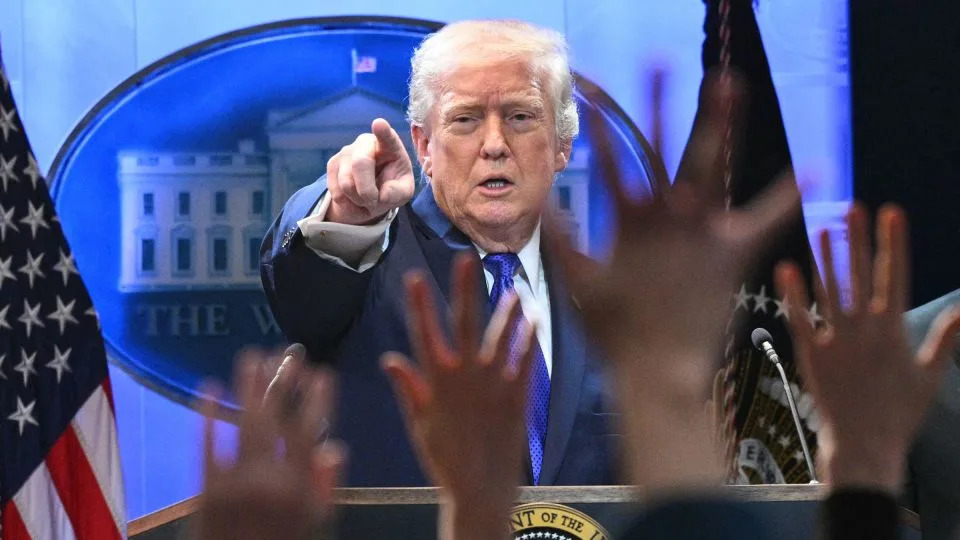
Members of the media raise their hands to ask questions to US President Donald Trump during a press conference in the Brady Press Briefing Room of the White House in Washington, DC, on February 20, 2026. (Photo by Mandel NGAN / AFP via Getty Images) - Mandel Ngan/AFP/Getty Images
The official BEA estimates show the U.S. economy grew at an annualized rate of 1.4% in the fourth quarter of 2025, down from 4.4% in the third quarter. The Atlanta Fed’s model-based projection had fallen from earlier highs to 4.2% by the time some of Mr. Trump’s remarks were made, but forecasts are not the same as final figures.
Analysts and officials point to the fall 2025 government shutdown as a material drag on fourth-quarter activity, undercutting claims that the economy powered through the interruption to produce 5%+ growth.
Full-year BEA data show U.S. GDP growth of 2.2% in 2025 — a pace below every year of the Biden administration and every year of Mr. Trump’s first administration except 2020, when the pandemic produced a historic contraction.
Legal And Policy Fallout
Late Friday the Supreme Court struck down several of the administration’s tariffs. Other levies remain in place, and the president quickly said he intends to seek replacement tariffs under a different statutory authority, setting up another round of legal and policy battles over trade strategy and economic impacts.
In short, the BEA’s trade and GDP releases removed the empirical foundation from two of Mr. Trump’s prominent economic talking points: sweeping tariff-driven reductions in the trade deficit and unusually strong fourth-quarter growth in 2025. The official data show a much more modest picture.
Help us improve.