The State of the Union has shifted from George Washington's short written report to a prime-time political spectacle shaped by television and polarization. Presidents now use the address to shape narratives and create striking images, while opposition members increasingly stage visible protests. This year's speech by President Trump is set against recent legal and political tensions, including a Supreme Court decision that struck down his tariffs.
How the State of the Union Turned Into a Prime-Time Political Battleground
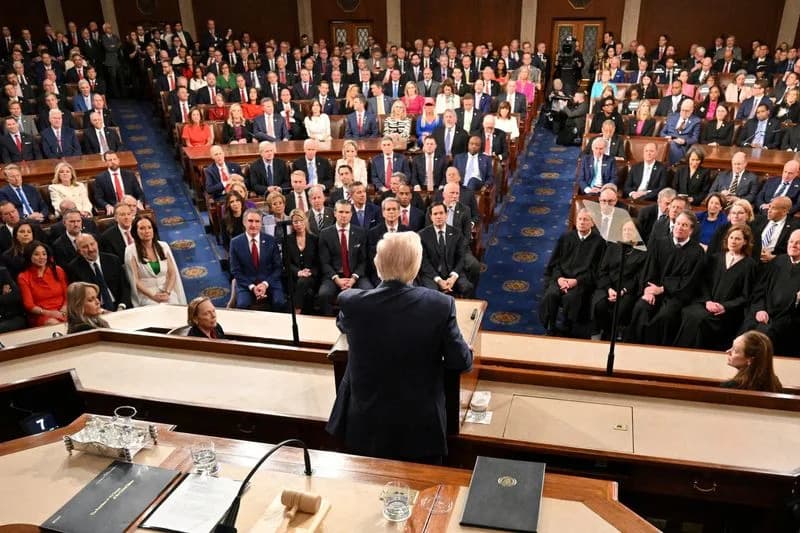
FILE PHOTO: US President Donald Trump speaks during an address to a joint session of Congress at the US Capitol in Washington, DC, on March 4, 2025. MANDEL NGAN/Pool via REUTERS/File Photo
The State of the Union has evolved from a concise report to Congress into a carefully staged, prime-time spectacle shaped by intense partisan division. What began in 1790 as George Washington's short, 1,089-word message is now a choreographed night of theatrical tension where presidents aim to seize the narrative and produce defining images of their tenure.
From Short Report to Television Spectacle
In 1801, Thomas Jefferson initiated a long-running change by sending a written message rather than speaking in person; that practice lasted for more than a century. President Woodrow Wilson revived the in-person address in 1913. Television transformed the event: Harry Truman delivered the first televised State of the Union in 1947, and Lyndon Johnson moved the address into prime time in 1965 to reach the largest audience.
Evening broadcasts amplified partisan theater. Members of the president's party often rise in applause while the opposition sits in visible protest — a dynamic that has made the chamber a stage for both policy arguments and symbolic gestures. This year, President Donald Trump is scheduled to speak at 9 p.m. ET, and several Democrats plan to skip the address and hold an outdoor rally instead. Newly elected Virginia Governor Abigail Spanberger will deliver the official televised Democratic response after the speech.
Heightened Stakes
Added drama surrounds this address: the speech takes place four days after the U.S. Supreme Court, in a 6–3 decision that included two Trump appointees, struck down Mr. Trump's signature tariffs as an overreach of presidential authority. With justices present in the chamber, that ruling intensifies the political theater and the scrutiny on the president.
When Speeches Grew Longer and More Theatrical
Modern presidents have stretched the address far beyond Washington's brief report. Bill Clinton set a pre-2025 record in 2000 with a 1 hour, 28 minute and 49 second address; according to the American Presidency Project, Donald Trump's 2025 address ran even longer at 1 hour, 39 minutes and 32 seconds. When presidents speak soon after inauguration, their early appearance is sometimes called a joint address rather than a formal State of the Union.
Ronald Reagan started the frequent practice of inviting featured guests to the chamber in 1982, using individual stories to illustrate policy themes. Those guest moments can be unifying or divisive — for example, President Trump awarded the Presidential Medal of Freedom to radio host Rush Limbaugh in 2020, a choice that provoked controversy.
Viral Confrontations That Reshaped the Moment
In recent decades, dramatic interruptions and viral reactions have become part of the modern State of the Union's identity:
2009 — Joe Wilson's Outburst: Representative Joe Wilson shouted 'You lie!' during President Barack Obama's healthcare speech to Congress (a joint session, not a formal State of the Union), then apologized after bipartisan criticism.
2010 — A Justice's Visible Reaction: Justice Samuel Alito visibly shook his head and appeared to mouth 'not true' when President Obama criticized the Citizens United decision — a rare break in the justices' usual restraint.
2020 — The Pelosi Moment: Speaker Nancy Pelosi declined to endorse President Trump's introduction and later tore up a copy of his remarks on camera, an episode that became one of the most widely seen symbolic acts in recent memory.
2023–2024 — Interruptions and Political Callouts: Recent addresses have featured shouted interruptions, boos and sharp exchanges between presidents and members of the opposing party. President Joe Biden used his speeches to sharply contrast his agenda with Republican opponents, and Republican lawmakers have increasingly interrupted or expressed visible dissent.
When Speeches Mattered for Policy
State of the Union addresses have sometimes signaled major policy turns. In 1941, nearly a year before the United States entered World War Two, Franklin D. Roosevelt articulated the 'Four Freedoms' — freedom of speech, freedom of worship, freedom from want and freedom from fear — framing American aims on the world stage. In 1964, Lyndon Johnson declared an 'unconditional War on Poverty,' launching sweeping domestic programs. Later speeches have likewise set tones for domestic and foreign policy, from Bill Clinton's 1996 declaration that 'the era of big government is over' to George W. Bush's post-9/11 framing of an 'axis of evil' in 2002.
The State of the Union remains a focal point where presidents try to define their tenure and frame national debates — even as media, optics and partisan theater continue to reshape its meaning.
Help us improve.