The United States is experiencing a significant rise in threats against public officials, prompting a record wave of federal prosecutions. A CBS News review found 126 people charged last year, with prosecutions more than tripling over the past decade. Experts attribute the surge to social media, pandemic-era divisions and dehumanizing political rhetoric, and recommend immediate security upgrades and long-term efforts to restore civility. Officials stress stronger enforcement and better personal-data protections to curb escalating risks to public servants.
Wave Of Threats Against U.S. Public Officials Spurs Record Federal Prosecutions And Security Alarm
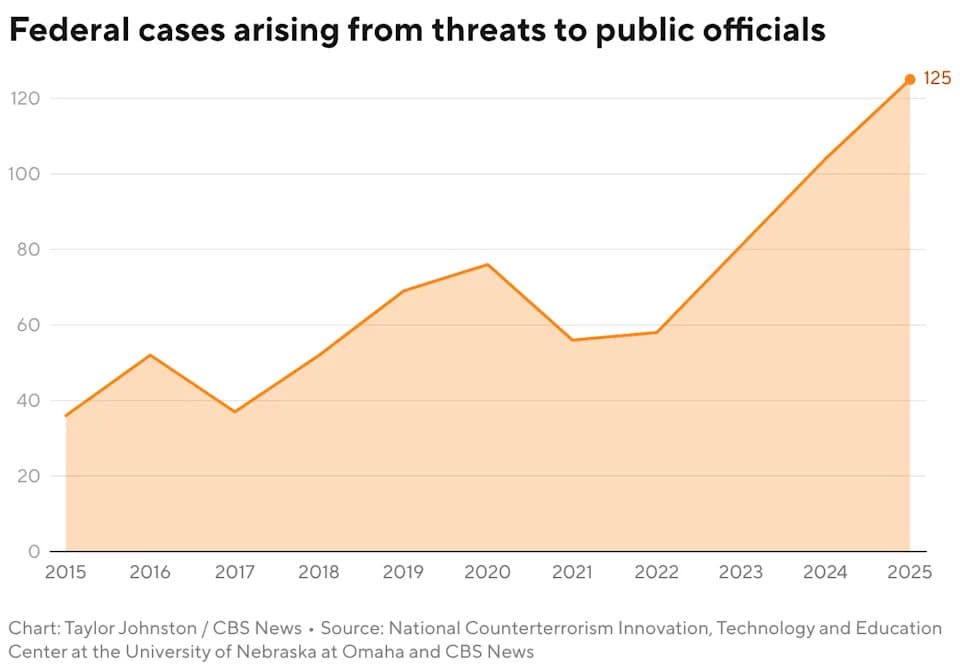
Threats to government officials, by year (Line chart)
A sharp rise in threats against judges, lawmakers, law enforcement and presidents has driven a record number of federal prosecutions and raised alarm about the safety of public servants. Federal prosecutors charged 126 people last year in cases tied to threats against federal and top state officials, a more than threefold increase over the past decade, according to a CBS News review of court records and data from NCITE and the Prosecution Project.
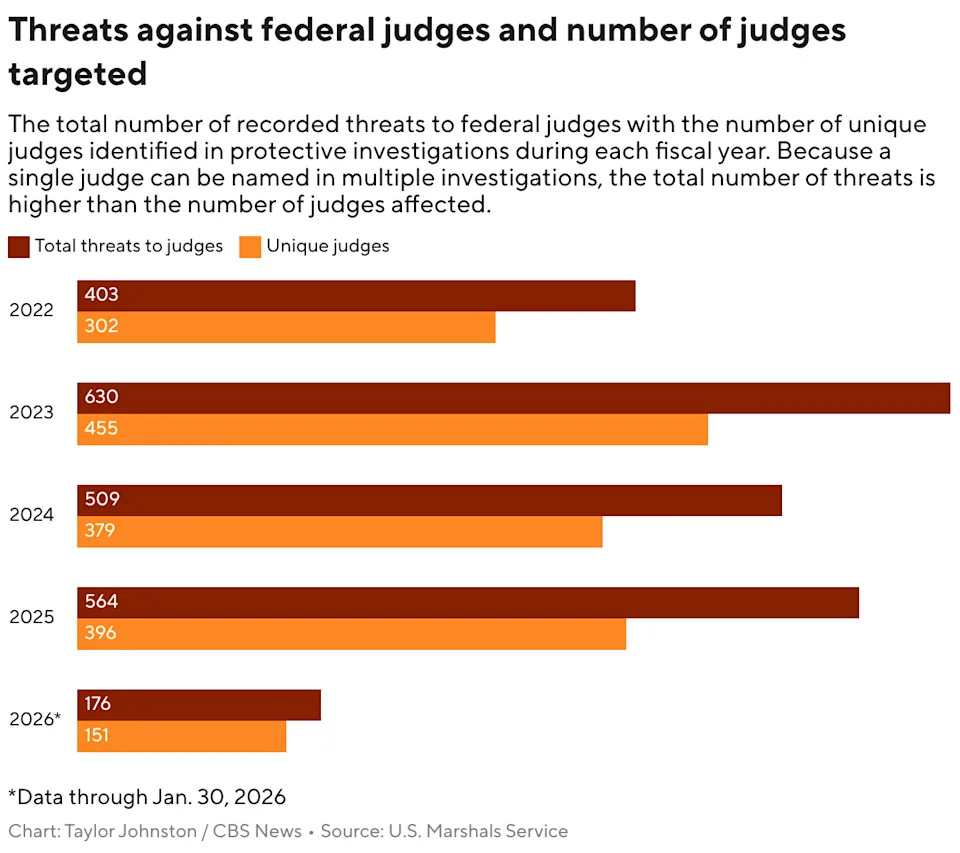
Threats against federal judges and number of judges targeted (Grouped Bars)
High-Profile Examples And Digital Origins
Prosecutors say some threats have roots in social media comment threads and anonymous posts. In one widely reported instance, posts over eight days in July under aliases invoking notorious mass shooters threatened a federal judge, Supreme Court justice, seven federal judges and 11 members of Congress. Those messages were traced to Jeffrey Petersen of Minnesota, who admitted to the FBI that he authored some posts and later was indicted on 20 counts; he pleaded not guilty and his lawyer argues the comments are protected speech.
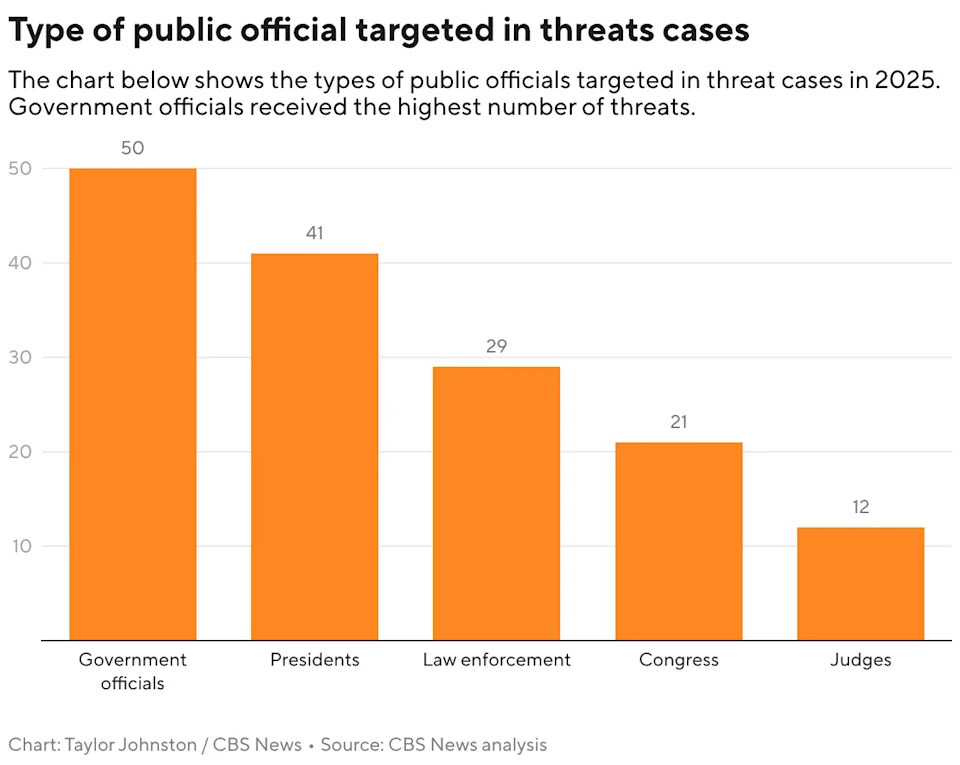
Charged cases by type of public official (Column Chart)
Voices From The Bench
U.S. District Judge John Coughenour of Seattle described an escalation in frequency and explicitness of threats over recent months. He said he was swatted, received a bomb threat at his home, and hundreds of threatening voicemails and other communications. The U.S. Marshals Service recorded 564 threats to judges in the last fiscal year, up from 509 the prior year, while Chief Justice John Roberts noted that threats targeting judges have tripled over the past decade.
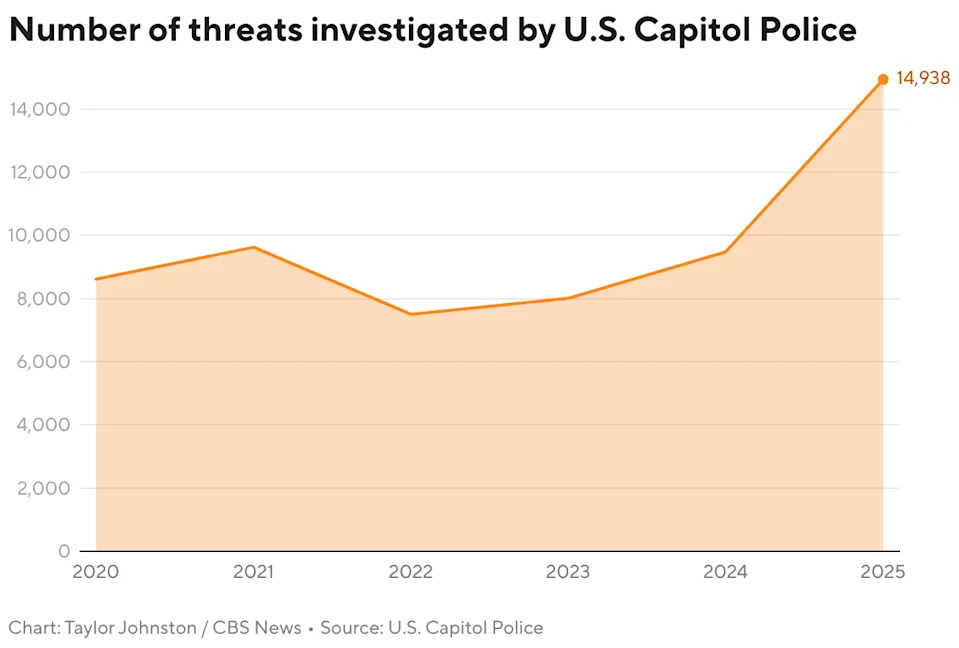
Number of threats investigated by U.S. Capitol Police (Line chart)
'The prior 40 years that I have spent on the bench...it had never before reached the level where the president and the attorney general and the president's staff were making hypercritical comments and calling judges monsters,' Coughenour told CBS News.
Scope, Targets And Trends
The threats documented by prosecutors are broad in target and method. The CBS News review found that among 126 prosecutions last year, 41 involved threats to presidents or former presidents, 29 targeted federal law enforcement officers, 21 cited threats against members of Congress and 12 included judges. The U.S. Capitol Police reported nearly 14,923 concerning statements, behaviors and communications directed at lawmakers, their families, staff or the Capitol complex last year, up sharply from prior years.
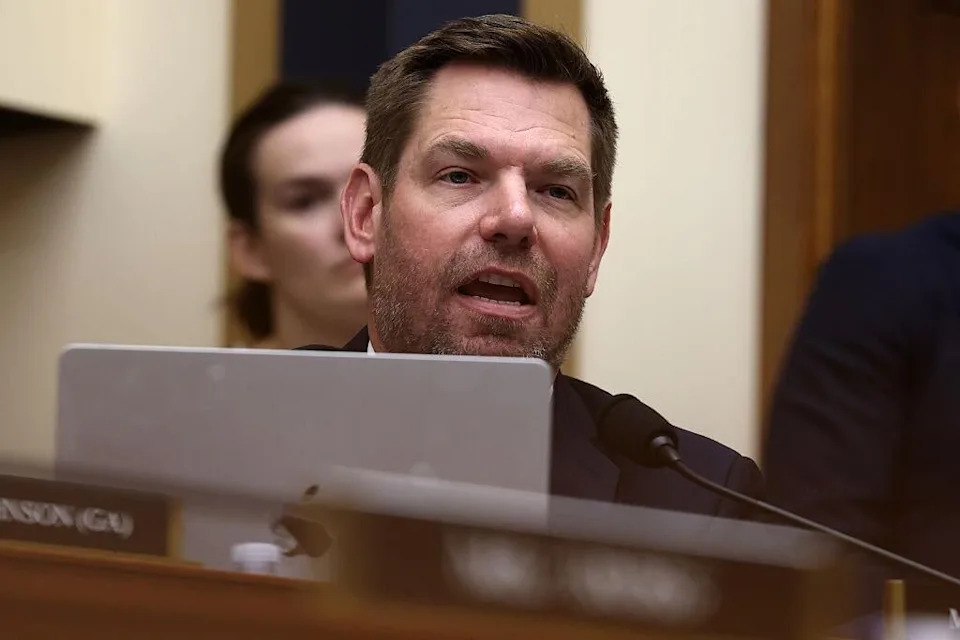
Rep. Eric Swalwell of California questions Attorney General Pam Bondi during a House Judiciary Committee hearing in the Rayburn House Office Building in Washington, D.C., on Feb. 11, 2026. / Credit: Getty Images
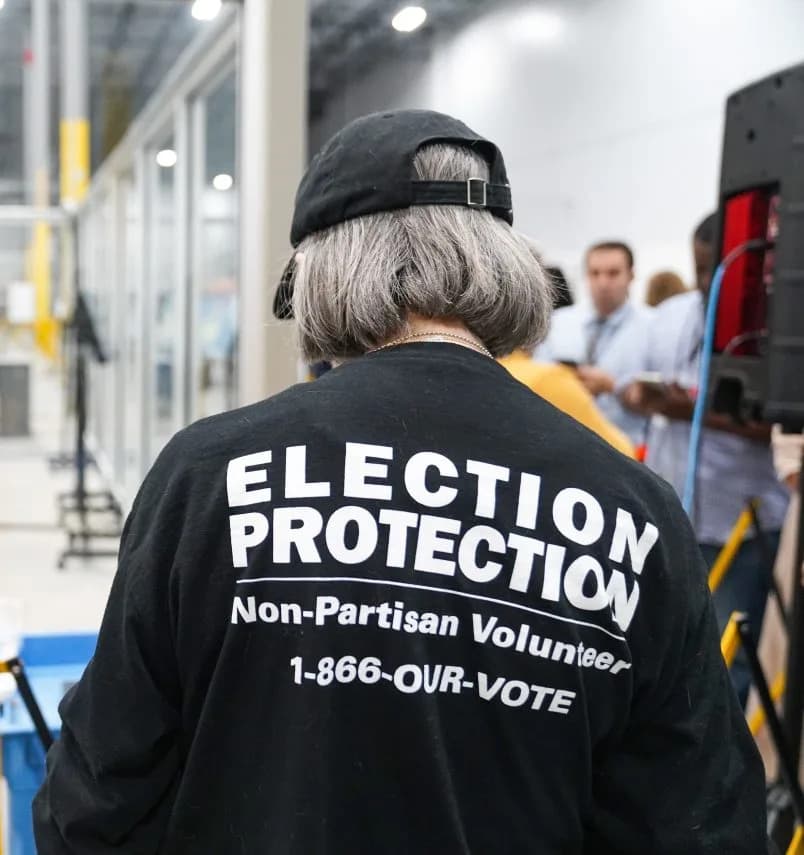
Experts say the pattern of who is targeted shifts with national events. During the COVID-19 pandemic, threats were often directed at public-health and education officials; in 2020 many cases targeted election workers. More recently, law enforcement officers have been more frequently targeted amid debates over immigration enforcement and other policy priorities.
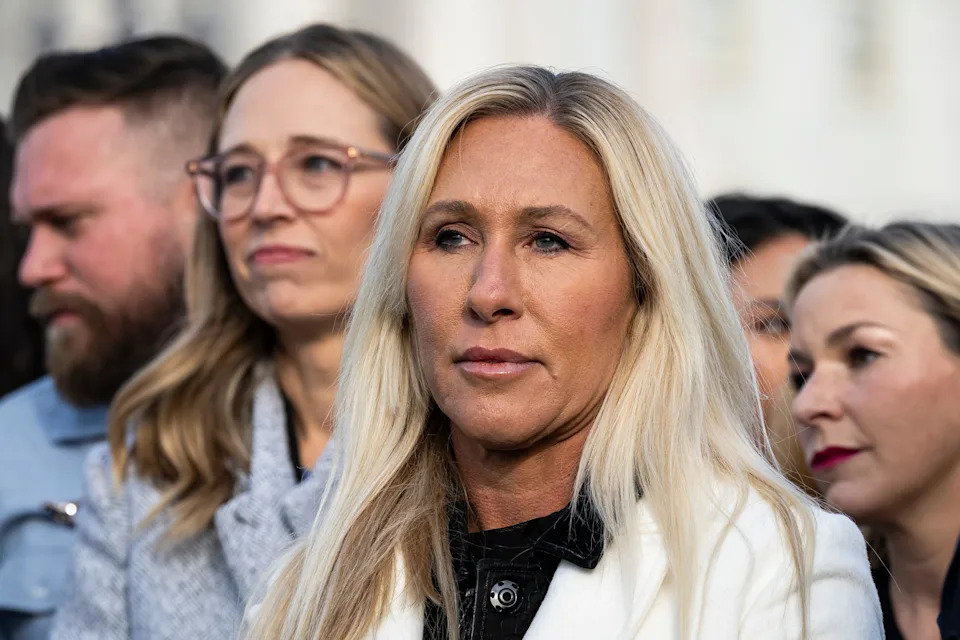
Then-Rep. Marjorie Taylor Greene during a news conference outside the Capitol on Tuesday, Nov. 18, 2025. / Credit: Graeme Sloan / Bloomberg via Getty Images
Real-World Violence And Near Misses
Some threats have turned into attempted or actual violence. High-profile examples include two attempted assassinations of former President Donald Trump in 2024, the 2022 arrest of Nicholas Roske (who now uses the name Sophie Roske) outside Justice Brett Kavanaugh's home, and the 2020 murder of Daniel Anderl, son of U.S. District Judge Esther Salas. In Minneapolis, Rep. Ilhan Omar was recently assaulted at a town hall and faces continuing threats, which she said increase after inflammatory rhetoric from national leaders.
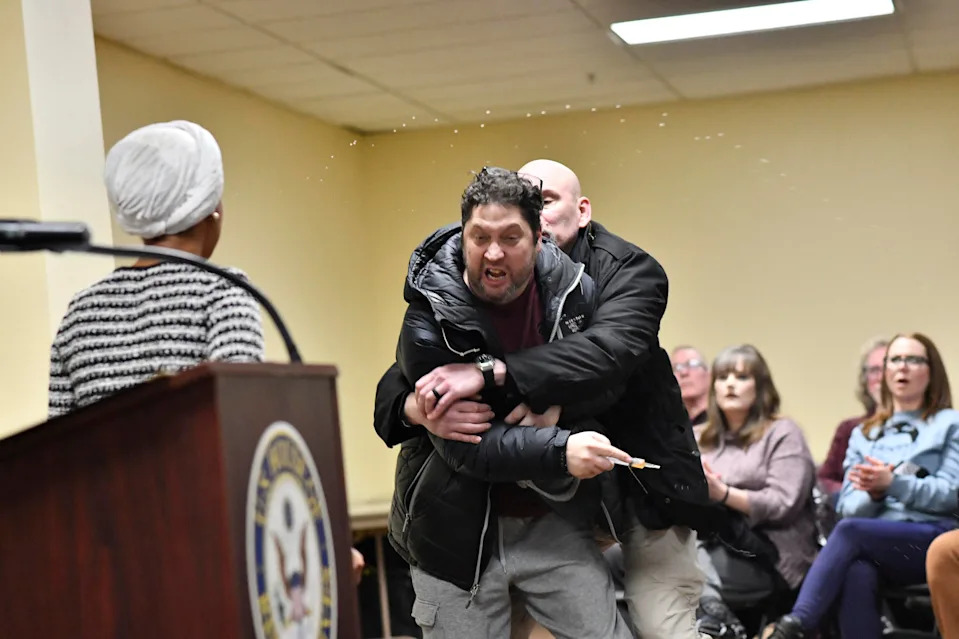
A man is tackled after spraying a substance at Rep. Ilhan Omar during a town hall in Minneapolis on Jan. 27, 2026. / Credit: Octavio JONES /AFP via Getty Images
Judges also face campaigns of intimidation such as unsolicited deliveries meant to frighten, sometimes called pizza doxxing, which Salas called a form of psychological warfare.
Responses And Recommendations
Officials and experts recommend a mix of immediate and long-term measures: strengthen security at public events and residences, improve protection of personal data, and ensure consistent prosecution of credible threats. Last November, Congress approved about 203.5 million dollars to bolster lawmaker security and provide additional funds for residence protections.
Shannon Hiller of Princeton's Bridging Divides Initiative and NCITE expert Seamus Hughes said social media, pandemic-era divisions and dehumanizing political rhetoric have amplified threats and normalized harassment. Prosecutors like Gregory Kehoe, U.S. attorney for the Middle District of Florida, emphasized the need to distinguish protected speech from criminal threats and to pursue cases that meet the legal threshold.
What This Means For Public Service
The rising threat environment may deter qualified people from serving in public office or the judiciary and increases the risks faced daily by those who do serve. 'We can't go on the way that we are today,' Judge Coughenour said, noting his concern about escalating polarization and violence. Experts urge both immediate protective steps and efforts to restore civility and accountability in political discourse.
Help us improve.