The Capitol’s dedication of the congressional press gallery to Frederick Douglass drew praise but also criticism for a perceived whitewashing of his legacy. Critics argue Rep. Byron Donalds and Speaker Mike Johnson presented a sanitized Douglass that conflicts with the MAGA movement’s record and some of Donalds’ own remarks. The article places the ceremony against a backdrop of attacks on the free press, especially Black journalists, while noting some earlier reporting in the original piece included unverified claims about arrests.
Donalds and Johnson’s Frederick Douglass Tribute Rings Hollow — A Critique of Performative Praise
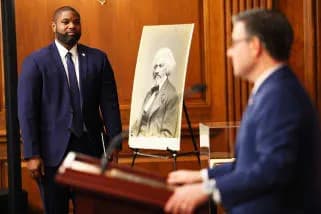
Rep. Byron Donalds and House Speaker Mike Johnson recently led a ceremony to rename the congressional press gallery at the Capitol for Frederick Douglass. On its face, honoring Douglass — the escaped slave, abolitionist, writer and orator — is right and overdue. But the event drew sharp criticism for what many saw as a sanitized, politically convenient portrayal of Douglass that conflicts with other positions and statements by the speakers and their allies.
The piece highlights a broader context: the sustained hostility toward the free press from former President Donald Trump and some in his orbit, and the specific impact on Black journalists. The nonpartisan National Association of Black Journalists (NABJ) has publicly rebuked Trump’s repeated attacks on Black reporters, including Yamiche Alcindor, and advocates have warned that political rhetoric and certain law-enforcement actions can chill independent reporting by or about Black communities.
At the Capitol dedication, critics said the ceremony presented a softened version of Douglass. Speaker Johnson called Douglass “an orator of almost unparalleled stature in American history — almost as good as Byron Donalds,” a quip some observers found tone-deaf. Donalds thanked National Park Service staff who brought artifacts for the event, then framed Douglass in laudatory, bite-sized terms — an account that, according to the article, resembled a conservative-friendly, classroom-ready depiction rather than the fuller, more confrontational Douglass who explicitly named and fought slavery and white supremacy.
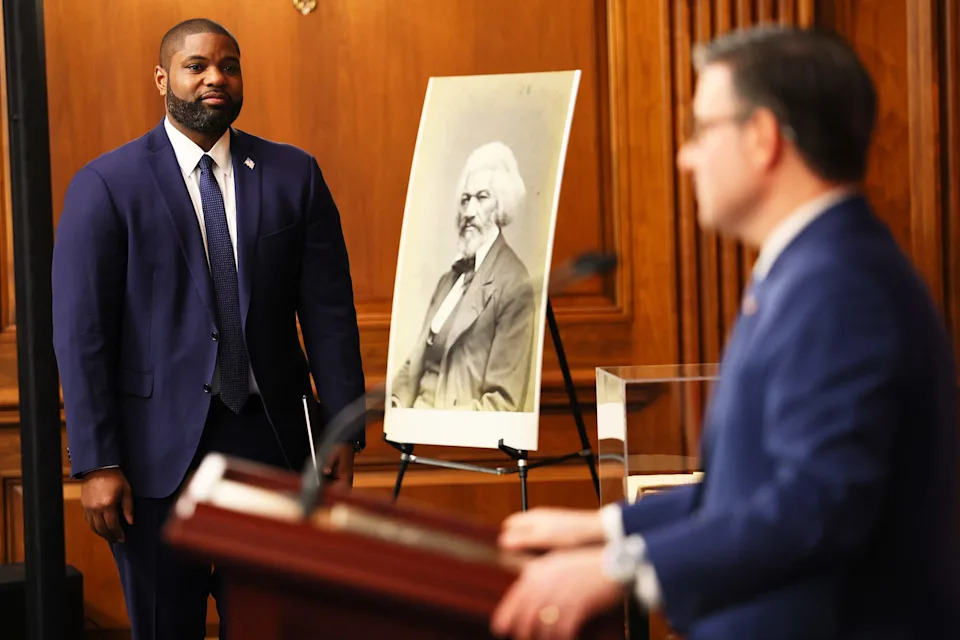
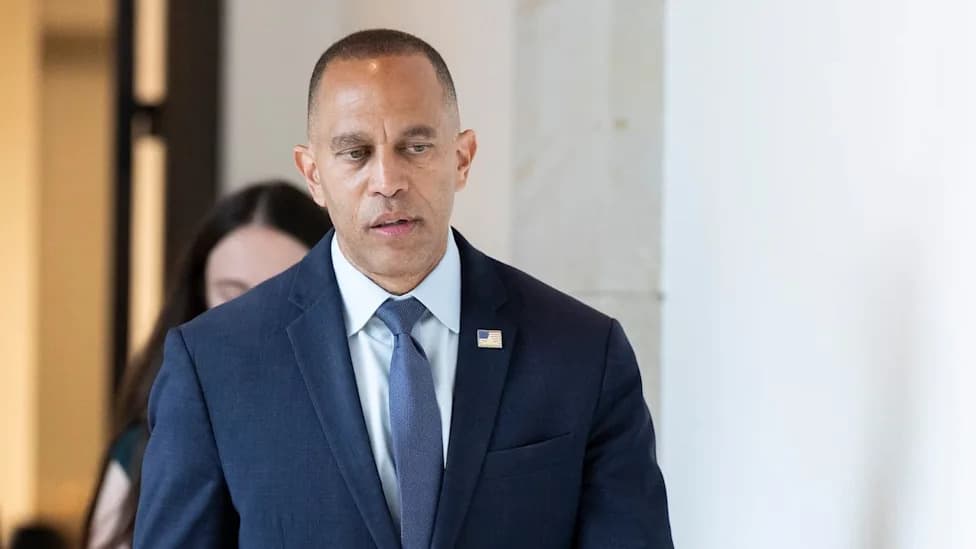
Rep. Byron Donalds and House Speaker Mike Johnson after formally unveiling the Frederick Douglass Press Gallery in the Rayburn Reception Room of the US Capitol.(Michael M. Santiago / Getty Images)
The article stresses what was omitted: Douglass’s physical resistance to his enslavers, his decades-long denunciations of systemic racism after emancipation, and his insistence that the country confront its past. As Douglass warned in an 1881 speech in West Virginia:
“Slavery is indeed gone, but its long, black shadow yet falls broad and large over the face of the whole country.”
Donalds urged journalists at the dedication to follow Douglass’s example — to be bold, factual and fiercely independent — but critics argue this rhetoric is inconsistent with the MAGA movement’s record and with some statements made by Donalds himself. The article calls out a 2024 remark by Donalds — “You see, during Jim Crow, the Black family was together” — as an example of commentary that undercuts his celebration of Douglass’s uncompromising truth-telling.
Notably, the article’s earlier references to the “arrests of independent journalists Don Lemon and Georgia Fort” raise accuracy concerns: Don Lemon has not been publicly reported as arrested in connection with these matters, and the reference to Georgia Fort is not corroborated in mainstream reporting. I have framed the piece to reflect the author’s argument that administration actions and rhetoric have been hostile to independent Black press voices, while avoiding unverified claims about specific arrests.
Ultimately, the event prompted questions about motive and substance: is this renaming an earnest tribute to a prophet of racial truth, or a symbolic gesture that whitewashes the very challenges Douglass spent his life exposing? The answer matters because honoring history without engaging its complexity risks turning moral leaders into convenient mascots for political theater.
Help us improve.