President Sadyr Japarov dismissed three ministers seen as allies of ousted ex-spy chief Kamchybek Tashiev, a move widely interpreted as consolidating power ahead of next year's presidential election. Japarov says the steps are intended to prevent a possible coup and halt plots to inflame regional divisions. Critics and rights groups warn the firings reflect growing authoritarian tendencies during Japarov's near six-year rule. The dismissals follow Tashiev's abrupt removal and highlight fragile north–south political balances in Kyrgyzstan.
Kyrgyz President Dismisses Three Ministers Linked to Ex-Spy Chief as He Consolidates Power Ahead of Election
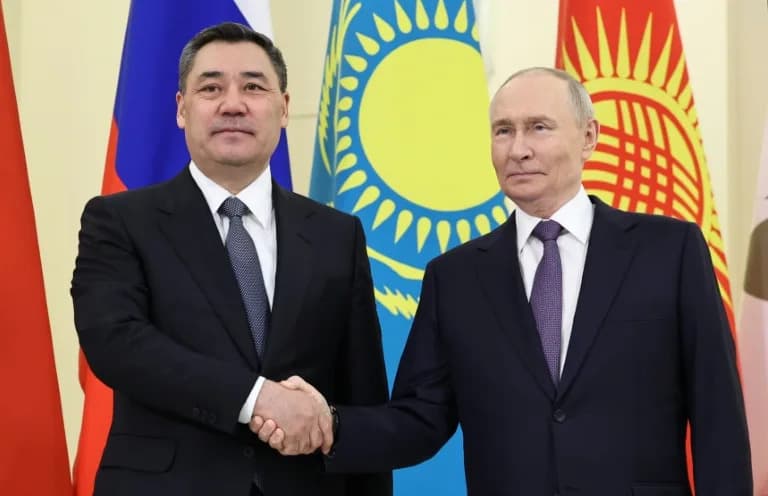
'Authoritarian tendancies': Kyrgyzstan's President Sadyr Japarov meeting his Russian counterpart Vladimir Putin in December (Alexander KAZAKOV)(Alexander KAZAKOV/POOL/AFP)
Kyrgyzstan's President Sadyr Japarov on Monday dismissed three ministers widely regarded as allies of the recently removed former head of the country's security services, in a move seen as clearing the political field ahead of next year's presidential election.
What Happened
The presidential administration said Japarov removed the ministers of transport, environment and emergency situations. The shake-up follows the surprise ouster last week of former security chief Kamchybek Tashiev, who had governed in close tandem with Japarov.
Official Justification
Speaking to state media, Japarov said the dismissals were intended to thwart the likelihood of a "coup" and to block what he described as plots by officials close to Tashiev to steer Kyrgyzstan "off the right path" and inflame regional and political divisions.
"We are acting to prevent attempts to destabilize the country," Japarov told state outlets, framing the moves as necessary to protect stability.
Political Context
Kyrgyzstan — once viewed as a relative outlier for pluralism in an otherwise authoritarian Central Asia — has experienced repeated upheaval, including three revolutions since the Soviet Union's collapse. After the 2020 uprising Japarov strengthened his control, sidelined rivals and has ruled for nearly six years; he is widely seen as the overwhelming front-runner for the presidential vote scheduled for next year.
The Japarov–Tashiev pairing had been an informal north–south power-sharing arrangement in a country where regional affiliation matters: Japarov is from the north and Tashiev from the south, and Kyrgyzstan's rugged mountains separate communities with strong local identities.
Reactions and Risks
Rights groups and critics say the latest dismissals fit a broader pattern of authoritarian consolidation as Japarov tightens control and projects himself as a guarantor of stability. Observers warn that removing influential figures and allies ahead of an election risks narrowing political competition and further polarizing the country.
For now, the government's narrative stresses preventing unrest and protecting unity; opponents and rights organizations stress the danger of shrinking civic space and weakened checks on power.
Help us improve.