GAO Review: The GAO found the FBI routinely used lower-threshold "assessments"—rather than formal investigations—to collect information, enabling scrutiny of roughly 1,100 targets labeled as Sensitive Investigative Matters (SIMs). Conversion Gap: SIM-designated assessments were converted to investigations at about a 48% rate versus 14% overall for Type I/II assessments. Compliance Issues: The GAO documented instances of insufficient authorized purposes, unauthorized methods, uneven reporting across field offices, and reliance on self-reporting, prompting calls for stronger oversight.
Report: FBI Used Lower-Threshold “Assessments” to Monitor About 1,100 ‘Sensitive’ Targets
Report: The FBI Bent Its Own Rules To Spy on 1,100 'Sensitive' Targets
The Government Accountability Office (GAO) found that the Federal Bureau of Investigation frequently used a lower standard called "assessments" to collect information—allowing the bureau to monitor roughly 1,100 targets labeled as Sensitive Investigative Matters (SIMs). The review raises questions about whether assessments are being used as a backdoor around the higher legal predication required to open formal investigations.
Background and Oversight
Members of Congress and outside groups pressed for scrutiny. Representatives Jamie Raskin (D–Md.) and Nancy Mace (R–S.C.) asked the GAO to examine whether assessments were being abused as end-runs around investigative limits. The Cato Institute then sued for records; reporting from Racket News and a Cato post helped make parts of the GAO report public after it was initially distributed as "for official use only."
What Is an Assessment?
Unlike a formal investigation, an assessment can be opened "with an authorized purpose and clearly defined objective and without a particular factual predication," the GAO summary notes. By contrast, initiating an investigation requires predication—allegations, facts, or circumstances that indicate possible criminal or national security threats. The Attorney General's Guidelines for Domestic FBI Operations (2008) allow assessments to detect or obtain information about federal crimes, threats to national security, or foreign intelligence, but they also can serve as gateways to higher-threshold inquiries.
Assessment Types and Scale
The GAO categorized assessments into several types: Type I/II target individuals or organizations connected to potential federal crimes or national security threats; Type III address threats within a field office's area of responsibility; Type IV examine internal FBI information gaps; Type V evaluate potential sources' suitability and credibility; and Type VI concern foreign intelligence collection. From 2018 through 2024, the FBI opened approximately 127,000 Type I/II and Type III assessments—about 124,000 Type I/II and 2,800 Type III.
Sensitive Investigative Matters (SIMs)
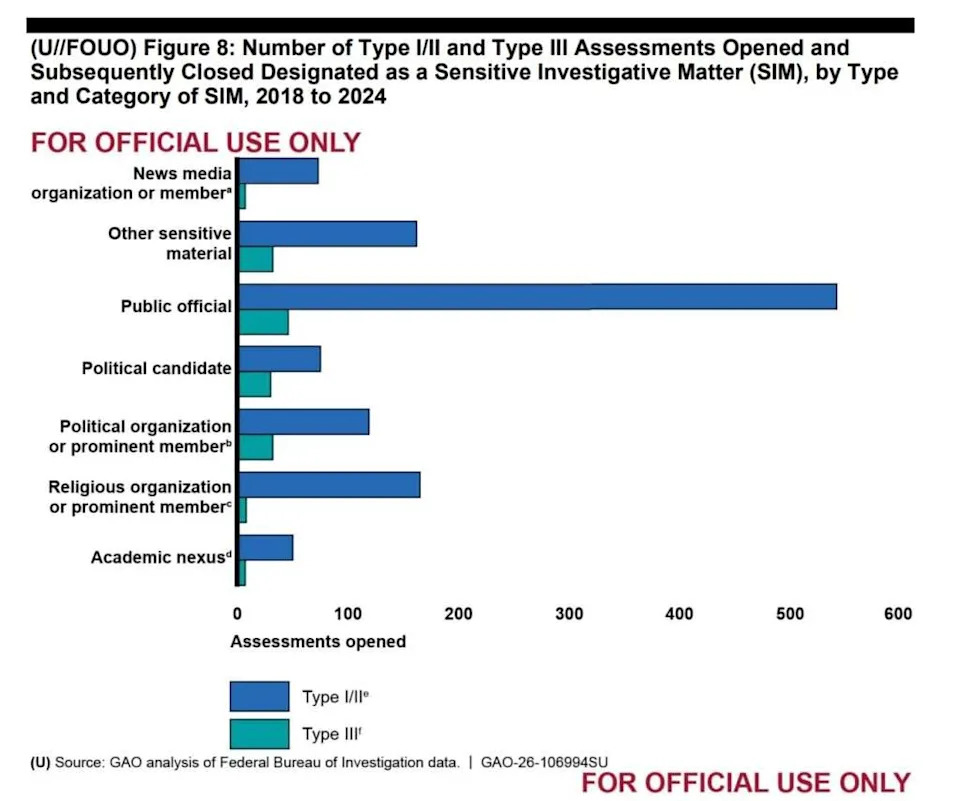
Some assessments were designated SIMs because they involved domestic political candidates, religious organizations, journalists, public officials, political organizations, or prominent members thereof. Between 2018 and 2024 the FBI designated roughly 1,100 Type I/II assessments and about 100 Type III assessments as SIMs; the largest single category among those SIMs was public officials.
Government Accountability Office(Government Accountability Office)
Conversion Rates and Disparities
The GAO found notable differences in conversion rates. Approximately 14% of Type I/II assessments overall were later converted into formal investigations, which require higher predication. But among the ~1,100 Type I/II assessments designated as SIMs, about 48% were converted into investigations—more than three times the overall Type I/II conversion rate. That gap suggests SIM-designated assessments were far more likely to escalate into full investigations.
Instances of Noncompliance
The GAO reviewed a sample of assessments and "information only" incidents and found evidence that FBI personnel sometimes violated even the looser rules for assessments. Of 988 reviewed Type I/II assessments and information-only incidents from 2018–2024, roughly 5% contained insufficient authorized purposes and about 7% involved unauthorized investigative methods. These issues were widespread rather than isolated: 24 of 56 field offices reviewed from 2021–2024 had used unauthorized methods at least occasionally for information-only activities tied to assessments.
"Today, the FBI can gather a dossier on anyone they choose. And the amount of information available is so much broader than anything J. Edgar Hoover could have imagined," said former FBI special agent Mike German.
Systemic Weaknesses and Recommendations
The GAO also flagged internal weaknesses: offices often did not share negative findings widely to discourage repeat misconduct, and the FBI largely relies on staff self-reporting to identify noncompliance—an approach the bureau acknowledges likely undercounts violations. In 2023, eight of 15 field offices that received National Security Reviews received identical recommendations for noncompliance with authorized purpose requirements, pointing to repeated, similar failures across regions.
Critics argue the combination of a low bar to open assessments and uneven adherence to rules poses significant civil liberties risks. Patrick G. Eddington of the Cato Institute suggested the misuse of assessments could be a Bill of Rights–level problem and urged Congress to consider a broad, Church Committee–style review of executive-branch surveillance programs. The issue has drawn comparisons to other surveillance concerns, such as FISA Section 702 electronic surveillance, which is set to expire in April 2026.
Conclusion
The GAO report, along with related reporting and litigation, indicates that the FBI has used the assessment category extensively—and that assessments designated as SIMs were especially likely to become full investigations. GAO-identified noncompliance, uneven reporting, and dependence on self-reporting highlight weaknesses that oversight bodies and lawmakers may need to address to protect civil liberties while preserving legitimate investigative tools.
Help us improve.