The author critiques a New York Times headline and Katherine Mangu-Ward’s op-ed, arguing that while libertarians have long warned about the growth of executive power, too few explicitly identified Donald Trump as a uniquely dangerous threat. Drawing on personal experience at Reason, the piece describes how many libertarians shifted toward MAGA or adopted a neutral "both-sides" posture, often penalizing those who spoke out. The author lists specific institutional concerns and argues that naming the distinct threat Trump posed was—and remains—crucial to protecting civil liberties.
Libertarians Warned Of The “Imperial Presidency” — But Too Few Named Trump’s Unique Threat
Libertarians warned about the ‘imperial presidency’ — but too few warned about Trump
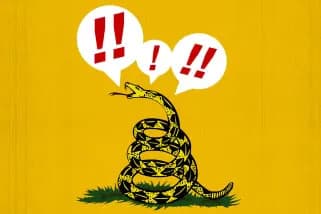
When I first saw the New York Times headline "Libertarians Tried to Warn You About Trump," I bristled: the line didn’t match Katherine Mangu-Ward’s argument. The column—illustrated by a Gadsden flag’s coiled snake seemingly poised to be stomped by a black jackboot—was written by Mangu-Ward, editor in chief of Reason, the libertarian outlet where I spent roughly six years as a journalist before leaving soon after President Donald Trump’s first inauguration.
The Times later amended the headline to the less specific but more accurate "Libertarians: We Told You So." That correction matters because it highlights a central distinction: many libertarians have long warned about the growth of presidential power in the abstract, but far fewer explicitly identified Donald Trump as a uniquely dangerous actor whose rhetoric, tactics and governing style posed different and deeper threats to liberty.
Abstract Warnings Versus Specific Dangers
It’s true that generations of libertarian thinkers have sounded the alarm about executive aggrandizement. But a generalized alarm about the "Imperial Presidency" is not the same as naming a single political movement and its leader as uniquely authoritarian, vindictive, racist, corrupt and lawless. Trump was never merely an abstract risk: from the beginning he telegraphed who he was. Only a minority of libertarians — not necessarily heroic, just clear-eyed — called him out for what he proved to be.
The Cost Of Even-Handedness
Too many in the libertarian movement chose a posture of even-handedness or "pox on both your houses." Framed as principled nonpartisanship, that stance frequently blurred important distinctions and created false equivalences. Treating temporary public-health restrictions as morally or practically equivalent to the kinds of extrajudicial policing, summary violence or institutional capture associated with authoritarian regimes obscures what was and is truly at stake.
My Position And Critiques Across The Spectrum
I describe myself as a civil libertarian, not a partisan Democrat. During the Trump administration, the cultural "Great Awokening" and the Covid pandemic, I criticized the left on civil-libertarian grounds: reductive racial essentialism, left-wing political violence, and Covid-era school closures that often outlasted scientific justification. I’ve also criticized Joe Biden and Kamala Harris for troubling records on civil liberties, drug policy and criminal justice. Still, my red lines include refusal to support any party that broadly debases itself by backing demonstrably false claims and endorsing a president who refuses to leave office peacefully.
How Libertarian Circles Shifted
Over roughly the last decade, many who identified with libertarianism drifted toward Trumpism in multiple ways: some went fully MAGA (including, controversially, parts of Libertarian Party leadership in 2024), others were "MAGA-curious"—comfortable with large parts of his agenda despite objections to a few policies—and many adopted a form of anti-anti-Trump bothsidesism that routinely cast Democrats as the greater danger.
Those who loudly warned about Trump’s escalating racism and violent rhetoric were often dismissed as "woke-adjacent" or afflicted by "Trump Derangement Syndrome." Many critics who took his words and actions seriously faced social and professional repercussions; some, including former Reason colleague Shikha Dalmia, say they lost jobs for being too outspoken. These claims are credible and emblematic of how internal pressure shaped public discourse.
Specific Dangers And Institutional Erosion
The author points to a string of developments in 2026 that, she argues, would have been unlikely under an ordinary Democratic administration: inflammatory and racist falsehoods from top Republican officials about migrants; public defenses of extremist-sympathetic groups; and instances where institutions and norms appeared to buckle under partisan pressure.
Examples The Author Highlights
- Claims that agency social posts used overtly white-supremacist imagery or themes.
- Senior officials publicly denigrating diversity in the armed forces or civil institutions.
- Attempts to prosecute or intimidate political opponents, including members of Congress.
- Self-interested use of executive leverage over funding, infrastructure or international trade.
- Allegations of secretive or extrajudicial actions by state agents and erosion of due process.
Whether each example is framed as confirmed fact or as the author's warning, the cumulative effect described is institutional erosion: norms and checks that historically constrained executive excess appear strained or weakened when a determined actor weaponizes them.
Conclusion: Naming The Threat Matters
It’s not merely that big-government expansions under past presidents created risk; the argument here is that the specific person holding power matters. A minority within the libertarian tent consistently named Trump’s movement for what it was: a danger rooted in racism, violence and proto-fascist tendencies. They weren’t especially brave; they were simply unwilling to avert their gaze. In hindsight, their warnings were prescient, and the rest of the movement should reckon with what silence and even-handedness cost.
Originally published on ms.now
Help us improve.