Kentucky Gov. Andy Beshear’s public call to withdraw ICE agents from cities drew a forceful response from Republican Attorney General Russell Coleman, who said cooperation with federal immigration authorities remains necessary for public safety. Coleman argued the governor’s comments were out of step with law-enforcement realities and stressed that many county sheriffs and the Kentucky State Police continue to work with ICE and DHS. Legal experts noted that governors often lack the legal authority to compel independently elected sheriffs to change enforcement practices, and DHS defended continued arrests of criminal noncitizens in Kentucky.
Kentucky Governor’s Call to Withdraw ICE Agents Sparks Legal and Political Clash With State Attorney General
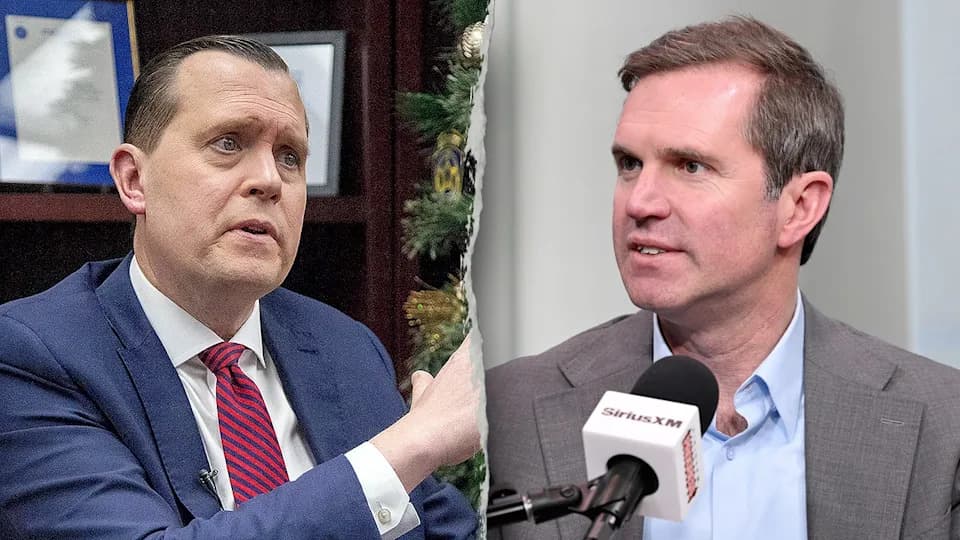
Kentucky Attorney General Russell Coleman, left, and Gov. Andy Beshear(Getty Images)
Kentucky Gov. Andy Beshear’s televised call for Immigration and Customs Enforcement (ICE) agents to be pulled out of “every city” has prompted a sharp rebuke from Republican Attorney General Russell Coleman, setting up a potential intergovernmental dispute over how state and local authorities cooperate with federal immigration enforcement.
Governor’s Remarks
Speaking on ABC’s The View, Beshear said the agency needs “top-to-bottom” reform, urged leadership changes and recommended retraining for agents. He also invoked a rising “body-count of American citizens” as a reason to pause and reassess ICE operations nationwide.
"Every ICE agent should be withdrawn from every city and every community that they're in. This organization has to be reformed from the top-down," Beshear said on the program.
Attorney General’s Response
From the sheriff’s office in Daviess County — one of several Kentucky jurisdictions that currently cooperate with ICE — AG Russell Coleman called the governor’s comments “absurd” and said they conflicted with the law-enforcement reality on the ground.
"My view as the chief law enforcement officer of this commonwealth, someone that's carried a badge and a gun, someone that has been a federal prosecutor, [is] that statement that the governor made was absurd," Coleman told Fox News Digital.
Coleman emphasized that many of Kentucky’s roughly 120 county sheriffs and the Kentucky State Police continue to work with the Department of Homeland Security (DHS) and ICE, and that collaboration has produced arrests in cross-jurisdictional operations — including a recent operation across the Tug Fork River that he said resulted in roughly 650 arrests.
Legal Limits And Practical Politics
Legal experts say the dispute highlights limits on a governor’s ability to dictate actions by other independently elected state or local law-enforcement officers. Zack Smith, a former federal prosecutor in Florida, noted that while attorneys general can issue legal opinions, governors and sheriffs are separately elected constitutional officers in many states and typically cannot compel each other’s actions except in narrow circumstances.
Smith also pointed to 287(g) agreements — formal pacts that authorize local agencies to perform certain immigration functions — as a complicating factor that could limit a governor’s practical authority to end cooperation unilaterally.
Examples Cited By Officials
Coleman and local law-enforcement partners cited operations that removed violent offenders from the streets, including the arrest of individuals accused of serious crimes. DHS officials, meanwhile, highlighted arrests they said underline the need to sustain federal-state cooperation.
Federal Response
At the federal level, DHS Assistant Secretary Tricia McLaughlin pushed back on Beshear’s remarks, saying federal agents would continue arresting criminal noncitizens in Kentucky and criticizing what she described as political efforts to undermine enforcement. McLaughlin argued that State and local engagement reduces the need for a larger federal presence and cited several high-profile arrests alleged by DHS.
Regional Context And Possible Fallout
The debate in Kentucky comes amid similar tensions elsewhere: in neighboring Virginia, some officials are moving to curtail state-federal immigration cooperation and lawmakers are advancing bills to restrict DHS collaboration. Coleman said he does not expect Kentucky to follow Virginia’s recent course.
Bottom line: The episode underscores a broader tension in U.S. immigration enforcement — between governors using public platforms to call for policy change and the practical limits of their authority when cooperating agencies and elected local officials choose their own course.
Help us improve.