Bangladesh holds a pivotal election on February 12 with nearly 128 million eligible voters as the country seeks to return to democratic rule after Sheikh Hasina's ouster in August 2024. Corruption tops voters' concerns, while inflation (8.58% in January), stalled post-pandemic growth and youth employment are also central issues. The ban on Hasina's Awami League complicates the race, though surveys show many former Awami League supporters shifting toward the BNP or Jamaat.
Bangladesh Votes Feb. 12: Corruption, Inflation and A Contested Return To Democracy
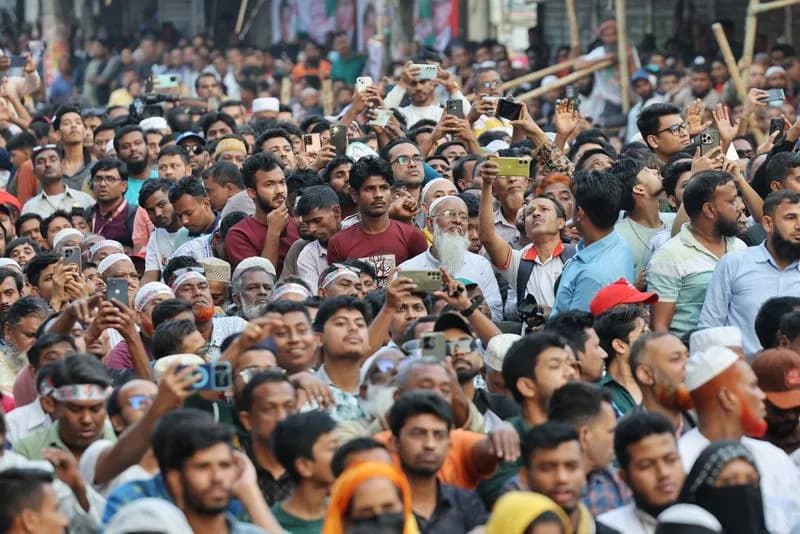
Supporters of the Bangladesh Nationalist Party (BNP) chant slogans, during an election campaign rally attended by the party chairman, Tarique Rahman, ahead of the national election, at Jatrabari, in Dhaka, Bangladesh, February 9, 2026. REUTERS/Mohammad Ponir Hossain
Bangladeshis are voting on February 12 in an election that could restore democratic rule after a popular uprising in August 2024 ousted long-time leader Sheikh Hasina. Nearly 128 million people are eligible to vote in a nation of about 175 million that has been led by an unelected interim administration since Hasina's departure.
Key Issues
Corruption
A Dhaka-based opinion survey by the Communication Research Foundation and Bangladesh Elections and Public Opinion Studies found corruption to be voters' top concern. Bangladesh consistently ranks near the bottom of Transparency International's Corruption Perceptions Index. Both the frontrunning Bangladesh Nationalist Party (BNP) and Jamaat-e-Islami have made fighting graft central to their campaigns, and Jamaat's anti-corruption positioning has helped its political comeback.
Inflation
Official data show inflation rose to 8.58% in January. More than two-thirds of respondents in the cited survey listed rising prices as their second-largest worry, making cost-of-living pressures a major driver of voter sentiment.
Economic Development
Once among Asia's fastest-growing economies, Bangladesh has struggled to regain momentum after the COVID-19 pandemic sharply disrupted its export-driven garment sector. The 2024 protests that toppled Hasina and led to her exile further unsettled the sector and weighed on overall growth. Voters ranked economic development among their top priorities.
Employment
With roughly 40% of the population under 30, the next government faces intense pressure to create jobs for millions of young people. Prolonged political and economic instability has made youth employment an urgent electoral issue.
Ban On Hasina's Awami League
Hasina's Awami League has been barred from contesting the election. Hasina warned the ban could leave millions without their preferred candidates and prompt calls for a boycott. While some supporters have said they will abstain, most analysts do not expect a widescale boycott; a recent survey suggests nearly half of former Awami League voters now prefer the BNP, with roughly 30% favoring Jamaat.
Outlook: The vote will test whether Bangladesh can transition back to elected civilian rule while addressing corruption, inflation and job creation amid lingering economic disruption.
Help us improve.