The U.S. plans to offer Bangladesh military systems from America and allied partners as alternatives to Chinese equipment, reflecting Washington's concern over Beijing's growing influence. The announcement comes ahead of a general election after the August 2024 uprising that ousted Prime Minister Sheikh Hasina. China recently agreed to build a drone factory near the India border, and Dhaka has discussed JF-17 fighter jets with Pakistan. The U.S. also prioritizes commercial diplomacy and remains the largest donor for roughly 1.2 million Rohingya refugees.
Exclusive: US Offers Military Alternatives To Counter China Ahead Of Bangladesh Election
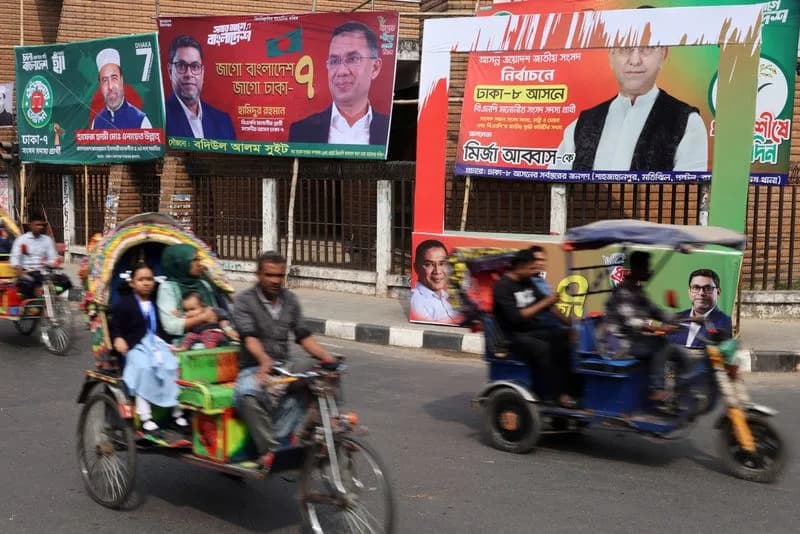
FILE PHOTO: Vehicles pass by election campaign banners ahead of the national election, in Dhaka, Bangladesh, February 10, 2026. REUTERS/Mohammad Ponir Hossain/File Photo
The United States is preparing to offer Bangladesh a range of defence options from the U.S. and allied partners as an alternative to Chinese military hardware, U.S. Ambassador to Dhaka Brent T. Christensen told Reuters. The move reflects growing Washington concern about expanding Chinese influence in South Asia as Bangladesh heads to a pivotal general election.
US Concerns and Diplomatic Offer
"The United States is concerned about growing Chinese influence in South Asia and is committed to working closely with the Bangladeshi government to clearly communicate the risks of certain types of engagement with China," Christensen said in an interview. He added that Washington "offers a range of options to help Bangladesh meet its military capability needs, including U.S. systems and those from allied partners," but did not provide specific offers.
Christensen: "We will work with whichever government is elected by the Bangladeshi people."
Context: Political Shift And Regional Dynamics
Bangladesh is due to hold a general election after an August 2024 uprising led largely by Gen Z that forced long-time, India-aligned prime minister Sheikh Hasina from office. Hasina has since taken refuge in New Delhi. Her departure has coincided with a detectable increase in China's engagement in Dhaka while India’s influence has waned, diplomats say.
Recently, Beijing signed a defence agreement to build a drone factory near the India border, a development that alarmed foreign diplomats. Dhaka has also held talks with Pakistan about acquiring JF-17 Thunder fighter jets, a multi-role aircraft developed jointly by China and Pakistan.
China's Response
China's Foreign Ministry defended its relationship with Bangladesh, saying the two countries are "comprehensive strategic partners" and that their cooperation across political, economic and security fields benefits both sides. The ministry added that their partnership is not directed against any third party and rejected outside interference.

FILE PHOTO: A 3D-printed miniature model of U.S. President Donald Trump and the Bangladesh flag are seen in this illustration taken July 23, 2025. REUTERS/Dado Ruvic/Illustration/File Photo
Economic Ties And Commercial Diplomacy
Christensen said commercial diplomacy is a principal U.S. priority. Many American companies are evaluating investments in Bangladesh but seek early, clear signs from the incoming government that it is "open for business." Although Chevron has operated in Bangladesh for decades, relatively few U.S. consumer brands or major firms have a visible presence, citing issues such as high taxes and difficulties repatriating profits. Notably, there are no Starbucks or McDonald's locations in the country.
The ambassador also said the Trump administration would like to see improved India-Bangladesh relations to support regional stability. Ties between New Delhi and Dhaka have deteriorated since Hasina's departure, affecting visa services and even cricket exchanges.
Humanitarian Support For Rohingya Refugees
On humanitarian matters, Christensen reiterated that the United States remains the largest single contributor to assistance for roughly 1.2 million Rohingya refugees sheltered in Bangladesh and continues robust health programming there. He pointed to a recent $2 billion worldwide funding framework agreed with the United Nations to improve aid effectiveness and urged other international donors to increase their contributions.
UN agencies have faced funding shortfalls in recent years, forcing reductions in food rations and the closure of some schools for Rohingya children.
Reporting by Krishna N. Das in Dhaka; additional reporting by Ryan Woo in Beijing and Tora Agarwala and Zia Chowdhury in Dhaka; edited by Saad Sayeed.
Help us improve.