Thousands of U.S. high school students have staged walkouts over the past six months to protest ICE activity in their communities. The Guardian interviewed seven teen organizers who described actions that went beyond leaving class: distributing "know your rights" materials, monitoring social media for ICE sightings, and staging coordinated speeches and posters. Students from Wisconsin, Maryland, Texas, California and New York said fear for family and immigrant neighbours drove their activism, and many urged peers to stay engaged despite risks of discipline or community backlash.
‘You Can’t Let Despair Take Over’: High Schoolers Nationwide Stage Walkouts To Protest ICE
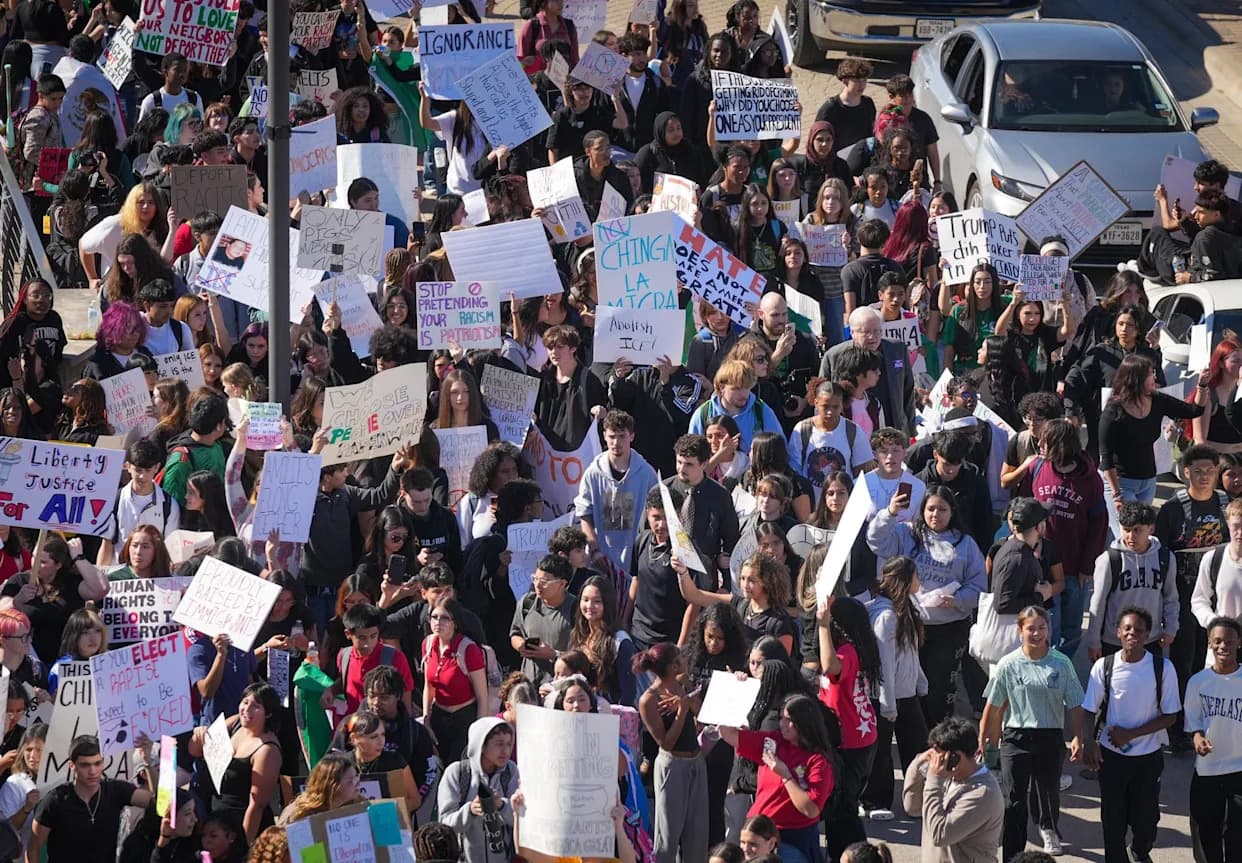
Hutto high school students march against ICE near city hall, in Hutto, Texas, on 5 February.Photograph: Jay Janner/Austin American-Statesman via AP(Photograph: Jay Janner/Austin American-Statesman via AP)
Over the past six months, thousands of U.S. high school students have staged walkouts to protest the presence and actions of Immigration and Customs Enforcement (ICE) in their communities. Responses from schools ranged from public support to threats of disciplinary action, while some remained neutral out of concern for students whose families might be exposed by publicity.
The Guardian spoke with seven teenagers who organized or joined these actions. Their activism often extended beyond walking out of class: students distributed "know your rights" guides, monitored social media for alleged ICE sightings and created political posters. Below are their accounts in their own words, edited for clarity.
Lark and Kiran — Silver Spring, Maryland
Lark (they/them): "This was our way to make our voices heard, because at the end of the day, we’re 16 — what we say isn’t going to make a lawmaker listen to us."
Kiran: "Our school population is majority Hispanic, and those are the people who are racially profiled by ICE, so it’s this huge fear. Lots of people in my family are immigrants and scared of what’s going on. Ethiopian immigrants in my family aren’t Hispanic, so when I’m protesting I’m thinking beyond my family — I’m thinking about people who don't have the privileges mine does."
Lark: "You have to care for your community, your friends, your family, your found family. Even though protesting leaves you emotionally exposed, you can’t let hopelessness and despair take over. Remain involved — if we can do it, so can you."
The Woodlands, Texas — High School Student
This student described a conservative community where the school board has banned many books. "It’s important that we express how we feel, especially because there’s a lot of fearmongering. Mostly everyone here supports ICE and pretty much everything Trump is doing right now. But today our student body demonstrated its commitment to social justice and we are proud of it. We will never tolerate the incitement of violence in our community."
Nathalie — Milwaukee, Wisconsin
Nathalie, 17: "I started my speech by naming the people killed by federal agents in January. Hearing those names aloud makes you realise how many that is in such a short span of time. The protest was for those people — I wanted them to know we were thinking of them, not only our families being targeted but them too."
They described feeling blamed and dehumanized by political rhetoric and explained the fear many families face: parents being pursued by agents and younger siblings used as bait. "My dad is an immigrant. Though I may not look stereotypically like it, that blood is still in me. ICE would take him, and it made me angry thinking about it."
Los Angeles — Student Organizer
This student pointed to online content that amplifies fear. "The White House has a TikTok account, and they’ll post things like 'deportation ASMR.' You go on YouTube the night before and you watch an ad featuring a political figure threatening people who have come to this country. It’s frightening."
They added that many high schoolers are learning their rights in class only to see online messages that undermine those rights. Students fear organizing because of how parents or others might react, but many feel speaking out is both noble and brave so long as it doesn’t place participants in physical danger.
Arianna and Rhy — New York City
Arianna: "My grandmother is an immigrant. I live with her. I wouldn’t be here without her. Immigrants contribute so much to this country; you can’t be mad at us for doing jobs you don’t want to do or for bringing culture. New York is built by immigrants — every neighbourhood reflects that."
Arianna: "I feel scared about ICE every day. I have nightmares. But I won’t let that stop me — bravery is a positive way to be scared, and I’d rather be brave than afraid."
Rhy: "Being scared makes me want to get more involved. My little cousins are scared because people tell them, ‘you’re brown, you’re going to be deported.’ There’s no reason people should be afraid to go outside. 'Land of the free'? I do not feel very free right now."
They urged classmates to stay informed and involved, especially as some states restrict teaching about immigrant histories. "One suspension isn’t that deep if you’re standing up for people you care about. Just be brave."
What students did beyond the walkouts: they organized informational outreach ("know your rights" materials), monitored social media for ICE activity, coordinated with peers across schools and used public speeches to name victims and humanize those affected.
These teenagers’ accounts show a mix of fear and determination: fear for family safety and community response, and determination to resist dehumanizing rhetoric and policies. Their actions underscore how young people are engaging civically and using direct action to call attention to immigration enforcement practices they view as harmful.
Help us improve.