Rural workers across India—many of them farmers by day—are increasingly performing essential data-labelling tasks that power global AI systems. An estimated 200,000 annotators in villages and small towns (per Scry AI) label images and video for uses from autonomous vehicles to security systems, earning roughly $275–$550 a month. The trend is attracting big-tech investment, expanding women's employment, and creating new local opportunities while strengthening AI development worldwide.
Rural India Powers Global AI: Farmers By Day, Data Annotators By Night
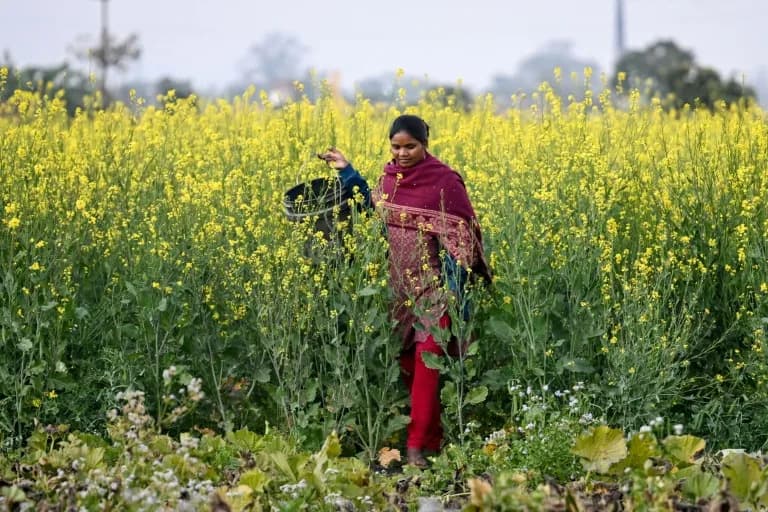
The government hopes the AI-driven labour shift will bring more women into the workforce (Arun SANKAR)(Arun SANKAR/AFP/AFP)
At dawn Chandmani Kerketta tends her tomato and pea crops in Jharkhand; by night she logs on to label images and videos that help train global artificial intelligence systems. Her story reflects a growing trend across India's villages and small towns: rural residents performing essential data-annotation work that fuels everything from driverless-car systems to content-moderation models.
These roles are straightforward but vital—labelling, annotating and performing quality checks on images, video frames and documents so machine-learning models can learn to recognise objects, behaviours and contexts accurately.
"This job helped me finish my studies, and help at home on our farm," Kerketta said. "After my night shift of data work, I sleep a little, and then help in farming. In Jharkhand, farming is everything."
How The Shift Works
After a brief computer course at her village school, Kerketta joined what US-based Scry AI estimates is at least a 200,000-strong workforce of annotators in India—many in small towns and rural centres. These workers can label hundreds of items in an eight-hour shift, either from modest local internet hubs or from home.
Tasks vary from tagging simple images to painstaking frame-by-frame annotation for video—such as distinguishing whether a person at an ATM is a customer or a potential thief—work that directly improves model accuracy.
Small-Town Offices And Global Reach
India, now ranked third in a global AI power index by Stanford University's Institute for Human-Centered AI, is attracting major investment. Google, Microsoft and Amazon have announced multi-billion-dollar projects to build large data centres in the country, while local firms such as NextWealth operate satellite offices in small towns to serve clients across the US, Europe and Asia.
NextWealth founder Sridhar Mitta stresses the geographic flexibility of such work: "When I can design a product for a US company 5,000 miles away, why can't I do it from 200 miles away? Anybody can be anywhere, because the value goes through the internet." Salaries for many rural annotators range from roughly $275 to $550 a month.
Social Impact: New Incomes And Opportunities For Women
Beyond wages, AI labelling jobs are quietly reshaping social dynamics. For women from conservative backgrounds, night-shift or local-centre work provides both learning opportunities and financial independence. Workers like Indu Nadarajan and Amala Dhanapal say the jobs have boosted local pride and helped change family expectations about education and employment.
"Being here in our hometown and learning about AI makes me feel very proud," Nadarajan said. Kerketta recalls that villagers once mocked her when she began annotating data; now they take pride in seeing her ride a scooter around town.
What Comes Next
Industry leaders predict that while automation may displace some roles, new opportunities—such as micro-entrepreneurship and specialized local service providers—will emerge. For now, the rural annotator workforce is a critical but often overlooked backbone of the global AI supply chain: low-profile work with outsized impact on how models perform worldwide.
Help us improve.