Immigration and Customs Enforcement told hospital staff that Alberto Castañeda Mondragón ran headfirst into a brick wall while handcuffed, but Hennepin County Medical Center clinicians and an outside forensic pathologist said his injuries — including at least eight skull fractures and hemorrhages in multiple brain regions — were inconsistent with that explanation. ICE agents’ conduct at the hospital, including temporarily shackling his ankles, heightened tensions and prompted new internal protocols. A federal judge later ordered his release; he was discharged but faces significant memory loss and a lengthy recovery.
Doctors Reject ICE Claim That Detainee ‘Ran Into Wall’ After Suffering Multiple Skull Fractures; Tensions Rise at Minnesota Hospital

The Hennepin County Medical Center emergency department is seen Friday, Jan. 30, 2026, in Minneapolis. (AP Photo/Julia Demaree Nikhinson)
MINNEAPOLIS — Intensive care nurses at Hennepin County Medical Center immediately questioned the account given by Immigration and Customs Enforcement (ICE) when agents brought in a Mexican national with severe head injuries.
ICE agents initially told hospital staff that Alberto Castañeda Mondragón, 31, had tried to flee while handcuffed and "purposefully ran headfirst into a brick wall," court papers say. Medical personnel, including doctors and nurses involved in his care, concluded the pattern of fractures and bleeding in his brain could not be explained by that scenario.
Injuries Inconsistent With ICE Account
About four hours after his Jan. 8 arrest near a St. Paul shopping center, Castañeda Mondragón arrived at a suburban emergency room with swelling, bruising and active bleeding. A CT scan later revealed at least eight skull fractures and life-threatening hemorrhages in at least five areas of his brain, and he was transferred to HCMC for critical care.
Hospital clinicians who reviewed his scans and condition — along with an outside forensic pathologist consulted by The Associated Press — said the injuries were inconsistent with an accidental fall or a person deliberately running into a wall. "There was no way this person ran headfirst into a wall," a nurse familiar with the case said on condition of anonymity. Dr. Lindsey C. Thomas, a board-certified forensic pathologist, said she was "pretty sure" those extensive injuries could not be self-inflicted by running into a wall.
Confrontation Over Restraints
The presence of ICE at Castañeda Mondragón’s bedside became contentious when agents insisted on shackling his ankles to the hospital bed. Staffers said the patient was disoriented — unable to state the year and not recalling how he was injured — and that his behavior was consistent with traumatic brain injury. Hospital security, the CEO and the hospital attorney were brought into discussions. Staff and ICE eventually agreed to have a nursing assistant sit with the patient; the shackles were removed later.
Court filings also quote at least one ICE officer as saying the man "got his (expletive) rocked" after the arrest. The Department of Homeland Security did not respond to requests for comment about how the injuries occurred; a deportation officer wrote in court paperwork that intake procedures determined he "had a head injury that required emergency medical treatment."
Broader Tensions at HCMC
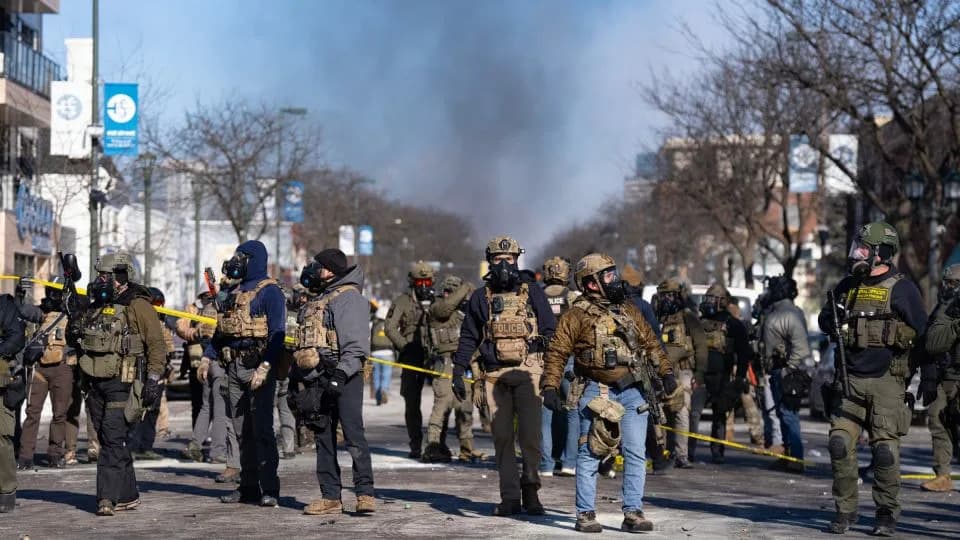
Staffers described heightened friction since the launch of Operation Metro Surge, part of stepped-up immigration enforcement in Minnesota. Nurses and doctors said ICE agents have sometimes stayed at patient bedsides for days, restrained patients in ways that conflicted with hospital policy, loitered on campus and questioned patients and employees about citizenship. Some hospital employees reported feeling intimidated, avoiding certain restrooms to reduce encounters and using encrypted messaging apps to share information out of concern about surveillance.
The hospital reminded employees that ICE cannot access patients or protected health information without a warrant or court order. A hospital bulletin emphasized: "Patients under federal custody are first and foremost patients," and reiterated that restraints should be used only when medically necessary. Hospital spokeswoman Alisa Harris said ICE agents "have not entered our facilities looking for individuals."
Legal Outcome and Recovery
More than two weeks after his arrest, a U.S. District Court judge ordered Castañeda Mondragón released from ICE custody. He was later discharged from the hospital. Justice Department filings confirmed he is no longer in federal custody.
His family and attorneys say he has no criminal record, entered the U.S. in 2022 with valid documents and founded a small company in Minnesota. He suffers significant memory loss and faces a long recovery, likely unable to work for the foreseeable future. "He still doesn’t remember things that happened. I think (he remembers) 20% of the 100% he had," his brother Gregorio said from Mexico.
Note: The account combines reporting from hospital staff, court records and outside medical experts. Assertions by ICE about how the injury occurred were disputed by clinicians and remain the subject of legal filings.
Help us improve.