Bedouin families in Ras Ein al-Auja are dismantling homes and leaving after repeated attacks and encroachment by a minority of Israeli settlers. Residents report water diversion from the village spring and growing settler housing as close as 100 metres to Bedouin dwellings. The UN recorded 260 settler attacks in October, and while the Israeli military says it has increased presence and deployed new monitoring tools, locals say law enforcement has failed to stop the harassment. About half of the hamlet's roughly 130 families have decided to flee, threatening the Bedouin way of life.
Bedouin Families Driven From West Bank Village as Settler Violence and Water Diversion Escalate
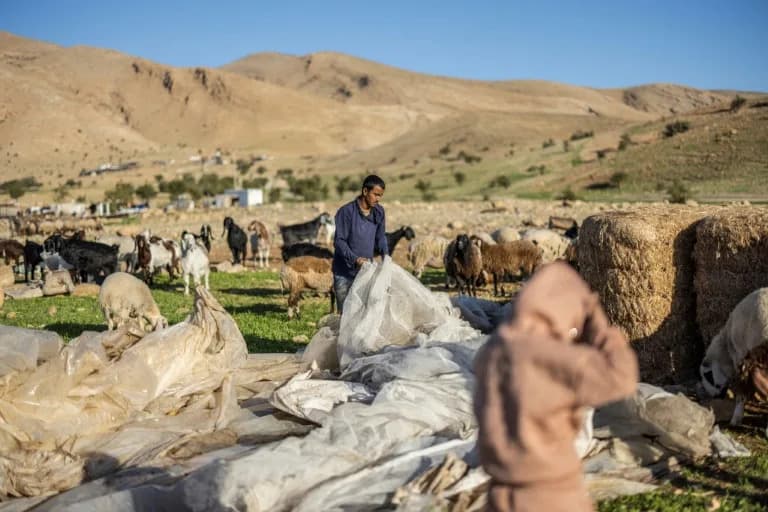
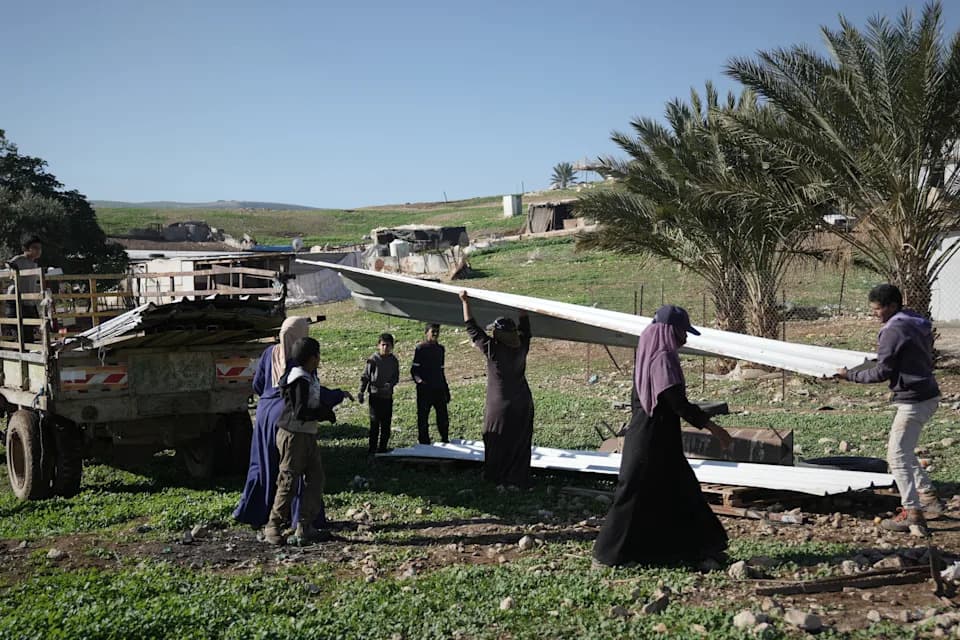
A Bedouin man gathers plastic sheeting as families begin to collect their belongings to leave their homes after harassment from Israeli settlers in Ras Ein al-Auja (ILIA YEFIMOVICH)(ILIA YEFIMOVICH/AFP/AFP)
In the Israeli-occupied West Bank, semi-nomadic Bedouin families in the hamlet of Ras Ein al-Auja are dismantling sheep pens and loading belongings onto trucks after repeated attacks by a minority of Israeli settlers, residents say. The community says inadequate law enforcement and growing settler encroachment have made daily life untenable for many families.
Community Under Pressure
Farhan Jahaleen, a resident of Ras Ein al-Auja, described the situation as "the complete collapse of the community" following "continuous and repeated attacks, day and night, for the past two years." Of the hamlet's roughly 130 families, about half have decided to flee. Jahaleen said 20 families from the local Ka'abneh clan left last week, and around another 50 families have begun dismantling their homes.
Encroachment and Resource Loss
Settler trailers and houses punctuate the landscape around the village; many are being replaced by permanent homes built as close as 100 metres (300 feet) from Bedouin dwellings. In May last year, residents say settlers diverted water from the spring that gave the village its name — a vital resource that had supported the community's self-sufficiency.
"If you defend your home, the (Israeli) police or army will come and arrest you. We can't do anything,"
Bedouin herders say they must constantly stand guard to prevent settlers from cutting power and irrigation pipes or grazing competing herds near Bedouin houses. Settlement watchdogs have described the deliberate introduction of settler flocks into grazing areas as "pastoral colonialism," a tactic that increases pressure on herding communities in isolated areas.
Official Responses and Ongoing Risk
The United Nations recorded an unprecedented 260 settler attacks in October last year, highlighting a sharp spike in violence. Israel's military chief, Lieutenant General Eyal Zamir, said in November he wanted to stop the violence. This month the army announced new monitoring technology aimed at enforcing movement restrictions on both Israelis and Palestinians; Israeli media reported the move is intended in part to curb settler attacks.
When asked for comment, the Israeli military said: "Incidents in the Ras al-Ain are well known. Forces enter the area in accordance with calls and operational needs, aiming to prevent friction between populations and to maintain order and security in the area," and that it has increased its presence "due to the many recent friction incidents."
Still, residents remain unconvinced. Naaman Ehrizat said he had already moved his flock to Hebron ahead of his own relocation, and Jahaleen warned that moving to other rural areas risks exposing families to fresh displacement — citing families from nearby Jiftlik who were again uprooted after relocating within the Jordan Valley.
Loss of Culture and Future
Slogans painted on major West Bank roads reading "No future in Palestine" have deepened a sense of despair among residents. Jahaleen, whose family has lived in Ras Ein al-Auja since 1991, says the community's traditional way of life is being eroded.
"The settlers completely destroyed the Bedouin way of life, obliterated the culture and identity, and used every method to change the Bedouin way of life in general, with the complete destruction of life,"
This unfolding displacement underscores broader tensions in the West Bank, where more than 500,000 Israeli settlers now live alongside roughly three million Palestinians. For Ras Ein al-Auja's Bedouin families, the choices are increasingly stark: remain and face repeated harassment, or leave home and risk further instability elsewhere.
Help us improve.