
MBARI researchers filmed a rare Haliphron atlanticus in Monterey Bay on Nov. 6 at about 2,300 feet, marking only the fifth MBARI sighting in 35 years. The octopus was recorded eating a red, bioluminescent helmet jelly and has been seen reusing jelly tentacles for defense. Females can grow up to 13.1 feet and weigh as much as 165 pounds, while males are significantly smaller. The sighting, captured by an ROV team led by Steven Haddock, provides valuable insight into the behavior of this rarely seen deep-sea species.
Rare Giant 'Seven-Armed' Octopus Spotted in Monterey Bay — Only Fifth MBARI Sighting in 35 Years

A boat sails in Monterey Bay, Calif. (EVA HAMBACH/AFP via Getty Images)
Scientists from the Monterey Bay Aquarium Research Institute (MBARI) recently filmed a giant, elusive octopus identified as Haliphron atlanticus during a midwater research expedition in Monterey Bay.
Details of the Sighting
The biodiversity and biooptics team led by senior scientist Steven Haddock recorded the animal on Nov. 6 at about 2,300 feet (roughly 700 meters) below the surface. MBARI confirmed this is only the fifth time the institute has documented the species in 35 years, underscoring how rarely researchers encounter this deep-sea animal.
"Each observation has provided important insight into the natural history of this rarely seen deep-sea octopus," MBARI's communications team said.
What the Video Showed
The octopus was filmed feeding on a helmet jelly, a red, bioluminescent jellyfish commonly found in the ocean's twilight zone. Although jellyfish are relatively low in calories, they are abundant and serve as an important food source for many large marine animals. After consuming tissue from the jelly's bell, Haliphron atlanticus has been observed reusing the jelly's tentacles as a defensive shield "as a bonus to the meal," MBARI notes.
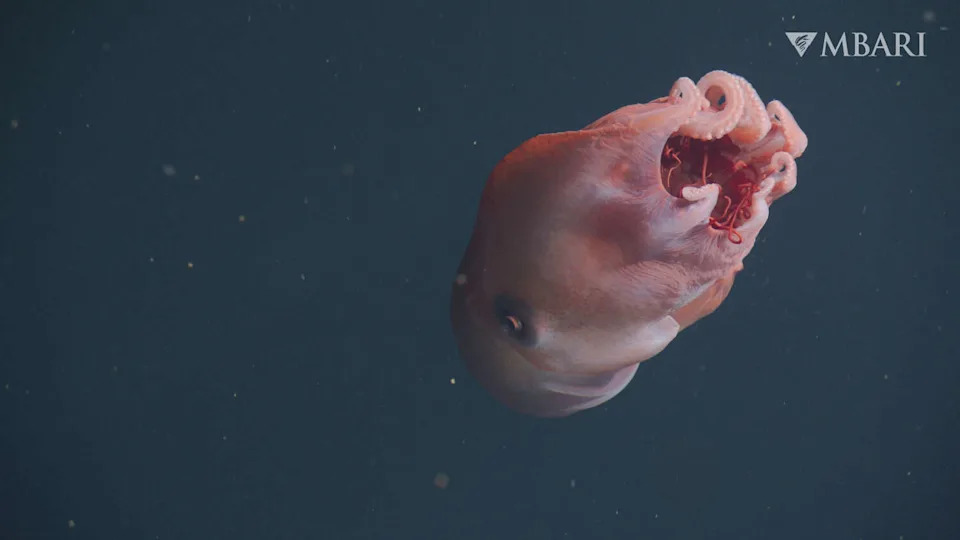
On Nov. 6, 2025, MBARI senior scientist Steven Haddock and researchers in MBARI's biodiversity and biooptics team observed a seven-arm octopus (Haliphron atlanticus) during an expedition in Monterey Bay with MBARI's remotely operated vehicle Ventana at a depth of approximately 700 meters. (© 2025 MBARI)
About Haliphron atlanticus
Haliphron atlanticus inhabits tropical and temperate waters around the globe and can reach an impressive length of about 13.1 feet. Females can weigh up to 165 pounds, while males are typically much smaller — often only around 8 inches long. Although the species has the usual eight arms, one arm is specialized for transferring sperm (a hectocotylus) and is tucked into a sac beneath the right eye, which gives the animal the appearance of having only seven arms.
How It Was Observed
Haddock's team used a remotely operated vehicle (ROV) equipped with video cameras to locate and film the octopus. MBARI points out that the first known observations of Haliphron atlanticus were also captured using remotely operated cameras, highlighting the importance of deep-sea technology in revealing rarely seen marine life.
Why This Matters
Each new observation adds to our understanding of the species' behavior, diet and role in midwater ecosystems. Encounters like this help scientists learn how deep-sea animals survive in low-energy food webs and how they interact with bioluminescent and gelatinous prey.


