
A massive exoplanet, HD 143811 AB b, has been rediscovered in archival Gemini Planet Imager data and confirmed with Keck observations. The planet is about six times the mass of Jupiter, roughly 13 million years old, and orbits a close binary pair about 446 light-years away. Although the host stars orbit each other every 18 days, the planet’s orbit is extremely long — about 300 Earth years — a configuration that challenges current formation models. Astronomers plan more observations to map the system’s dynamics and better understand how such a planet formed.
Rare ‘Tatooine-Like’ Exoplanet Rediscovered — Orbits Twin Stars Once Every 300 Years

An illustration of the Tatooine-like planet HD 143811 AB b as it orbits its twin parent stars. | Credit: Robert Lea (created with Canva)
Astronomers have rediscovered a remarkable exoplanet that orbits a close pair of stars at a smaller separation than any previously directly imaged planet in a binary system — yet completes a single orbit only once every ~300 Earth years. Catalogued as HD 143811 AB b, the planet lies about 446 light-years from Earth and displays the classic "two suns" sky evocative of Tatooine from Star Wars.
Discovery and Data
The object was not found in new observations but was identified in archival images taken with the Gemini Planet Imager (GPI). GPI first captured the faint source in 2016 while operating on Gemini South. Team members re-examined the archive ahead of a planned instrument upgrade (to GPI 2.0), and cross-checks with follow-up observations from the W. M. Keck Observatory confirmed the source is co-moving with the host star, a key sign it is gravitationally bound rather than a background star.
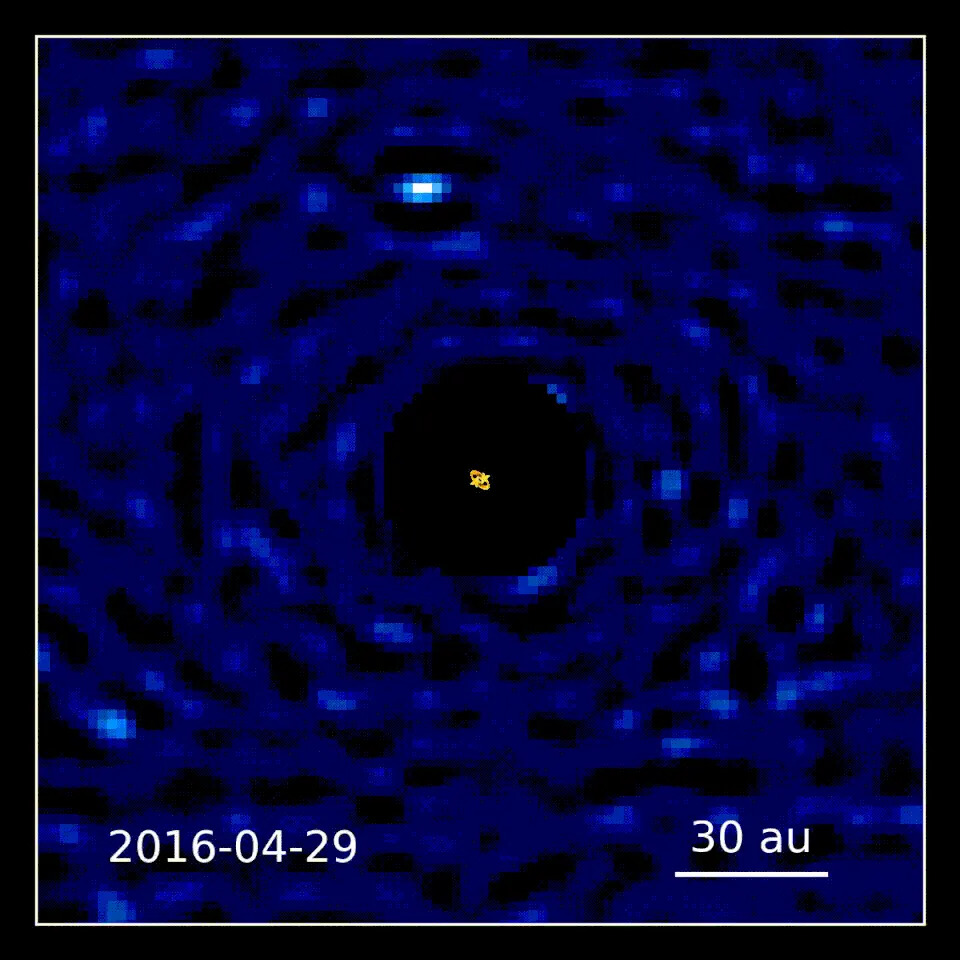
A time-lapse image of the exoplanet HD 143811 AB b orbiting its parent stars. | Credit: Jason Wang/Northwestern University
How It Was Confirmed
GPI used a coronagraph to block most of the stars' light and adaptive optics to sharpen faint planetary signals. Scientists compared the object's motion and its spectral and photometric signatures with expectations for planets and stars. Those diagnostics — performed independently by multiple teams — indicate the faint source is indeed an exoplanet rather than a background object.
What We Know About HD 143811 AB b
Mass and Age: The planet is large, about six times the mass of Jupiter, and quite young on astronomical timescales at roughly 13 million years. Because it is young, it still radiates heat from formation, which helps make it visible in infrared imaging.
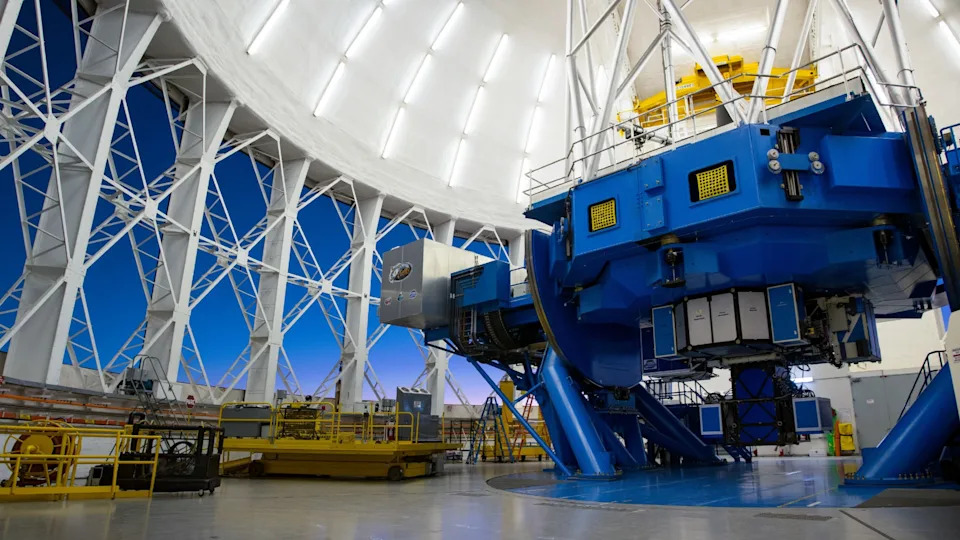
The Gemini Planet Imager (GPI) on the Gemini South telescope. | Credit: International Gemini Observatory/NOIRLab/NSF/AURA/M. Paredes
Orbital Architecture: The host stars, HD 143811 A and B, orbit one another every 18 Earth days, making the stellar pair very compact. Despite HD 143811 AB b’s relatively close projected separation compared with other directly imaged planets in binaries, its orbital period is long — about 300 Earth years — a configuration that puzzles researchers.
"Exactly how it works is still uncertain," said Jason Wang of Northwestern University, a member of the team. "Because we have only detected a few dozen planets like this, we don’t have enough data yet to put the picture together."
Why It Matters
Planets orbiting binary stars are rare among the roughly 6,000 exoplanets known, and only a handful have been directly imaged so that both the binary and the planet appear in images. Systems like HD 143811 AB b offer a rare laboratory to simultaneously trace the motions of the two stars and the planet across the sky, improving constraints on dynamics and formation scenarios for planets in multi-star environments.
Next Steps
The team is requesting additional telescope time to monitor the system and better map the orbits of the binary and the planet. Continued astrometric and spectroscopic monitoring will help reveal how the planet remained stable and how it formed around such a close stellar pair. Meanwhile, researchers will continue combing archival datasets for other missed planets; several other candidates remain under investigation.
"We're excited to keep watching it in the future as they move, so we can see how the three bodies move across the sky," Wang said.
The discovery was presented in a paper published Dec. 11 in The Astrophysical Journal Letters.


