
New November observations from ESA's JUICE spacecraft and NASA's Hubble Space Telescope produced fresh images of interstellar comet 3I/ATLAS. JUICE returned a low-resolution NavCam preview taken near its Nov. 2 flyby, and Hubble captured higher-quality frames on Nov. 30. Early analyses suggest unusual chemistry — including a high CO2-to-water ratio and nickel-rich gas — hinting the comet may have formed in an ancient planetary system. Scientists stress the object poses no threat to Earth.
Hubble and JUICE Reveal New Images of Interstellar Comet 3I/ATLAS — Unusual Chemistry Points to Ancient Origin

Hubble Space Telescope captured interstellar comet 3I/ATLAS in November. . | Credit: NASA, ESA, STScI, D. Jewitt (UCLA). Image Processing: J. DePasquale (STScI)
Two flagship observatories — the European Space Agency's Jupiter-bound JUICE spacecraft and NASA's Hubble Space Telescope — returned fresh images in November of interstellar comet 3I/ATLAS, offering new clues about the object's composition and history.
Discovery and Context
3I/ATLAS was first spotted on July 1 by the NASA-funded ATLAS survey in Chile. It is only the third confirmed interstellar visitor to our system, after 1I/'Oumuamua in 2017 and 2I/Borisov in 2019.
JUICE: A Surprise Preview From a Navigation Camera
On Nov. 2, JUICE observed 3I/ATLAS with five science instruments as part of a planned campaign to study the comet's activity and composition. Because the mission is currently using its main high-gain antenna as a sunshield, the high-resolution data will not arrive on Earth until February 2026.
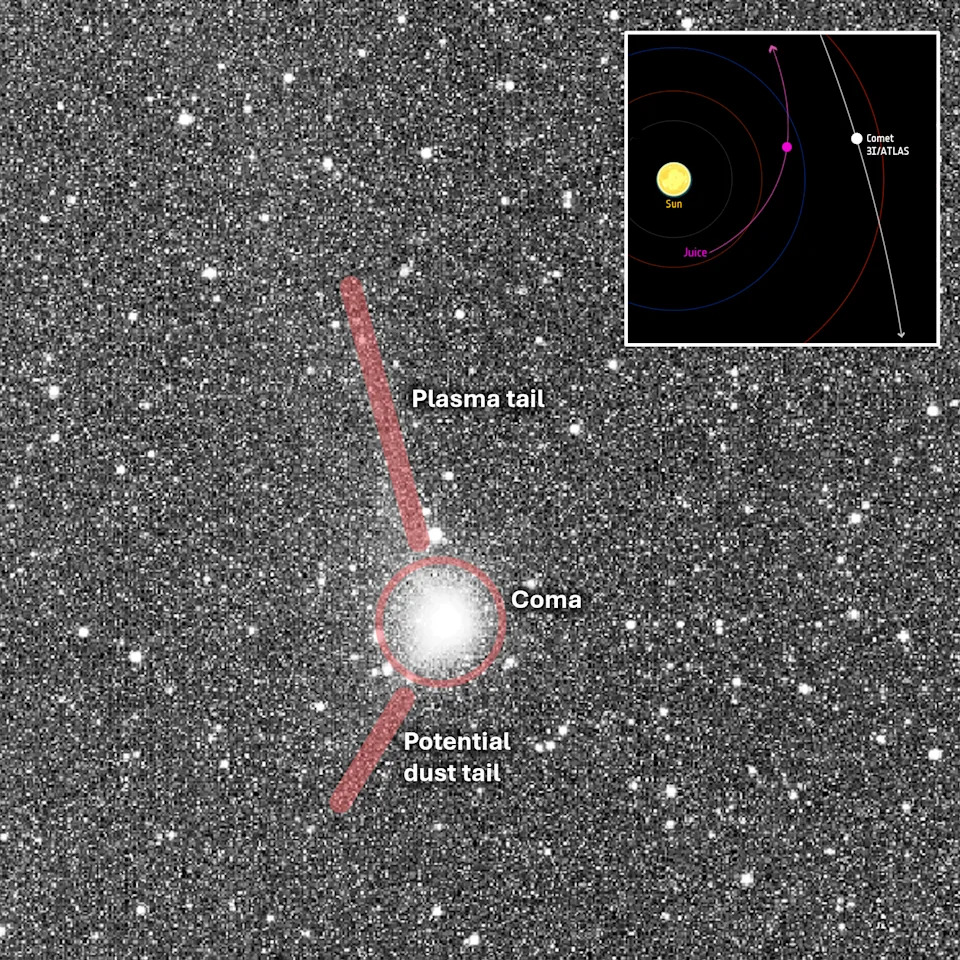
Interstellar comet 3I/ATLAS caught by the JUICE spacecraft. | Credit: ESA/Juice/NavCam
Impatient for an earlier look, ESA engineers transmitted a single quarter-frame from JUICE's Navigation Camera (NavCam) using the spacecraft's smaller, lower-rate antenna. NavCam is primarily a guidance imager intended to help steer JUICE around Jupiter's moons after its 2031 arrival, not a science camera — yet the grainy preview is scientifically valuable.
The NavCam frame shows a bright nucleus surrounded by a luminous coma and at least two tails: a faint plasma tail stretching sunward and a subtler dust tail drifting down and to the left. JUICE took the preview two days before its closest approach to the comet, when the spacecraft passed roughly 41 million miles (66 million kilometers) from 3I/ATLAS.
Hubble Follow-Up
Weeks later, on Nov. 30, the Hubble Space Telescope revisited 3I/ATLAS with its Wide Field Camera 3. At that time the comet was about 178 million miles (286 million kilometers) from Earth and moving relative to background stars; Hubble tracked the comet, causing the stars to appear as streaks in the exposures.
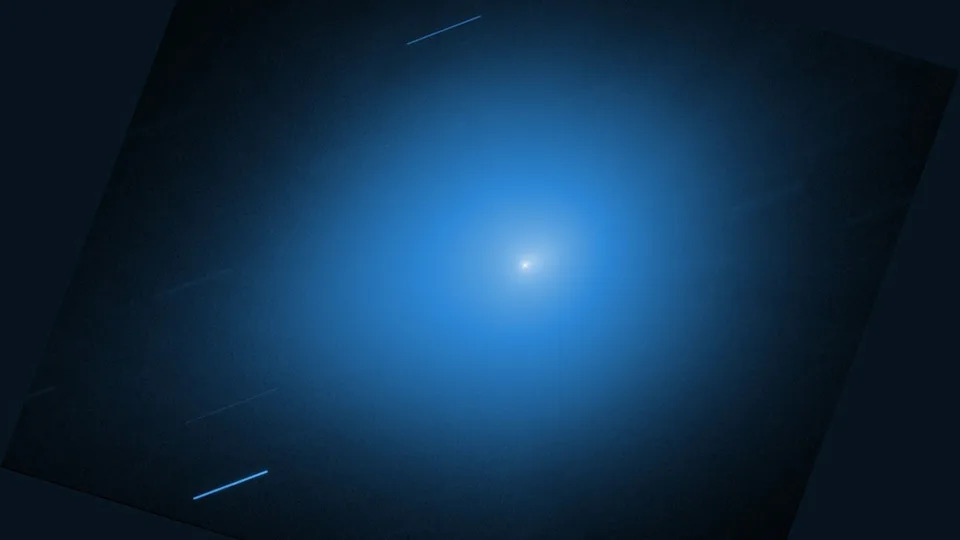
The Hubble Space Telescope image of interstellar comet 3I/ATLAS | Credit: NASA, ESA, STScI, D. Jewitt (UCLA). Image Processing: J. DePasquale (STScI)
Hubble first imaged 3I/ATLAS in July, revealing a teardrop-shaped envelope of dust streaming from the nucleus. The new frames again show a bright central core wrapped in a halo of dust, confirming that the comet remains active after perihelion (closest approach to the Sun) on Oct. 30.
Unusual Chemistry and What It Might Mean
A coordinated, NASA-led observing campaign that combined data from dozens of spacecraft and telescopes — from Earth orbit out to Mars and beyond — has revealed hints of atypical chemistry in the comet's material. Preliminary findings include a higher-than-typical carbon-dioxide–to–water ratio and gas unusually rich in nickel relative to iron. These signatures may reflect formation conditions different from those in our own solar system.
Origin, Safety, and Next Steps
Scientists say 3I/ATLAS likely spent a very long time wandering interstellar space. Its incoming speed and trajectory suggest it may have formed in an ancient planetary system, possibly older than our own.
Tom Statler, NASA lead scientist for solar system small bodies: "The possibility that the comet comes from such an ancient system gives me goosebumps to think about, frankly."
NASA officials emphasized the comet poses no hazard to Earth: it will not come closer than about 170 million miles (270 million kilometers) and will not approach any planets as it departs the solar system, including when it crosses Jupiter's orbit in spring 2026.
Nicky Fox, Associate Administrator of NASA's Science Mission Directorate: "The objects in our solar system will be just fine."
What to Watch Next
The full, high-resolution JUICE dataset expected in February 2026 should provide a much clearer view of the comet's activity and composition. Combined with continued Hubble monitoring and ground-based spectroscopy, scientists hope to confirm the preliminary chemical clues and better constrain where and how this interstellar visitor formed.


