
The Bay Area has experienced a monthlong swarm of small earthquakes centered near San Ramon, including M4.0 and M3.9 events and at least 80 quakes ≥M2 since Nov. 9 (USGS). Seismologists say swarms are common along faults like the Calaveras and rarely provide reliable short‑term forecasts for a larger quake. Long‑term USGS estimates still show a substantial chance of M6.7+ events in the Bay Area over 30 years, so residents are urged to prepare.
Relentless San Ramon Swarm: What It Means — And What Californians Should Know

(Raoul Rañoa / Los Angeles Times)
For more than a month, the Bay Area has experienced an extended series of small earthquakes centered near San Ramon — a seismic swarm that has rattled windows and raised concerns across California. The most powerful events in the latest episode were a magnitude 4.0 (M4.0) on Friday night and a magnitude 3.9 (M3.9) on Saturday night. According to the U.S. Geological Survey (USGS), the area has seen at least 80 earthquakes of magnitude 2.0 or greater since Nov. 9.
What’s Happening
The small quakes are occurring along the northern stretch of the Calaveras fault where it approaches Mount Diablo. Swarms like this — clusters of many small earthquakes over days or weeks — are not uncommon in the region. Including the current episode and a swarm last month, seismologists count nine swarms in the surrounding area since 1970, with durations ranging from two to 42 days and with typical maximum magnitudes in the M3–M4 range.
Animation does not reflect actual speed.(Swetha Kannan / Los Angeles Times)
What Experts Say
“There’s gonna be a big earthquake in the Bay Area. We just can’t say exactly when and where. So you should be prepared for that,” said Annemarie Baltay, a U.S. Geological Survey seismologist.
Seismologists emphasize that while some major earthquakes are preceded by smaller foreshocks, most swarms do not reliably predict the timing or location of a future large quake. Statistically, any given earthquake has roughly a 1-in-20 chance of being followed by a larger event, and only about half of major earthquakes are preceded by clear foreshocks.
Long-Term Risk Remains
Longer-term hazard estimates underline the ongoing risk in California. USGS 30-year projections published in 2014 estimate roughly a 72% chance of a magnitude 6.7 or greater earthquake in the San Francisco Bay Area and about a 60% chance in the Los Angeles region by 2043. Statewide, the USGS gave about a 48% chance of an M7.5+ event and a ~7% chance of an M8.0+ event by 2043. Faults of particular concern include the Calaveras, the Hayward, and the San Andreas.
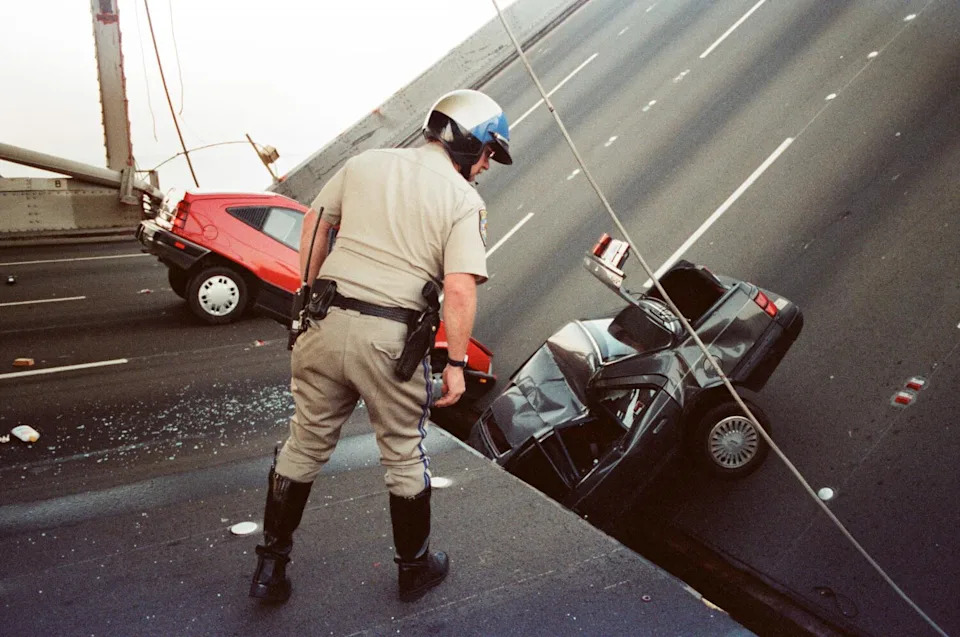
A California Highway Patrol officer checks the damage to cars that fell when the upper deck of the Bay Bridge collapsed onto the lower deck.(George Nikitin / Associated Press)
Context From Southern California And History
Southern California saw an unusually busy year for moderate quakes in 2024, with 15 independent sequences that included at least one M4.0+ event — the most in 65 years, according to seismologist Lucy Jones. By contrast, 2025 has recorded fewer such sequences so far.
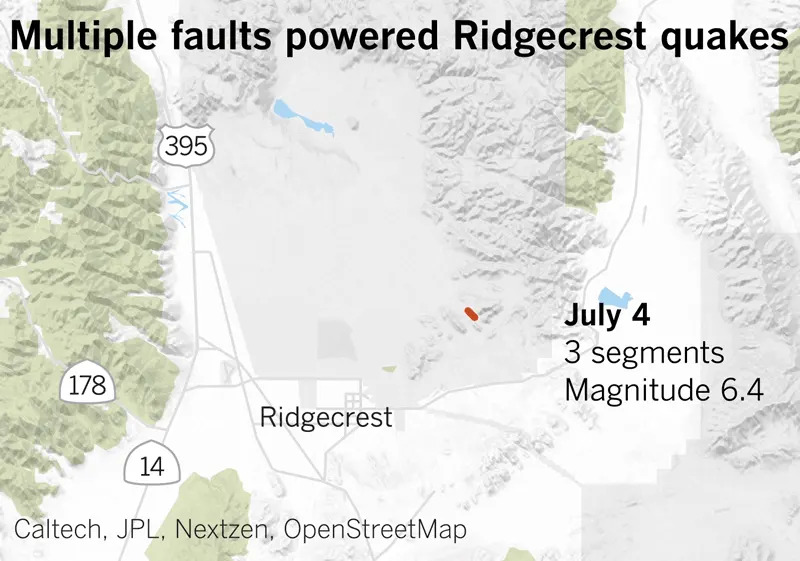
There are historical examples where modest quakes preceded much larger ruptures — for example, the 1857 San Andreas rupture and the 2019 Ridgecrest sequence — but there are also major earthquakes with little or no observable foreshock activity, such as the 1994 Northridge quake.
What Residents Should Do
- Prepare now: Keep an emergency kit with water, food, a flashlight, and first aid supplies for at least 72 hours.
- Secure your home: Fasten heavy furniture and appliances, and secure cabinet latches to reduce injury and damage.
- Have a plan: Know safe spots in each room (under sturdy tables, against interior walls), and practice Drop, Cover, and Hold On.
- Use alerts: Enable ShakeAlert and local emergency notifications for early warnings where available.
In short, current swarm activity near San Ramon is consistent with past local patterns and by itself does not indicate an imminent major rupture. But the long-term earthquake risk in California remains substantial, and preparedness is the best way to reduce harm when the next large quake comes.


