
Prime Minister Benjamin Netanyahu has announced he will head a new government inquiry into failings before the October 7, 2023 Hamas attacks — a move that has drawn sharp criticism. Many families of victims, senior military figures and polls have long called for an independent state commission chaired by a Supreme Court justice. The government proposes a six-member, politically appointed panel; opponents warn this risks a whitewash while prior army and Shin Bet reviews have already acknowledged major intelligence and security failures.
Netanyahu To Head October 7 Inquiry — Critics Say Politically Appointed Panel Will Undermine Accountability

Israeli Prime Minister Benjamin Netanyahu chats with close ally Amir Ohana, who will be playing a key role in selecting the new committee’s members [Amir Cohen/Reuters]
The announcement that Prime Minister Benjamin Netanyahu will lead a new government inquiry into Israel's failures ahead of the Hamas-led October 7, 2023 attacks has provoked intense criticism across the country.
Calls For An Independent Probe
Since the attack, families of victims, senior military officers and public-opinion polls have repeatedly demanded a full state commission of inquiry, typically expected to be chaired by a sitting or retired Supreme Court justice. Supporters argue such an independent body would be best placed to examine planning, intelligence and command failures and to hold political and military leaders to account.
The Government Plan
On Thursday the Prime Minister's Office said Mr. Netanyahu would back legislation to create a politically appointed six-member inquiry, which he would lead. Parliament Speaker Amir Ohana, a close ally of the prime minister, is expected to have a major role in selecting the panel's membership. The proposed framework would let the six members choose their own chair. Government officials said they would first seek cross-party agreement on all appointments; but if the opposition boycotts, as widely expected, the speaker would be empowered to name nominees instead.
The ministerial team charged with defining the inquiry's remit is scheduled to meet in West Jerusalem on Monday — coincidentally the same day Mr. Netanyahu is due to give testimony in his long-running corruption trial in Tel Aviv.
Public Reaction And Political Fallout
An October poll by Israel's Institute for National Security Studies found that roughly three out of four Israelis support the creation of an independent state inquiry. The proposal that the prime minister lead a politically appointed body has been described by critics as a conflict of interest and an attempt to preempt a genuinely impartial investigation.
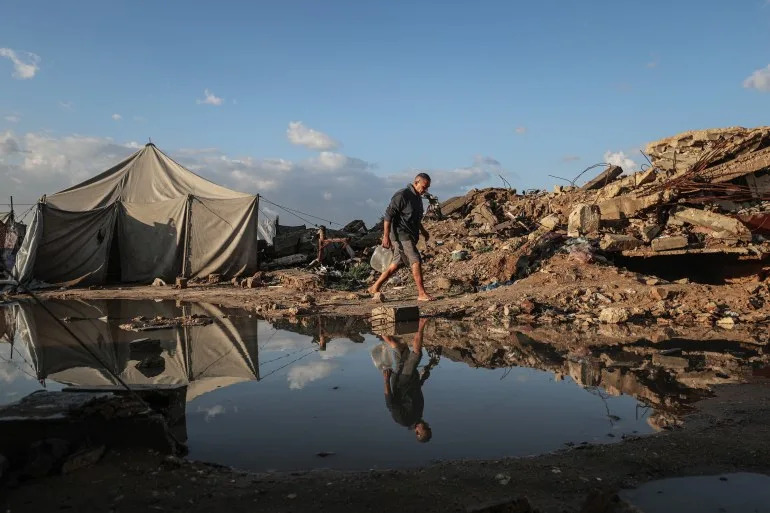
Israel has levelled nearly all of Gaza and killed more than 70,000 people in response to the Hamas-led attacks on October 7, 2023 [Moiz Salhi/Anadolu]
Eyal Eshel, whose son was among the soldiers killed on October 7, said in court the bereaved had not come to provoke but "to look him in the eyes and request the simplest of things — a state commission of inquiry."
Former Defence Minister Yoav Gallant and former military chief Herzi Halevi have publicly called for a state commission. Last Sunday, 22 former captives and dozens of relatives signed an open letter demanding either the formation of an independent state inquiry or the government's resignation, urging officials to "stop evading, stop procrastinating, stop whitewashing."
Outside the coalition, opposition figures expressed fierce anger. Democrats leader Yair Golan wrote on social media that the move was tantamount to seeking an "alibi" rather than answers. Other parties, including Yisrael Beytenu and Blue and White, have also demanded an independent judicially chaired commission or parliamentary steps to compel one.
Findings From Existing Military And Security Reviews
Separate internal reviews have already acknowledged major failures. An army investigation published in February described a "complete failure" by the military before and during the attacks, saying it had vastly underestimated Hamas's capabilities. Herzi Halevi resigned before that inquiry concluded, conceding "terrible" security and intelligence failures.
In November, an external panel appointed by Halevi's successor, Eyal Zamir, found that the army's own probe had been "inadequate." In March, Israel's internal security service, the Shin Bet, also admitted a series of pre-October 7 failures, including shortcomings in threat identification and in sharing intelligence with the military. Shin Bet director Ronen Bar later announced he would step down after a protracted dispute with the prime minister.
Why The Debate Matters
Supporters of an independent state commission argue it is the only mechanism that can produce a comprehensive, unbiased account of what went wrong and recommend structural reforms. Critics of the government's proposal say a panel led or effectively controlled by the prime minister would lack credibility and could leave key questions unanswered — deepening public distrust at a moment of national trauma.
To date, Benjamin Netanyahu has not publicly accepted personal or political responsibility for the security breakdowns that preceded and accompanied the October 7 attacks. The shape and remit of the new inquiry — and whether it will be perceived as legitimate — remain intensely contested.


