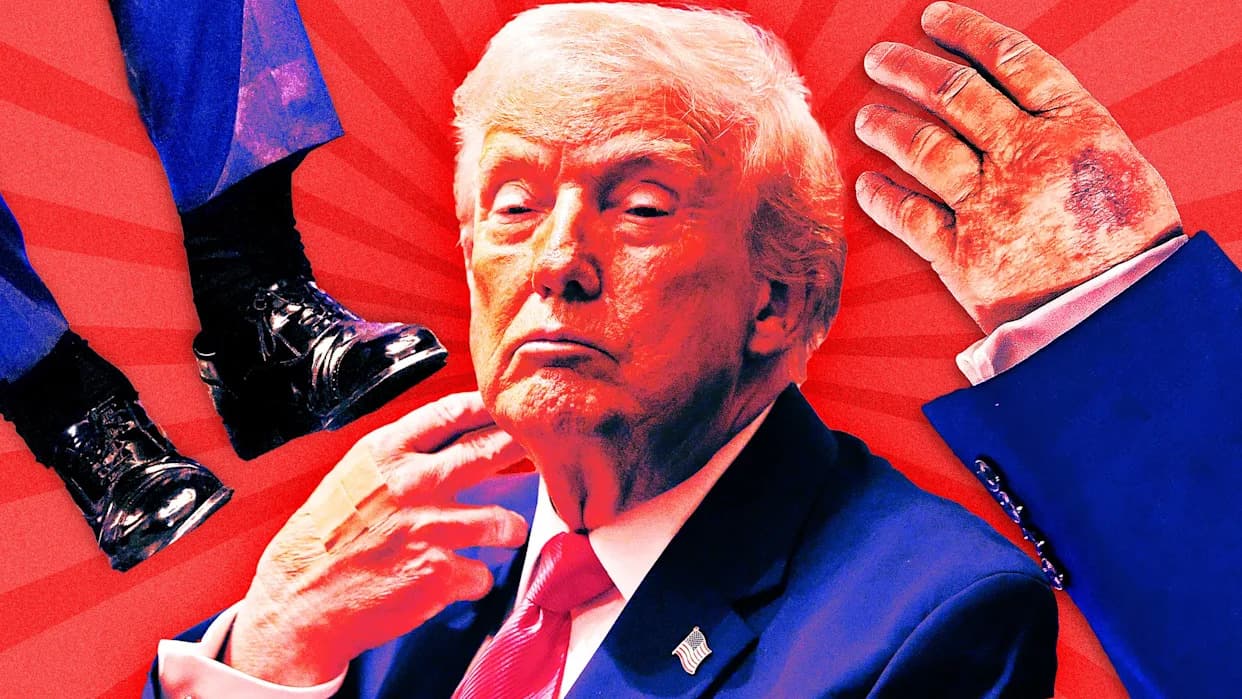
The author intended a holiday essay but focuses instead on President Trump’s recent impulsive, inappropriate public behavior and how the media treats it. He argues that these patterns — while not sufficient to diagnose dementia — are consistent with disinhibition seen in early cognitive decline and deserve clinical context. The piece urges journalists to balance the Goldwater Rule with routine consultation of dementia experts so readers can understand whether behavior warrants medical concern. Given the stakes, the author says this is a vital public‑interest story for the months ahead.
For Christmas, I Want Honest Reporting About Trump’s Troubling Behavior

With the holidays approaching, I had planned a hopeful column about It’s a Wonderful Life. That will have to wait. Instead, I’m writing about President Donald Trump and how the press covers his increasingly erratic public conduct.
After a recent, widely reported homicide drew his attention, the president posted on social media calling the episode evidence of “Trump Derangement Syndrome.” Many found the comment tasteless; it prompted bipartisan condemnation, including from Reps. Thomas Massie (R‑Ky.) and Marjorie Taylor Greene (R‑Ga.). As Greene observed, “Many families deal with a family member with drug addiction and mental health issues. It’s incredibly difficult and should be met with empathy especially when it ends in murder.” If a fellow Republican publicly labels your reaction insensitive, it’s worth pausing to reconsider your tone.
I do not believe every blunt remark by the president is merely a rhetorical choice. We have seen persistent examples of poor judgment and confabulation. More recently, however, his pattern of behavior suggests a rise in disinhibition — a clinical term describing a loss of social restraint and impulse control that can be an early sign of dementia.
Disinhibition can take the form of socially inappropriate comments, loss of decorum, sudden anger, gratuitous insults or racially insensitive remarks. While Mr. Trump has long used insults strategically as a political tool, many of his latest outbursts appear impulsive rather than calculated: abrupt attacks on reporters (often women), odd taunts and erratic social‑media posts that many observers call gratuitous and hurtful.
Am I diagnosing the president with dementia on the basis of these public episodes alone? No. Medicine requires examination and testing. But the pattern of behaviors is consistent with what clinicians describe when early cognitive decline begins to affect social filters and impulse control. If you observed the same changes in a loved one, you would reasonably ask for a medical evaluation.
Journalists can and should report that a public figure’s conduct is consistent with certain medical phenomena without violating professional ethics. The Goldwater Rule rightly cautions clinicians about public diagnosis from a distance. It does not prohibit careful reporting that includes expert context explaining whether observed behavior merits medical concern.
There is also a media‑coverage double standard to acknowledge. Many outlets — particularly on the right — aggressively parsed Mr. Biden’s every stumble and gaffe, shaping a rapid political consensus about his fitness for office. Much mainstream coverage of Mr. Trump, by contrast, often frames his conduct as theatrical or purely political provocation rather than exploring whether health issues might be involved.
Responsible journalism can balance ethics and public interest. Reporters should avoid speculative clinical diagnoses, but they should routinely seek informed commentary from neurologists, geriatric psychiatrists and other specialists when a president’s behavior repeatedly resembles known medical syndromes. Including that context is not sensationalism — it is essential public‑service reporting.
Donald Trump is the president. If there is any plausible chance that cognitive decline is affecting his judgment and behavior, it is a matter of urgent public interest for the next 37 months and beyond. The press should treat that possibility with sober, consistent coverage that explains the medical questions as clearly as it describes the politics.
Chris Truax is an appellate attorney who served as Southern California chair for John McCain’s primary campaign in 2008.
Help us improve.