
The TomoGrav project at Heriot‑Watt University will generate the first 3D films that visualise how black holes warp time and space by combining telescope data, computational imaging and AI. A £4m Royal Society Faraday Discovery Fellowship funds the work, which aims to produce time-resolved views of plasma flows, magnetic field evolution and dynamics near the event horizon. Project leads include Dr Kazunori Akiyama and Professor Yves Wiaux. The AI methods may also speed up MRI scans and improve climate-monitoring systems.
First 3D Films of Black Holes Will Show How Gravity Warps Time and Space

The TomoGrav project at Heriot-Watt University aims to show how time and space are bent by extreme gravity around black holes - EHT Collaboration via Heriot-Watt University
The first-ever three-dimensional films that show how black holes warp time and space are set to be created and unveiled. The multimillion-pound TomoGrav project will combine telescope observations, advanced computational imaging and artificial intelligence to visualise how plasma, magnetic fields and gravity interact near a black hole's event horizon.
What TomoGrav Will Do
The project, hosted at Heriot‑Watt University, is funded by a £4 million fellowship awarded through the Royal Society’s Faraday Discovery Fellowships Accelerated International Route. Researchers will use AI to convert sparse telescope data into time-resolved visualisations, producing films that track how material flows and evolves in the extreme gravity around black holes.
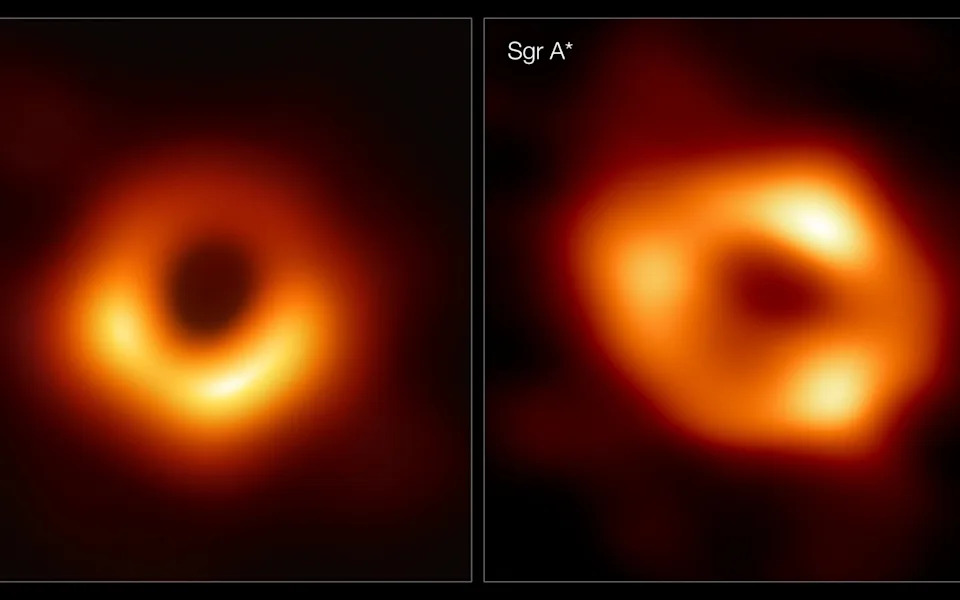
Black holes are stellar bodies which are so dense nothing, including light, can escape - EHT Collaboration via Heriot-Watt University
Why It Matters
Dr Kazunori Akiyama, an astrophysicist joining Heriot‑Watt from the Massachusetts Institute of Technology who helped produce the first black hole images, says the move from static pictures to dynamic films will open new scientific questions. "Instead of a single blurred frame, we will see how plasma moves, how magnetic fields evolve and how gravity shapes everything around the event horizon," he said.
"By combining world-leading telescope capabilities with Heriot‑Watt’s strengths in computational imaging, we will be able to follow black hole dynamics in a way that has never been possible before." — Dr Kazunori Akiyama
Interdisciplinary Collaboration and Practical Benefits
Professor Yves Wiaux, an expert in artificial intelligence who will co-lead the effort, explained that the collaboration brings together observational expertise and AI-driven interpretation methods. The techniques developed could have practical spin-offs beyond astronomy — for example, accelerating MRI scans for heart and liver patients and improving climate-monitoring systems by making imaging and reconstruction faster and more robust.
As TomoGrav moves from concept to execution, scientists expect the resulting 3D films to change our understanding of accretion, magnetic turbulence and relativistic effects close to event horizons — advancing both fundamental physics and computational imaging techniques with broad cross-disciplinary applications.


