
Sen. Raphael Warnock prayed publicly after a deadly shooting at Brown University and urged concrete action to reduce campus violence. Former President Donald Trump criticized Warnock online, questioning whether his ministry conflicts with the separation of church and state. Constitutional experts say a senator preaching in his private time is protected speech; government-sponsored religious events are a clearer example of potential entanglement. Warnock called out what he described as hypocrisy and invited Trump to Bible study.
Trump Misstates ‘Separation of Church and State’ While Targeting Sen. Raphael Warnock

Sen. Raphael Warnock appeared on NBC News’ Meet the Press to respond to a deadly mass shooting at Brown University and to urge national action to curb repeated violence on school and college campuses. Warnock, who is also the senior pastor of Ebenezer Baptist Church in Atlanta, said he planned to pray for the victims and called for Americans to pair prayer with concrete political action.
“As I make my way to my own pulpit this morning, I’m going to say a special prayer for Brown University and for our nation,”
Warnock reflected on the particular agony of families torn apart by sudden violence, noting that as a pastor who has presided over many funerals he knows that few pains compare to parents burying a child. He urged citizens to translate mourning into efforts to prevent future tragedies, saying the nation is “broken and in need of moral repair” if it tolerates recurring campus violence without taking meaningful steps to stop it.
Three days after the interview aired, former President Donald Trump posted on his social platform criticizing both Warnock and NBC’s host Kristen Welker. Trump claimed Warnock had used religion to divide the country and asked, “What ever happened to separation of Church and State?” The post also attacked network coverage and complained about the use of public airwaves.
Separating Church and State: What the Constitution Actually Means
The constitutional principle of separation of church and state is intended to protect religious freedom by ensuring government neutrality on matters of faith. That neutrality prevents the government from establishing or favoring a religion and protects citizens' rights to follow their own spiritual or secular paths.
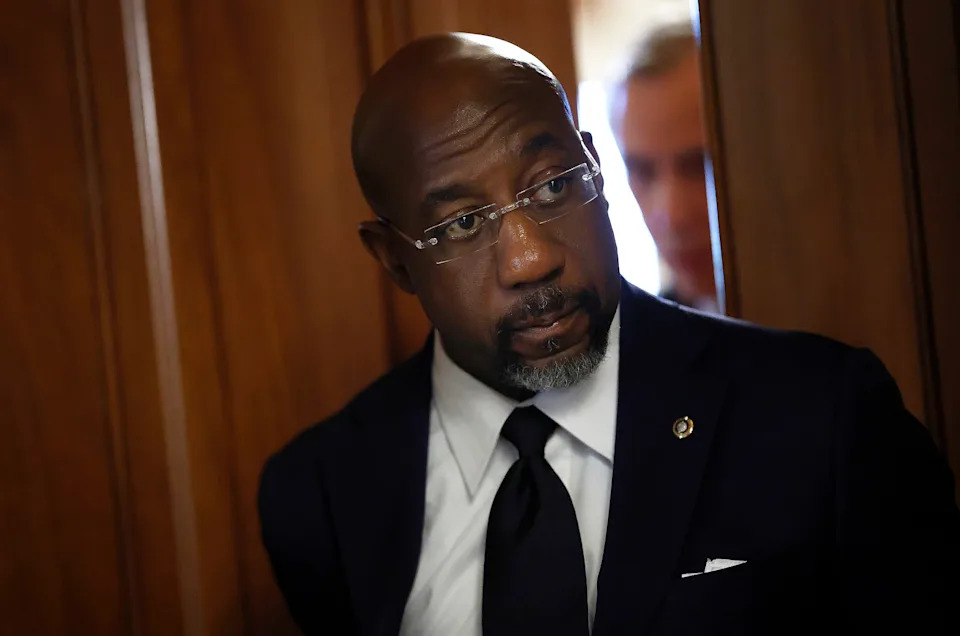
U.S. Sen. Raphael Warnock leaves a Senate Democratic meeting on Oct. 3, 2025 at the U.S. Capitol Building.(Getty Images)
By that standard, a sitting senator who preaches at his own church in his personal time does not automatically violate the First Amendment. Constitutional concerns would arise if a lawmaker used public office to funnel government funds to a congregation, coerced citizens into worship, or imposed religious doctrine in public schools or government programs. None of those actions occurred in Warnock’s case.
Where Church-State Lines Have Been Tested
If examples of problematic entanglements are needed, they include recent federal-sponsored Christian prayer events organized by agencies such as the Department of Labor, the Department of Housing and Urban Development and the Department of Defense. Those events have prompted debate about whether they reflect an improper government endorsement of a particular faith.
Warnock’s Response
Warnock publicly responded to Trump’s criticism, calling it hypocritical. He recalled when federal forces cleared protesters so the then-president could appear in front of a church holding a Bible, and urged Trump to consider the Bible’s teachings about caring for the poor, healing the sick and standing with the marginalized. “My faith is not a weapon, it’s a bridge,” Warnock said, inviting Trump to attend Bible study and vowing to continue advocating for ordinary people.
Bottom line: The dispute highlights a common misconception about the First Amendment. Private religious speech by an elected official is protected; government actions that actively promote or favor religion are what constitutional doctrine seeks to prevent.
Originally published on MS NOW.


