
Researchers working in Cueva de Mono, Dominican Republic, report that solitary bees built tiny mud brood cells inside bone-filled regurgitations brought into the cave by raptors. Scans of fossils from more than 50 species revealed brood chambers — each smaller than a pencil eraser — sometimes containing pollen provisions, indicating they were used to rear larvae. Published in Royal Society Open Science, the study dates this behavior to the last 50,000 years and marks the first documented case of bees nesting in bone.
Ancient Bees Built Tiny Mud Nests Inside Fossilized Owl Pellets

Ancient Bee Nests Hiding in Regurgitated, Fossilized Bones
Tens of thousands of years ago, resourceful bees exploited bone-filled regurgitations left by raptors, constructing tiny mud brood cells inside fossilized owl pellets discovered in a Caribbean cave.
Researchers excavating Cueva de Mono in the Dominican Republic recovered a diverse faunal assemblage dominated by rodents but also including birds, sloths and reptiles — remains from more than 50 species. Many of the bones were likely introduced to the cave by owls and other raptors that regurgitate indigestible skeletal fragments in pellet form.
Unusual Sediments Turn Out To Be Brood Cells
Paleontologist Lazaro Viñola López, who first studied the material while a doctoral student at the Florida Museum of Natural History, noticed odd sediment fills lodged in bone cavities during routine cleaning. High-resolution scans and 3-D reconstructions showed that these deposits were not ordinary sediment or cocoons but tiny mud nests similar to those constructed by some solitary bees today.
The brood chambers were found in a variety of bones — including part of an extinct sloth tooth and cranial cavities of an extinct rodent. In several cells the team identified fragments of pollen provisioned as larval food, providing direct evidence that the structures served as brood cells. Each chamber measured less than a pencil eraser and was constructed from a mixture of saliva and local dirt.
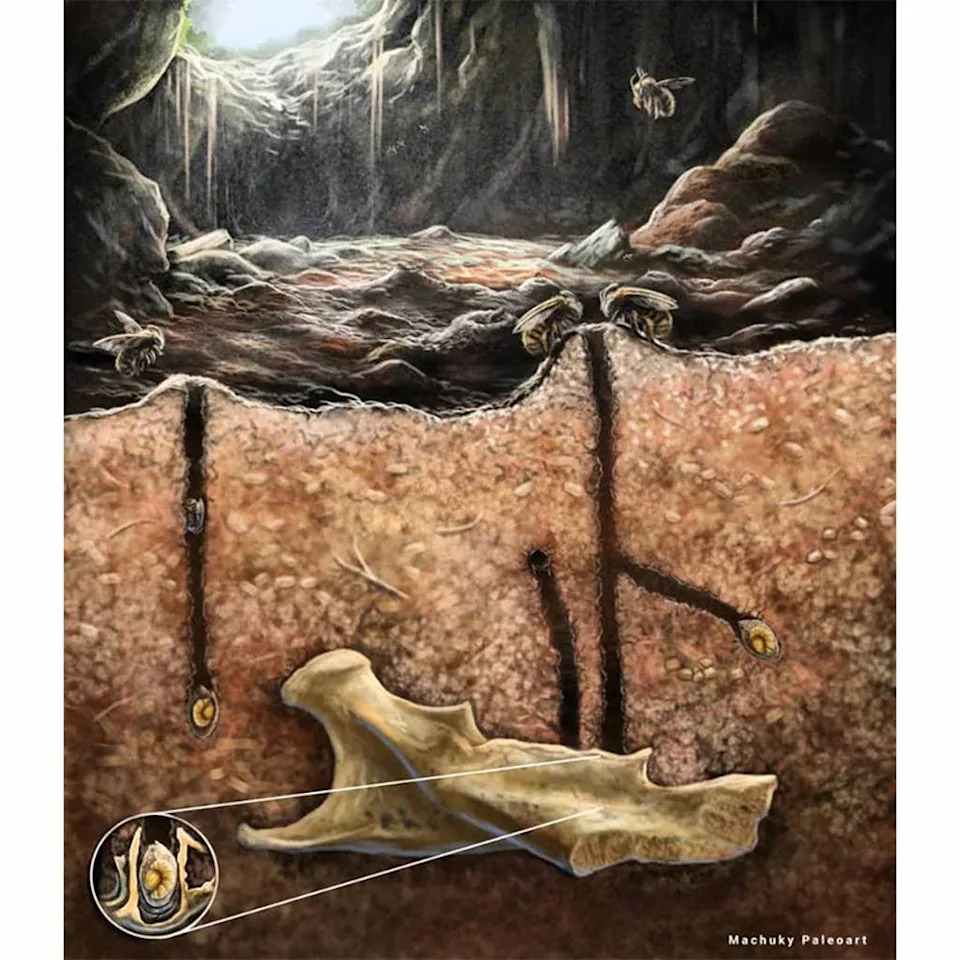
EASTER EGGS: Weird bits of sediment discovered in ancient mammal bones turned up an unprecedented surprise: bee nests.From Viñola López, L.,et al. Royal Society Open Science(2025).
Why Bones?
The authors suggest a likely explanation tied to local geology: the cave sits in limestone terrain where topsoil is scarce. Small amounts of soil are washed into caves, offering both the building material and abundant nesting real estate when bones are present. The protected interior of a bone would also have kept larvae safe from predators such as wasps.
Significance And Limits
Published in Royal Society Open Science, this study documents the first known case of bees nesting inside bones, dated to within the last 50,000 years (late Quaternary). The warm, humid cave environment likely destroyed delicate insect remains, so no fossilized adult bees were recovered and the species cannot be identified. The nesting species could be extinct or may still persist today.
“This discovery shows how weird bees can be — they can surprise you,” Viñola López, now at the Field Museum in Chicago, said in a statement. “But it also shows that when you’re looking at fossils, you have to be very careful.”
These findings illuminate an unexpected nesting strategy and highlight how interactions among predators (owls), their prey (small vertebrates) and insects (bees) can create microhabitats that persist in the fossil record.
Reference: Viñola López et al., Royal Society Open Science (2025).


