
Justice Clarence Thomas pressed attorney Marc Elias over whether coordinated party spending with campaigns is fully protected by the First Amendment, centering on a Federal Election Campaign Act provision that caps such expenditures. Elias acknowledged the payments are speech but said courts treat them as contributions that Congress may limit. Conservative justices, including Brett Kavanaugh, worried parties are disadvantaged compared with outside groups that accept unlimited funds, while liberal justices warned against further weakening spending limits. The case, brought by the NRSC, NRCC, J.D. Vance and Steve Chabot, could significantly affect political spending ahead of 2026.
Supreme Court Showdown: Clarence Thomas Challenges Marc Elias Over Limits On Party-Coordinated Campaign Spending

Clarence Thomas presses Dem operative Marc Elias in high-stakes Supreme Court clash
Supreme Court Justice Clarence Thomas sharply questioned prominent Democratic-aligned attorney Marc Elias this week in a high-profile dispute over whether limits on party-coordinated campaign spending violate the First Amendment. The exchange focused on a provision of the Federal Election Campaign Act (FECA) that restricts how much state and national political parties may spend when coordinating expenditures with particular candidates.
The Core Issue
Republican challengers argue that coordinated party spending is protected political speech and therefore should not be capped by Congress. Elias, a well-known election lawyer, told the court that while such payments convey speech, longstanding precedent treats them as contributions that Congress may lawfully limit to prevent corruption or its appearance.
Key Moments From Oral Argument
Thomas pressed Elias on whether coordinated payments—such as a party paying for a campaign's hotel or catering—enjoy full First Amendment protection. "Just so I'm clear, is there any First Amendment interest in coordinated expenditures?" Thomas asked.
"It is speech," Elias replied, "but precedent holds that such bill payments are treated as contributions, and therefore, though they express speech, Congress may limit how much may be spent on that speech."
Thomas persisted: "If the party coordinates with the candidate and pays the bill, does that have a First Amendment protection or is it simply, as you say, a bill-paying exercise?" Elias answered that coordinated payments reflect symbolic speech but have been categorized by courts as contributions subject to limits.
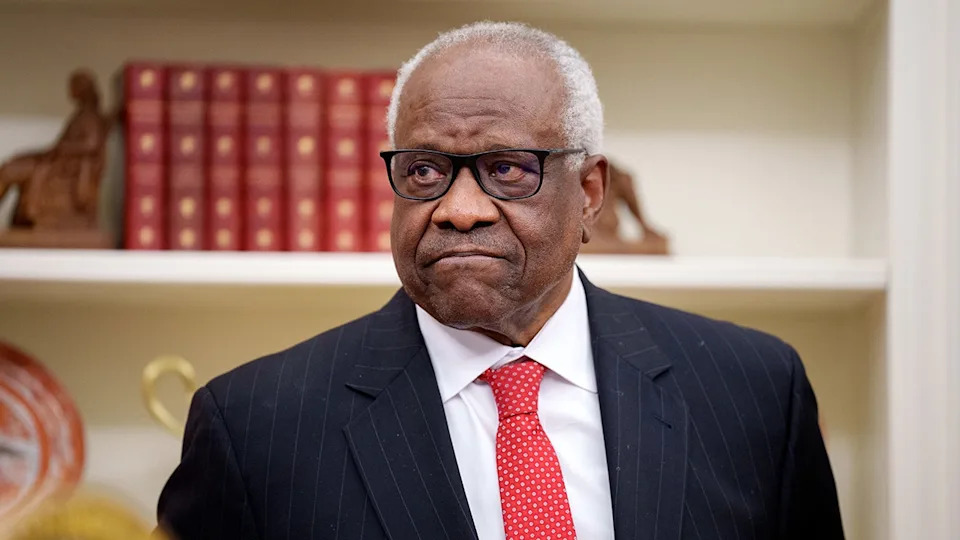
Supreme Court Justice Clarence Thomas before swearing in Pam Bondi as U.S. attorney general in the Oval Office at the White House on Feb. 5, 2025.
Broader Stakes And Judicial Reactions
Conservative justices signaled skepticism about the FECA restrictions. Justice Brett Kavanaugh warned that outside groups can already accept unlimited funds and exercise significant influence, leaving traditional parties at a disadvantage. "You can give huge money to the outside group, but you can't give huge money to the party, so the parties are very much weakened," he said, calling the imbalance a risk to party influence and to democratic accountability.
Liberal justices expressed concern about further eroding campaign spending safeguards. Justice Sonia Sotomayor cautioned that judicial interference with Congress's statutory design could remove meaningful guardrails: "Once we take off these coordinated expenditure limits, then what's left? What's left is nothing. No control whatsoever."
Who Brought The Case And What Could Change
The lawsuit was filed by the National Republican Senatorial Committee (NRSC), the National Republican Congressional Committee (NRCC), and two former Ohio Republican candidates—now Vice President J.D. Vance and former Rep. Steve Chabot. If the court rules for the challengers, wealthy donors could potentially channel large, unlimited contributions to state or national parties that then spend in coordination with specific candidates, a shift that could reshape campaign finance ahead of the 2026 midterms.
The outcome will test how the Court balances First Amendment speech protections against Congress's interest in limiting contributions to prevent corruption and preserve fair elections.


